Tuesday, February 18, 2020

Book Alert: Graded Motor Imagery Handbook

How is it already mid-February?  I swear each year flies by faster and faster... and yes, I realize that's a cliche thing to say.  I did some really fun volunteering earlier this month that took up my usual blogging hours, so I'm long overdue for a post today.  I'll be writing about those experiences soon, but today I've got a Book Alert on the Graded Motor Imagery Handbook, by Lorimer Moseley, David Butler, and their crew with the NOI Group.   The NOI Group is the Neuro Orthopedic Institute of Australasia that teaches a variety of topics related to neuroscience and pain.  I've previously written about their books Explain Pain and Explain Pain Supercharged as well as my experience meeting Lorimer Moseley here. You might call me a NOI Group Superfan at this point since I think I've read all their books, but not their research articles because there are hundreds of those.  Working on it.  This topic was fueled by my work with the Seattle Children's Hospital Pain Management Team, and every time I read one thing, I identify tons more to learn about.  Definitely falling down the chronic pain rabbit hole over here.

The Graded Motor Imagery (GMI) Handbook was on my list of six books I wanted to read in 2020 which I'm tracking on the right side of the blog for the year.  One down, five more to go!  Now that I've read it, I've already started incorporating the concepts into practice, and if you're a physical therapist, I highly recommend you read this, particularly if you treat patients experiencing chronic pain or CRPS, but also this probably should be considered with more of our patients. This topic, as are all the topics that come from the NOI Group, is complicated, so I'm trying to share my understanding of what I read.

I've chosen one example to use to demonstrate the concepts of GMI throughout this post.  GMI can be applied to injuries anywhere in the body, though.  I've used it more in extremities than in the spine, but I also don't treat many patients with chronic neck or back pain in the clinic.  Let's say you sprained your left ankle playing soccer yesterday.  It hurts.  You've just injured it!  It is reasonable to have pain right now and the amount of pain seems appropriate based on the mechanism you experienced. Tissues may have some damage - maybe your anterior talofibular ligament has a few fibers that were damaged.  This is the most commonly injured ligament in an ankle sprain and you've probably already hurt it before if you're playing soccer.  Maybe you see some bruising, swelling, and are having a little difficulty walking.  The XRAY says you didn't break anything.  The doctor at urgent care puts you in a boot and tells you that you can do as much activity as you can tolerate and that you can wean out of the boot in a week or two. 

In this acute phase of a recent injury, your brain is processing many inputs from your injured ankle and it does so in the "typical" way.  The brain processes the sensory inputs from the ground and the boot and produces your pain experience.  Maybe you don't have much pain because the injury has occurred and ended, no additional threat is perceived, and you know that you've had this experience before and that things will recover quickly.  You think you'll be ready for the soccer tournament next month without any issues.  This is when you think, "phew, it's not broken and it's not really even hurting that much.  I'll just wear this boot and be back to normal soon."  You probably won't even see a physical therapist, though I've previously written here why you should, even if it's just a minor ankle sprain. 

But what happens if, for a variety of possible reason(s), the pain doesn't go away, or maybe even worsens. Your simple ankle sprain from playing soccer persists longer than you think it should.  You find yourself unable to wean out of the boot after several weeks of wearing it and you've gone back to the doctor who does an MRI that says there's some mild damage but your pain level has remained higher than it should be.  You've finally gone to your physical therapist and they have been able to get you walking a bit more, but you still can't really tolerate activities and pain is worse than what you expect.  Maybe swelling persists and you're still having trouble walking a few weeks later. Sometimes you could even experience a cold, sweaty, purple foot with weird growth of your leg hair or toenails on that side.  You've stopped playing soccer and are spending less time out with your friends because that's where you would typically see them.  Maybe you've declined invitations to hike and are even losing sleep sometimes because your ankle hurts.  Your job is being affected because your work requires you to stand for extended periods of time and you can't tolerate that because your ankle still hurts.  All of this from a little ankle sprain that isn't healing the usual way.

The research in the GMI Handbook (of which there is A LOT) explains that people who experience chronic periods of pain sometimes lose their ability to differentiate between their right side and their left side.  The brain is affected by your ankle injury.  In some patients, you might even start feeling pain on the other ankle.  If you're thinking what I was thinking when I first read about this, you might be thinking "No way!?!?!?! How?!?!"  That's how I felt, at least.  

Now that I've started using GMI assessments and treatment tools in the clinic, I can actually see that patients have difficulty doing this. I wouldn't have believed it if I hadn't seen it for my own eyes.  Ive worked with patients, particularly with foot/ankle injuries, who haven't put their foot on the ground in months.  MONTHS!  They're spending time on crutches or even worse - in wheelchairs.  They exhibit fear towards walking, standing, or even having their feet touched.  The brain is processing input signals - maybe even caused by being in a boot - for far too long and starts to understand the input signals differently.  Not only does your brain start to confuse things, but it also starts to react to stimuli in new ways.  Things that wouldn't typically hurt most people, like the feeling of your sock on your ankle, now hurt. This is called allodynia: a central pain sensitization in which neurons exhibit increased response to normally non-painful stimuli.  Basically - you experience pain to a stimulus which typically would not be painful.  I see allodynia frequently in the clinic and have actually experienced it for myself.  About eight years ago, I badly cut my finger on one of those apple corer things while helping my sister cook Rosh Hashanah dinner for our family.  Sometimes even now if I touch that old cut, I might feel a sharp pain and pull my hand away, but usually I don't even notice it.  Patients who have had chronic pain sometimes cannot tolerate me touching their foot with my hands or even a towel because it feels too painful. They pull away or shout or cry or sometimes even kick me (unintentionally, I'm sure), and they recognize that their response to what I'm doing doesn't make sense.

Graded Motor Imagery is a tool to try to restore the brain's proper understanding of left versus right while exercising the brain.  The book outlines a series of steps starting with understanding left versus right, followed by imagined movements where the patient concentrates on their injured ankle while mentally picturing themself doing activities like walking, followed by the use of mirror therapy to almost trick the brain into thinking that their injured limb is moving without pain while you're moving your non-injured limb while looking into a mirror.  
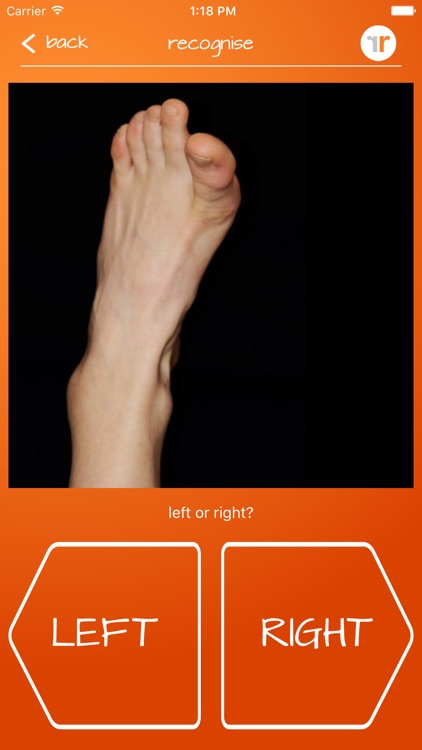
From the Recognise App
When I see a patient experiencing chronic pain of their ankle, I'm using an app created by the NOI Group called "Recognise Foot" (yes, spelled that way, because they're Australian and they don't like the letter Z).  The app shows you pictures of a foot and you have to identify if it is a left or a right one.  (They have apps for several different body parts).  You can change the settings to start with fairly simple images like this one --> with a black background in typical positions to more complex images with varied backgrounds that are covered in paint or wearing a cast or flipped upside-down and it's basically like playing a game to see how fast you can identify the side of the body and how accurate you are.  I've tested out the app for the hand (Recognise) and the app for the foot (Recognise Foot), each of which are $5.99 at the App Store.

A normal result would be at least 90% accuracy and symmetry between sides as well as response time of less than .2 seconds.  The app will tell you your scores and you can use it to assess the patient's ability to discriminate between left and right as well as treat them using the app. I've been adding this as a home exercise program component to patients who have been experiencing chronic pain and having them "play the game" several times per day in addition to doing some activities to try to get them moving towards less pain. 

A word of caution: the GMI Handbook does say that some people will experience pain just from using the app. This is not something I have experienced yet, but if it does occur, there are ways to change the settings on the app so the patient has more time to respond or less images. Also you can actually regress from this to watching other people move, focusing on the other person's body.  For example if your ankle pain was increased just by using the app, you could go to the mall and watch people walking and focus on their ankle instead.  There's science to support this regression and the book talks discovering this using monkeys who would watch people eat and some of their own brain cells that would be activated if they were eating would "light up" as if they were doing the activity themself. It's a less intense way for your brain to process information, watching someone else do an activity, because of the ways the sensory and motor cortexes of the brain are uniquely used with watching versus participating in activity.

Ultimately, GMI is a science that is still developing.  There is research to support some of the claims, but not all of them and the NOI group points out where there are holes in the evidence.  There is evidence to support using this treatment in specific patients, such as those with CRPS, and less evidence for others.  Some of my colleagues are using this treatment more frequently and with patients in more acute pain states.  Some colleagues don't use it because they don't know anything about it - like myself only a few months ago. The app is actually pretty fun and if you don't have pain doing it, who wouldn't benefit from some brain training?  I'm tempted to see if the basketball players I work with have any change in their reaction time by using this sort of brain training to try to use if for performance enhancement, but again, I have no evidence to support that thought and can't usually use them as guinea pigs.  I'm curious to know who else is using GMI in their clinical practice, how often, for what conditions, and what others have found with using it.  And I highly recommend that PTs read this book to learn about where we are on this type of patient care right now and to see if it might help some of your patients.  

Thursday, January 30, 2020

Resilience

Resilience.  Major Buzzword.  Everyone seems to be talking about it.  "The capacity to recover quickly from difficulties; toughness."  Particularly in the wake of the recent helicopter crash that ended the life of Kobe and Gianna Bryant and reflecting on Kobe's basketball career.  Resilience is a psychological principle.  Can you cope?  Can you face the struggles in your daily life?  Can you manage conflict and overcome tragedy or trauma?  

You can see it when you look around you, to some degree.  A friend just summitted Mount Kilimanjaro.  Just got on a plane in the US, headed to Tanzania, Africa, and then climbed to the 19,308 foot high summit.  I'd say that takes resilience.   I work with patients every day who are overcoming injuries, surgeries, physical pain, chronic conditions, family struggles... and more.  I see resilience in front of me all the time.

This year, Seattle Children's hosted a leadership conference where Dr. Bertice Berry was the keynote speaker who spoke about Resilience.  She later presented to a remote Seattle Children's staff about Resiliency Connections.  So in the past month I've listened to Dr. Berry speak about resilience twice, and it seemed like a fitting topic this week.

When asked what Dr. Berry would choose as her dream job, she said she wanted the title of "Chief Inspirational Officer."  That sounds like a giant undertaking. The responsibility to inspire staff to improve their life on a day to day basis is not something Dr. Berry takes lightly.  I have the challenge of motivating and/or inspiring (definitely not the same, though sometimes both are needed) patients every day and this is hard!

Here are some things I took from Dr. Berry's presentation.  

First, identify your own purpose and identify your daily intentions.  This could be in your personal ife or in your professional world.  Consider "Why me, here, now?" Why am I here, helping this particular person with their physical therapy today?  How can I make this the best experience for both the patient and for myself so that they have the optimal outcome.  Why is it important to me that I do this?  How can I make a difference in my coworkers' lives, in my patients' lives, and in my own life? 

Second, have I given enough of myself today?  There were many memorable quotes from Dr. Berry's presentations, but one in particular was "you feel poor when you're not able to give."  And I agree.  I struggle the most when I'm facing a patient I can't help. I get frustrated with patients who have conditions that don't have a positive outcome.  I know that I can't help everyone.  I am constantly grateful that I am able to help anyone.  My usual intention is to help my patients learn to help themselves.  I don't like the idea of fixing people or that they need fixing.  Patients, even those with injuries, diseases, or conditions, are still humans and they are not broken.  They are filled with life, experience, and resilience.  Sometimes they may need a little guidance in harnessing their inner drives and motivations.  
Dr. Bertice Berry on remote feed at Seattle Children's

And third, the need for human connection. Dr. Berry said, “You can’t be well without connecting.  You can’t help others be well if you’re not well yourself.”  As a healthcare provider, the amount of time you spend giving of yourself is a lot.  You need to find ways to take a little bit too, to refill your cup or recharge your batteries - whichever metaphor you prefer.  There is a reason why people gather into communities, why the family unit has so much value for many cultures, why prayer is regularly participated in collectively.  A meal can be eaten alone, but is it ever as good as it is with good company? Prayer can be done individually, but doing so in a community elevate the spirit differently. Is singing alone in the shower the same as singing in your car with your best friends?  I find, particularly when I'm working with patients experiencing chronic pain, that they have started to isolate themselves.  They've stopped hanging out with friends, sometimes have stopped going to school, they withdraw from their family members, and they sometimes even say out loud that they don't like people.  It's far easier to suffer alone than to hear others living their lives despite your suffering.  But re-integrating into a community, finding people with shared interests and beliefs, and increasing interaction helps drag people out of that loneliness and into the light. 

As a physical therapist who values therapeutic alliance first and foremost, before my patient care really gets underway, I prioritize connection.  If my patient is not interacting with very many people, my role as their PT may be even bigger than guiding them in exercise.  Showing interest in their life, who they are as a person beyond their pain circumstances, and simply listening may have a much bigger impact on them.  Dr. Berry emphatically encouraged healthcare providers to connect with their patients.  Find the common ground.  Don't confuse your own vulnerability with authenticity.  "Nothing sucks the energy out of you more than being someone other than who you truly are."  Share your experiences to help them find their paths. 

Whether you're mourning the loss of Kobe and Gianna Bryant or someone in your personal life, or you're facing an obstacle or tragedy that has got you down, know that you have resilience inside of you. Know that you're not alone, you just might need to look around to see who else is on your team.  But look and you will find support in the most interesting places.  Maybe it's your dog or your stuffed animal or your online blog that is primarily just read by your mom, like mine.  Know that I'm rooting for you. Hopefully you can look around and find that you have enough inspirational and motivational people around you to move in the right direction.  

Thank you, Dr. Berry.  

“When you walk with purpose, you collide with destiny.”


Monday, January 20, 2020

What Do Physical Therapists Do? Installment #6: We Critically Appraise Research

Link
I'm long overdue for another installment of my "What Do Physical Therapists Do?" series.  I've previously written about the PT role in emergency response, return to sport participation, strength training, therapeutic alliance and listening, and assess biomechanics.

Have you ever seen a toothpaste commercial saying "100% of Dentists Recommend that particular brand?"  Do you think to yourself, 1) "Ooohh, I should go buy that right now!?"  Do you wonder, 2) "Would I like that flavor?"  Do you consider,  3) "I wonder if they surveyed one dentist or 1,000 dentists to get that outcome?"  Or do you 4) just let the commercial come and go and ignore it entirely?

I'm very particular when it comes to all things related to teeth... I hate when people walk around brushing their teeth, I can't stand the sound of the electric tooth brush, I gag in response to watching others floss in my presence. I can't understand why they made cinnamon or grape or bubble gum flavored toothpaste when it's clearly meant to be mint-flavored. Only. And chocolate with mint has been ruined.  Tragedy.  Today I'm giving these commercials more thought than they deserve.

I think that many people probably just follow option 4, completely ignoring the commercial and moving on with their show.  But that path ignores that behind that advertisement, there was some amount of research done, data was compiled, and the information was put out into the world for you to interpret.  So the purpose of this blog post is really about choice number 3) "I wonder if they surveyed one dentist or 1,000 dentists to get that outcome."  This isn't where my mind automatically goes, but it's the way that scientific research needs to be considered.  And it makes me nervous to think that there are physical therapists who don't read any research at all - or who read a paper but then ignore the findings entirely.  Just like option 4. 

Let's say you're a physical therapist and you're working with a patient who recently sprained their ankle.  What does the research say is the best thing to do for this patient?  Did one physical therapist present a case study that you read and you're taking their word for the best approach?  Have you, yourself, done a treatment with a similar patient before and found that it worked so you now think it's the best option for everyone with this condition?  Is there a journal article that says to do certain things, but other papers that show the opposite information?  Were the research tests done on a teenage male, like the patient you're working with, or were they conducted on a group of women in their 40's... and does that matter?  These are just the beginning of the thoughts involved in using Evidence-Based Practice in medical care and show why this is so complicated.  What does the research say?  What does it actually mean?  Is it clinically relevant to your patient? 

I've previously written about the changes that healthcare is experiencing here, but in that post, I didn't give enough credit to the transition in healthcare to more use of evidence-based practice.  I think use of research to support the decisions made with patients is very important, but I also find it to be incredibly difficult.  The example above with the patient with the ankle sprain is just one possible scenario out of tons of different ones to see in the clinic.  There isn't research to support all of our decisions, and even if there was research covering all aspects, there's no way I could ever read it all.

For myself, I work in pediatric orthopedics.  In a typical day, I will see eleven patients.  No two are the same, even if three of them are recovering from ankle sprains.  My job limits me to seeing patients between ages 5-21, which is far more restrictive than most people who work in an orthopedics setting.  But research on kids is often lacking, so to try to make decisions for kids based on research in adults tends to happen a lot.  I know that it may not be accurate - but I also know that I don't have anything else to base my decisions on.  While there is an increase in research available for teenagers with ACL tears, there are many conditions and treatment approaches that have not been well studied with matching characteristics to my patients.  And, again, even if I had all the time in the world and devoted it to reading, I could never read all the papers and really know what all the researchers recommend to make the most educated decisions possible.  So we work to make our best decision and review the literature as much as possible, and this requires the ability to critically appraise the literature.  Reading the papers is only the first step.  Understanding their meaning is even more complicated.

I mentioned in my last blog post (here) that I recently launched the Seattle Children's Hospital Sports Physical Therapy Journal Club.  So far, this project is in its infancy.  To get it started, I was advised by several physical therapists working elsewhere who already participate in a journal club to start by focusing on papers that help you critically appraise literature.  I followed their advice, but had to start with learning more about what that even meant. 

Journal of Sports Physical Therapy
According to the Center for Evidence Based Management, "Critical appraisal is the process of carefully and systematically assessing the outcome of scientific research (evidence) to judge its trustworthiness, value and relevance in a particular context. Critical appraisal looks at the way a study is conducted and examines factors such as internal validity, generalizability and relevance."  The Journal of Sports Physical Therapy (JOSPT) has been publishing a series of articles to help Critically Appraise Scientific papers here and as I've been reading through them and collecting information for the journal club, I've been finding that 1) the topic of critical appraisal of the literature is not very interesting, and as such, I have never previously given it much consideration to learn as a skill and better question the research I'm reading. Lack of interest is a poor excuse for something this important.  I'm also not interested in gymnastics, but I work with gymnasts so I need to take an interest in it to sufficiently work with that patient population. 2) There are a whole lot of ways for a scientific study to go wrong - without the researchers having that intent or despite their efforts to avoid it.  Things like bias, blinding study participants, misunderstanding confounding variables or inclusion and exclusion criteria for subjects, insufficient sample size, improper use of certain types of statistics, lack of awareness to the true definition of terms and what they mean in a scientific setting, and I'm sure more ways that I don't even know yet. 3) Research is super complicated and cannot be taken solely at face value.  Simply reading an abstract and the conclusions of a paper can be incredibly misleading if authors have put a spin on their findings or if the methods of the paper are ignored.  Critical Appraisal requires thought, analysis, interpretation, and questioning.  

As clinicians, I think learning about how to appraise the literature is something many of us need to do better.  As physical therapists, many of us did not have to go through the full research process to get to our clinical status.  This may be a shortcoming of our learning because too many of us are not considering whether or not the findings of a study really mean what is presented and whether or not a lab study actually applies to the clinical setting.   It seems like a lot of research principles come from the pharmaceutical world.  If a medication is provided to 100 people and nobody dies and an abstract for the paper says it saves lives, that is a misrepresentation of data.  What if the methods show that the criteria to select the participants in the study excluded people who would really need that medicine?  What if they only tested the medicine on people over age 75 and you work with children - would it also save them?  What if, when the study is expanded further to maybe 1,000 people, there are deaths in the bigger group?  This is a call for us all to be better about consideration of the research with a healthy skepticism towards methodology and interpretation.  

So the next time you want to do a treatment technique on a patient, have you considered the literature supporting or refuting the efficacy of that approach? This could be anything.  Dry needling.  Massage.  Cupping.  Specific types of exercise - maybe yoga or pilates.  Stretching.  Strength training.  Breathing.  Biofeedback. Foam rolling. Desensitization.  We have a lot of tools available to us - many with different levels of support in the literature. And have you looked to see if there is a paper that suggests outcomes to the contrary?  What do you think is the best option for this specific patient?  I'm struggling so much to read papers that, for example, suggest that manual therapy is no better than exercise.  Some patients really do seem to need manual therapy.  There are lots of papers that suggest it isn't useful, and there are also whole institutes, like the North American Institute of Orthopedic Manual Therapy (NAIOMT), who have evidence to support the exact opposite. A paper cannot study every circumstance, so the setting and the patient demographics and pathological condition have to be considered. 

I'm hoping this post just encourages you to question how you use research and evidence-based practice, which you should definitely be doing, and perhaps you can teach me ways to more critically appraise what I'm reading.  We can all get better at doing this.  And we can all hold each other accountable to be better clinicians. 

Monday, January 6, 2020

I'm a Book Nerd

I really love to read.  I don't think anyone who knows me would be surprised to hear this, and I've written a bit about this in the past.  I've written a few book reviews (you can search the blog for those easily if it interests you), and I wrote about my anti-library here.  I constantly have a book in my bag, an audio book in the car, a creased journal that I'm mid-way through reading usually on the back seat of the car, on the side table in the living room, and in my laptop bag.  There are things to read everywhere!  I even occasionally have an audio book on my phone to listen to, now that I figured out how easy it is to connect an app on my phone to my library account.  The ways to access knowledge continue to skyrocket and I feel like I just keep devouring more and more, but each thing I read just shows me multiple new sources I can add to my list.  I remember fondly the days when I only read fiction, many years ago, and I'm embracing the transition that I've gone through to make it so I'm about 60% non-fiction and 40% fiction reader now.  I love getting lost in a tale of unique characters or far away places and won't really ever stop reading fiction entirely, but the non-fiction and the science are so fascinating, too!  I read about a huge variety of topics  But I also like reading things that help me grow as a physical therapist and as a person.

Last week I was working with a teenage patient in the clinic who I have had the opportunity to work with over more than two years following multiple surgeries.  She was telling me about her most recent Netflix binge and asked what I was watching.  When I told her that I didn't have a TV or a Netflix account, her jaw hit the floor.  It's not like I don't waste plenty of time on Facebook or goofing off on my phone or watching movies or occasional shows.  For certain, I do. Some days I want to go back to my old flip phone so I could have less access to all the distractions my Smartphone provides.  When I told her I read books, she called me a nerd.  And I wear that title with pride.

Until now, I've kept a running list of books I want to read on Goodreads and as I get close to finishing one, I just pick the next one. Sometimes a friend or coworker recommends a book and I pick it instead of what's been on my list for a while. I'm a regular at the local library and when they don't have something I'm interested in getting, I can use the Seattle Children's Hospital Inter-Library Loan System to get my more sciency books.  I've had a list of the "Top Five To Read Next" books on my list for years... but some of those books have never moved off the list because I read others first.  I've never really wanted to commit to making a plan of topics or books to read and sticking to it because I liked the flexibility, because I don't want reading to feel like an obligation, and because I have been reading so much, that I didn't think it really mattered.  But I'm not reading some of the things I really want to get to, so I'm going to try a plan this time.

For 2020, I'm picking a few work-related topics ahead of time with the goal of reading at least one book for each of those topics.  The books have all been on my list, some for years.  They've been recommended by people I respect.  Some match my personal beliefs and some are a bit more contrary. They seem interesting from their descriptions.  They're bound to help me grow as a physical therapist, and also likely as a human being.  Though I've written them as if they are in some sort of order, that may change.

Graded Motor Imagery Handbook + Mocha = JOY
The first book is "The Graded Motor Imagery Handbook" by Lorimer Moseley, David Butler, Timothy Beames, and Thomas Giles. You may have read my previous post about when I met Lorimer Moseley as his team studies pain extensively and he's written several books, which I've also written about here and here.  I don't actually know what topic this specifically falls under.  Maybe pain, maybe physical therapy treatment, maybe neuroscience.  Either way, this book has been on my list for a long time.  I just started it and can already tell it's going to be a journey. I expect this experience will be like climbing the mountain that "Explain Pain Supercharged" was.  In the event I decide to dig even deeper into this topic, I'll read some of the resources or books recommended within it, such as "Phantoms in the Brain" by V.S. Ramachandran, or one of his other books.  This is how I start to fall down the rabbit hole.  Speaking of which, I hope to read "The Adventures of Alice in Wonderland" in 2020, also.

The second topic will be pain.  Shocker, right?  The pain saga continues.  I've been wanting to read "Gift of Injury" by Stuart McGill which is about recovery from lower back injury and if I'm able to get access to it, I'll also read his book "Back Mechanic" to make a more focused reading cluster about low back pain.  And I also have "The Gift of Pain" by Dr. Paul Brand and Phillip Yancey on my list.

The final subject will bring me back to the basics: a look at Anatomy by reading "Anatomy Trains" by Thomas Myers.  Hopefully a refresher on the basics of anatomy with new learning about the fascial system.  I think this book is going to go against some of my biases, but I'm not sure yet. The list of these six books is now at the right side of the blog and I'll be checking them off as I complete them throughout the year.

In addition to these books, I recently launched the Seattle Children's Hospital Sports Physical Therapy Journal Club.  After recommendations from many of the physical therapists I met at the AASPT Fellowship I wrote about here, a few editions have already gone out looking at the "Linking Evidence to Practice" series in JOSPT written by Dr. Stephen J. Kemper that teach readers how to critically evaluate scientific literature.  I won't lie... those papers were a bit dry, but they're important. Too often we read a journal article and take every word of it like it's gospel when in reality there are other papers that share opposing views or the methodology is not really sound.  I'm guilty of this myself, and hope to learn more about the biases I fail to recognize in my own treatment methods. I'm really looking forward to getting into some more interesting papers that have been recommended and I hope to share some of those here on the blog, also.  Specific topics I'm looking forward to reading about in the scientific literature include: the basics of tendon structure and healing, more about evaluation and treatment for concussions, therapeutic alliance, the mechanisms of manual therapy (this will be the next paper, thanks for the recommendation Jarod Hall), and looking at different conditions we treat in the clinic.  Anybody who wants to join in on our journal club emails, just say the word and I'm happy to share.

I guess I've been blogging more and more about PT-related topics, though once the WNBA season starts back up, I'll still write about basketball... or maybe about things that interest people that are not physical therapists.  Until then, I'm loving all this PT learning and personal growth and want to know what others are reading to help grow their clinical practice.  Or just books you liked.  There's always room for more on my list.


Monday, December 23, 2019

2019 in Review

Reflecting...
This is my third "Year in Review" blog post since starting "Abby's World" in 2017.  (If you wish to read my previous versions, 2018 is here and 2017 is here.)  When reflecting on this blog, I feel gratitude to those who have read posts - one or many, I cherish the experiences that I've been able to document here, I acknowledge that I still don't know my target audience and I've embraced that.  I like that I chose a name that allows me write about random topics, though I wish I had come up with something more creative.  My mind wanders a lot... my blog topics only tend to wander occasionally. For the most part, I've stuck to Physical Therapy/Health and WNBA Basketball/Women's Sports, but I've thrown in some odd topics along the way, too, like this post which had weird photos of my eyelids.

In summary, since starting the blog, I've written 110 posts with a collective total of over 25,000 readers. I've had two posts eclipse 1,000 hits (this one about Physical Therapist Board Certification and this one about sport specialization), and I'm sure they're not my mom reading the same post 1,000 times. I posted less in 2019 than in 2108, but I also traveled and read a lot more. I like this pace and expect it will be similar in 2020.  Here are a few of the highlights from 2019, both personal and professional, and a look forward to what's coming in 2020. 

The beginning of 2019 was insanely busy.  From January through early April I supervised my first PT student who I wrote about here. In March, I presented advanced anatomy and biomechanics of the shoulder at a Youth Upper Extremity Injuries conference, which I wrote about here, and which showed me that I really enjoy teaching, though I would miss clinical work way too much to dive into that full time. At least for now. And then a week later was the Sports Certified Specialist PT Exam which I wrote about here.  Taking a student really opens up your time to focus on other things, at least when they're as good as mine was. I took full advantage of that opportunity. 

In 2019, I "came out" about my eating disorder with this blog post and shared some mental health struggles.  It's amazing how much better things can get when you 1) learn there is, in fact, a problem and 2) do something about it.  I faced these issues with a much bigger support system than I had anticipated, along with an army of healthcare providers, which made things so much better.  I spent many hours and even more dollars between my Therapist's office and my Dietician's office along with visits to my Naturopath and Gastroenterologist because adding foods back into my diet that I had been previously binging or restricting ultimately made me pretty sick. Like bent over in pain, leaving work early, and carrying extra clothing around in case something horrific happened sick. Unbelievable how much damage you can do to yourself but also how resilient the body is!  It could be that some of those foods made me start restricting in the first place, but we'll probably never know that. I'm certain that we need to continue working to de-stigmatize mental healthcare in the US. Too many people need help but are ashamed to get it, and it can make a huge difference in your quality of life.  
Justin Timberlake!

Despite having a persisting gut ache, I also traveled more in 2019 than ever before.  It started with a day trip to Vancouver, BC, on Valentine's Day to see Justin Timberlake in concert. Amazing.  So Amazing.  In March, an East Coast visit with the family and Climb to the Top of Rockefeller Center for Multiple Sclerosis for the fifth time (which I've previously written about here). I won't be climbing in 2020 but if you'd like to donate and support the cause, please let me know and I'll connect you to fundraisers! In May a trip to the Olympic Peninsula to check out Dungeness Spit and learn about that type of land formation. In June I headed East twice more for weddings, once with family in Ohio and then in New Hampshire two weekends later.  

World Travels
In August I enjoyed a life-changing opportunity to volunteer in Tanzania, Africa, for two weeks which I wrote about here, and which was has captivated my thoughts and prayers since. In September the AASPT Traveling Fellowship brought me to Ohio and Minnesota, which I wrote about here, and which impacted my learning and career goals in several ways. In October there was a quick snowy vacation weekend to Denver followed by a Thanksgiving trip to Connecticut to see the family, which I wrote a bit about here.  The year will wrap up with my birthday celebration in Portland, OR for some Trailblazers vs Lakers basketball.  Basically, I was all over the map and spent a lot of time reading and writing in airports.  Shockingly I have zero travel plans for 2020 right now, but I'm sure that will change. 

I read a lot of books in 2019, both fiction and non-fiction, thanks to audio books for the commute and OverDrive on my phone for while I was on the road.  Four books were listed in the syllabus for The Level Up Initiative, which I wrote about here, all of which were really awesome. My favorite reads of 2019 were "The Moment of Lift How Empowering Women Changes the World" by Melinda Gates, "Yale Needs Women" by Anne Gardiner Perkins, "Educated" by Tara Westover, and "Hunger: A Memoir of (My) Body" by Roxanne Gay.  I also listened to some podcasts and binge watched "The Handmaid's Tale" on Hulu... can't wait until the next season comes out!

There was continuing education, kayaking, basketball, and time with family and friends.  I didn't spend nearly enough time with my family, but hopefully that will change next year.  My biggest goal for 2020 is to purchase a house, so perhaps I'll write about that experience.  My student loans are finally under $80,000, so it only seems appropriate to acquire more debt, right?

As the sun sets on 2019, I'm wishing everyone a safe holiday season and look forward to writing more in the new year.  

Monday, December 16, 2019

How I Spent My Day

Remember when social media first started to become popular and people started posting on Facebook every little thing they did?  Like folded laundry, took a shower, went to the gym... nothing really out of the ordinary, usual everyday kinds of things?  Like today, my brother just re-posted his first Facebook post of each month of 2019.  How four people liked that is beyond me.  Or remember when AOL Instant Messenger had "Away Messages" that would automatically get sent back to anyone who wrote you because you were away from your computer?

One time in college, I had an "Away Message" up that was a quote from the band "3 Doors Down."  Here's a YouTube link to one of their hits, "Here Without You," in case you need a refresher. I don't remember the quote I used, but it was probably from this song.  Anyways, I had their quote as my away message and I probably didn't have proper punctuation to identify it as a song because my sister called me at 2AM and when I sleepily answered from my own bed in my dorm room, she asked "Who lives 3 doors down from you that you're spending all this time with?"  Ha!

Anyways, now that you are reflecting on all the simple things you used to post on your own social media or the things that annoy you when you read them from others, I'm going to tell you how I spent my day today. An Abby Play-By-Play for your reading enjoyment.  I'm sure you all want to know.

Today is Monday, December 16th.  I woke up around 7:30AM, before my alarm.  I usually don't need my alarm to wake up, so today was no exception.  I have Mondays off and was excited that I had signed up to watch the Breakthrough Summit, a digital leadership conference for women in sports.  If you missed it, you can still watch the replay by signing up here.

LaChina Robinson and Jill Ellis
The Summit kicked off with introduction from ESPN Basketball Analyst LaChina Robinson (Twitter @LaChina Robinson) interviewing Jill Ellis Head Soccer Coach for the 2019 World Cup Champions US Women's Soccer  National Team.  I didn't plan to live tweet quotes from today... but then the inspiring quotes just wouldn't stop coming.  Coach Ellis talked about her career path, things coaches should consider as they work towards the top, her experience working with outspoken professional athletes in the current environment where women are voicing their opinions, loudly, about the inequalities in opportunity, pay, the workforce, and so many other areas.  My favorite quote from this interview was Coach Ellis saying "If I'm the same leader today that I was two years ago, I'm failing."  The value of personal growth is enormous, and I heard her loud and clear.

At this point, I got out of bed and made a bowl of Frosted Flakes with Almond Milk and some grapes which I enjoyed while watching the next portion of the Summit. LaChina had an interesting discussion with a panel coming from three different sports backgrounds.  Dr. Jen Welter (Twitter @jwelter47) is considered to be the first woman who worked in the NFL when she joined the Arizona Cardinals Coaching Staff in 2015 after a successful career as a Pro Footballer herself.  She said she called herself a 'Pro" because they didn't earn enough money for the "fessional" and that when her team won a championship following a 12-0 season, she got her first paycheck along with her championship ring. The check was for $12.  But she was paid to play her sport, football, and that was a big deal.

LaChina and Panel: Jen, Ginny, and Charmelle
Also on the panel was Seattle Storm co-owner Ginny Gilder (Twitter @ginnygilder) who I've previously written about here and who is an Olympian Rower.  What stuck out to me from Ginny's talk was how the Storm ownership group, Force 10 Hoops, initially came together to determine why they wanted to collectively purchase the Seattle Storm.  They wanted to support a team that the community loved, but they also wanted a platform to use to support the changes they saw necessary in the world.  After five years working with the team, I had never heard that story, and now I can't wait to hear more about it.

Third on the panel was Penn State Senior Associate Athletic Director Charmelle Green (Twitter  @charmelle44) who played college softball at Utah and was the only black female athlete on campus at that time.  She talked about her career path and about learning from your mistakes and using them for growth.  Carmelle is also the President-Elect of WeCoach who sponsored this event.  The Vision Statement of WeCoach is "recruitment, advancement, and retention of women coaches of all sports and levels."  Throughout today's event, data was presented showing that female coaches don't stick around as long as their male counterparts.  The data improves if the female coach was, herself, coached by a female coach.  The data also improves if females were asked as student athletes if they would consider coaching as a career after college - compared to those who were never asked to consider that path.  The data was presented in an online live Q+A chat during their lunch session by two of the later presenters.

It was at this point that I unfortunately had to head out for my appointment with my therapist because #mentalhealth.  In the car I listened to the presentation of Felecia Mulkey (Twitter @BaylorAcroCoach), Acrobatics and Tumbling Coach at Baylor University who discussed the process of developing a team culture using Dr. Bruce Tuckman's "Developmental Sequence of Team Development" model.  She uses boundaries, clearly defined expectations, and consequences paired alongside coaching staff congruency to make sure her team functions as a program.  I liked her discussion of how a coach can't really choose the culture of their team, the culture is what the team thinks it is and the coach can impact that culture with how they lead.  Then I had to miss some of the Summit, but it's going to be available in recorded form and I guarantee I'll catch up and watch WNBA All Star playing for the Connecticut Sun, Layshia Clarendon (Twitter @LayshiaC) because she's an awesome human being and I was bummed that I missed it today.

Betsy Butterick
Following mental health came physical health.  I made it to the gym in time to catch my old pal Betsy Butterick, The Coaches' Coach and Communication Specialist. (Twitter @BetsyButterick) with her presentation. What could be more motivating on the treadmill than watching Betsy demonstrating how easy it is to tangle up communications as she was instructed to make a PB&J sandwich.  Something so simple went horribly wrong in a memorable visual presentation.  I first met Betsy in 2007 when I worked for the Connecticut Sun and she worked for the Seattle Storm.  We were both doing laundry for our teams and there was a small group of us around the WNBA at that time who were around the same age, all hoping to find our paths in women's sports. She's paving the road for many behind her and elevating so many coaches with her work, doing amazing things.  We both participated in the Women's Basketball Summit which I wrote about here, and you can check out her latest work here!

I missed the next presentation and a half because I needed amped up music to deadlift, but then saw the second half of the data on women in coaching presented by Dr. Nicole Lavoi (Twitter @DrSportPsych).  Dr. Lavoi is the Director of the Tucker Center for Research on Girls & Women in Sport at the University of Minnesota, but what I did hear was a combination of optimistic room for growth and disbelief at the current status of the NCAA.  It made me sad to hear how few women hold higher up roles in NCAA Intercollegiate Athletics as well as coaching women's teams around the country.  Women in higher ranks will ultimately help women get the jobs in sports they aspire to have, so the future will hopefully have room for more female athletic directors. There are report cards grading athletic departments based on their gender hiring practices.  UConn doesn't look good with their D, but the shining light was seeing my college professor, Dr. Laura Burton, on the Tucker Center staff.  She was always pushing for improved gender opportunities 15 years ago.  I didn't know the Tucker Center existed, but I can't wait to read through some of their research in the upcoming weeks and finish watching her presentation.

LaChina and Holly Warlick
By now I had made it home for a late lunch... I'm sure you're wondering... chicken salad in corn tortillas, taco style. I was able to finish watching the last interview with former Tennessee Lady Vols Women's Basketball Head Coach Holly Warlick, who spoke highly of legendary Women's Basketball Coach Pat Summitt.  Holly's top quote was "You meet the same people on the way up that you do on the way back down, so treat people with respect."  She also gave the advice to young coaches that they really need to love what they're doing.  Coaching is a huge time commitment that requires you to sacrifice time away from your family, so loving it and having family support are essential.

Then I went to Target.

Overall, a pretty awesome day.  I really enjoyed the parts of the Summit I was able to watch and can't wait to fill in the gaps soon.  Hopefully they'll do a repeat next year.  What did you do ttoday?

Sunday, December 1, 2019

In the Spirit of Thanksgiving

The Family
I just returned from a great week on the East Coast celebrating Thanksgiving with my family. It's always great to see them, as well as my friends, but this year was more emotional than usual. My parents are moving to Florida after spending their entire lives in Connecticut and the future of family get-togethers now falls to the unknown. Though they may not realize it, they're the pillars of the family, the matriarch and patriarch. They're the glue that keeps everyone together. Without them in New England, it's hard to know when my whole immediate family will all be in one place. I think that's sad. It's also great for them to escape the snow... I did that five years ago and I've grown soft because of it. I hate to see snow, now, and can't really tolerate the cold the way I used to. I'm really happy for them to get away from the winter, enjoy more sunshine, and spend time with their friends who escaped the winters in the past.

Justin Timberlake 2/14/19
Fortunately my parents didn't move out of my childhood home this week... that occurred over a decade ago and I rarely spent the night at their most recent CT place. It had a lot of the same things in it that my childhood home did - similar artwork, family photos, the same board games they always beat me at, same dining room table and china closet, plus my parents. But it wasn't my old bedroom. There were no Justin Timberlake photos taped under the bottom of the top bunk where I had created a collage of all my favorites. My stuffed animals and high school yearbook never lived there. My sister's family was close by so if I wanted to stay in my hometown, I sometimes stayed with her.  Usually, though, I stay about 40 minutes away with my roommates from graduate school, one of which has been my friend for fifteen years, who keep a room available with a set of my pajamas in the closet (plus I never returned my key when I moved out), and they're more centrally located to all the places I tend to visit and closer to UConn and Boston-Logan airport.  Plus they have a really cute almost 3-year-old who wakes me up at the crack of dawn saying that the sun is up and I should be too... can't argue with that.

So with a lot of emotions of an unknown future and big changes staring me in the face, it seemed difficult to focus on gratitudes this Thanksgiving. I think I'm generally a grateful person. I pray with gratitudes. I try to see the positive in any situation. But at a time when gratitude should have been pouring out of me, I felt myself struggling to find what I'm most grateful for. And then I remembered the "Things I Take For Granted" list which I wrote on the super long flights back from Africa this summer. (I wrote about Africa on the blog here).

Things I take for granted (not listed in any particular order):

1) Fresh water, in the tap, that I can drink to my heart's content without immediately causing me diarrhea. 
2) Ice. In unlimited quantities. For making my water cold, or for use to deal with acute pain, or countless other ways I can use ice at home. 
3) Fresh fruit and vegetables that won’t make me sick because my fresh water does not contain parasites. 
4) Clean clothes, cleaned in a washing machine and with a dryer. 
5) My parents - who happen to be American, who happen to be white, who happen to live in the United States. Who love me unconditionally.  No child gets to choose their parents. No child gets to choose the color of their skin or where they are born. 
The Siblings
6) My siblings, and the fact that there are only 2 of them. Who support the ways I chose to spread my wings and leave the nest, even if it means thousands of miles between us and far too infrequent sibling selfies. Who manage the time change between the East Coast and West Coast with early morning or late night texts and regularly scheduled Happy Thursday phone calls.  Who came to visit me in Seattle, met my Seattle friends, and saw first-hand the beauty of this side of the country.
7) My friends. Near and far. Who helped make Seattle feel like home. Who meet up for sushi on a moment's notice. Who keep in touch despite the distance and time change. Who let me share in the joys of their children's milestones while I simultaneously laugh at them for having moved onto the diapers and minivan lifestyle. Whose husbands and parents are kind and willingly take the kids so we can have friend time. Who have seen me at my worst but love me anyways. Who tell me the truth, to my face, even when I don't want to hear it.
8) Hot showers. As hot as I want. All the time. And not wondering if the water might be hotter if I wait a little bit longer.  Or needing someone to heat the water to have it poured over my head. Or that one time when I got so excited to have a hot shower after a few too many cold ones that I left it running and woke up my travel buddy, Kristen, and told her she had to jump in immediately so she could have a hot shower, too!
9) Brushing my teeth using the sink rather than a bottle of water. 
10) My education. The fact that it was available to me, at the highest level, provided by excellent schools and professors from my littlest years all the way through graduate school. That, even though I’m still paying for it for the next several years, is ultimately affordable and a choice that I made, and was able to make. I chose to attend the University of Connecticut. I could have chosen elsewhere or not to pursue higher education - and I still could have had a successful career in this country. Being a female in the United States allows for access to feminine hygiene products, which are often a limiting factor around the world for why young women must stop attending school. 11) So I guess I also take tampons and maxi-pads for granted.  And similarly birth control pills and contraceptive methods which considerably restrict accidental pregnancy, where many women around the world do not have access to these items or are mistreated if they are caught using them.
12) My home, which is cozy, well-heated in the cold season with ample blankets and a fireplace, cool enough in the summertime, with running water and apparently endless electricity, with a secure roof over my head and a roommate who consistently cleans the bathroom. 
13) My job. Which gives me a generous salary to do work that I love, that gives me the opportunity to have enough money to buy things I want. Which I can have despite being a woman, (which I believe pays me equitably to the men who work alongside me with similar amounts of experience), which won’t kick me out if I ever choose to have children and will make it possible for me to breast feed if I ever choose to do so. And which empowers me to grow and supports my individual career goals.
14) Paved roads that don’t have livestock freely roaming alongside them and which allows me to drive my vehicle, which I own, rather than walk carrying my goods on my head. 
15) My health.  My access to healthcare when something is not right, including access to well-educated doctors who can prescribe medications that are readily available if that's what's needed. My ability to communicate with a variety of specialists who will explain their findings to me and answer all my questions to help me advocate for my own well-being.  My ability to openly use mental health providers - who are readily available- something that does not exist in other parts of the world. 
16)  The ability to choose my own spouse- man or woman- because I do not belong to a tribe where my father could choose my husband in exchange for 10 cows, as a teenager, where my husband could have multiple wives, where I could be living in a country whose laws would imprison me if I chose to marry a woman.  This is the case in at least one of the tribes in Tanzania, who have ancient beliefs, that I can respect but which I do not agree with, and for which I'm now realizing how much gratitude I have for being born in the United States to Jewish parents who passed on religious beliefs that help me to appreciate other peoples' beliefs, but which are vastly different from what I learned about on this trip.
17) My bed, which does not require a mosquito net over it, which I own, which I do not have to share, which is not on the floor, and which is clean. 
18) Women's basketball. Or just basketball in general. Or women's sports. Because some places in the world can't afford to allow their children to grow up playing games. Some places in the world have children sent away from home at young ages, into the fields and working manual labor jobs. For sure those places won't be having their girls playing a sport, for fun or for a career. Probably not the boys either.
19) Did I already mention Justin Timberlake? And the Goo Goo Dolls?  Access to concerts of my favorite musicians? There was some really interesting music in Africa, but they didn't have my favorites.  
20) This blog. Where I can say whatever I want.  Which I use to collect new bits of knowledge and then share those with the world. Which I write on my personal laptop and include photos taken on my personal cell phone. And that I then go ahead to share on unrestricted social media with all my friends and family.  I'm sure my mom will read this, and at least three other people, all of whom I'm surely taking for granted.

Reality check. There's so much I'm grateful for and I'm certain I've missed more.  But these are the things I realized I missed while I traveled to a place considered to be less fortunate than the USA. It was helpful to have a reminder of all these things when I needed it most. As we head through this holiday season, I hope everyone is able to spend time with their families and the people who mean the most to them. Most of my favorite people are far away and I don't know when I'll get to see them next, but whenever that is, I'll be grateful.