Showing posts with label research. Show all posts

Wednesday, February 25, 2026

Where does the time go?!

 Hello Blog Readers - Long time, no see!

In the past few weeks, two queries came my way related to some of my older blog posts. I found myself dusting off the Abby's World cobwebs to share those prior experiences. A PT student asked about my time volunteering in Tanzania and my clinic aide, who aspires to be a physician, asked me for articles that could provide a basic overview about central sensitization, so I shared what I had written about a chronic pain course with Morten Hoegh at the San Diego Pain Summit which included several related articles. 

Once I returned to these old stomping grounds, a wave of nostalgia hit me. I re-read the last post I wrote, where I announced that I'm writing a book! The book is still in progress, and it has been an awesome learning experience. I can't believe how difficult it is to write a book! I took a few months off from writing while I prepared two talks for the APTA (American Physical Therapy Association) CSM (Combined Sections Meeting) talks. The conference talks are only 90 mins long, but they take many more hours across several months to prepare. I got to read a bunch of articles and meet with my awesome co-presenters as part of the planning to make sure we were well organized. I'm pretty sure that's where my dedicated writing time went. In the immortal words of Congresswoman Maxine Waters, "I'd like to reclaim my time."

While re-reading my last post from a year ago, I saw that I was missing writing in this way, and I still do.  Blogs help me to organize what I'm learning and process my thoughts. While I have still been writing articles for The IX Sports occasionally, that's also different. In 2025, I wrote an article about the inaugural sensory friendly University of Washington Women's Basketball game and another about the recently launched associations for the WNBA medical providers.  All in all, I've been writing... but not sharing... and while it's still awesome, it eliminates the opportunity for conversation, which is part of what I like. 

I probably should have decided what comes next before writing this post. Should I be using substack more? Will my blog topics continue to revolve around sports medicine and pain? Do I need to be organized or can I stay random? While I debate my blogging future, I decided to write about a post I saw on social media this morning that prompted me to seek out an article to read and then which I directly applied to my patient care.

I saw this post on instagram this morning.  It's from Dr. Dan Cobian at the University of Wisconsin Badger Athletic Lab. He was describing his research from this article, "Knee Extensor Torque Steadiness and Quadriceps Activation Variability in Collegiate Athletes 4, 6, and 12 months After ACL Reconstruction." (open access, Orthopedic Journal of Sports Medicine, 2024). 

I had never heard of torque steadiness, so my initial thought was - is this what I'm seeing when my patient's leg shakes while they're straightening their knee? We see shaky post-surgical legs in the clinic all the time. The article didn't include a description of the visual presentation of the athletes, and neither does Dr. Google, but I'm going to assume that if the measurements indicate a movement isn't steady, this could be visible in some patients/athletes. The article does, however, explain how electrodes are applied to specific locations on the muscles and these can measure Athletes who underwent an ACL Reconstruction showed decreased torque steadiness at all three post-surgical timepoints.

A few hours later, I was in the clinic working with my post op ACL patient who could easily hold an isometric knee extension on her non-surgical limb, but then on her surgical limb, the leg was shaking right from the start. Concentric contractions are difficult and eccentrics are even harder. Her surgical limb is weaker than the other one and her leg is atrophied. She's working hard, but sometimes the shaking scares the younger patients and they ask a lot of questions about it...

Per usual, whenever I read an article, I come out with more questions than I went in. Is it a reasonable assumption to use my patient's visible leg shaking as a proxy for torque steadiness?  How long after the visible leg shaking resolves would there still be EMG findings of torque unsteadiness and quad atrophy? The article points out study limitations which makes me wonder if the outcomes would differ in a pediatric population or with more quad tendon grafts, because it primarily examined bone-tendon-bone grafts, which aren't what I'm seeing in the clinic. 

It's good to put my questions out into the world... great article.  I hope the researchers repeat with a bigger sample... and maybe they can tell me if my observation of shaking legs is a useful tool in the clinic. 


Thursday, April 30, 2020

To Clam, or Not to Clam

As the battle to annihilate the coronavirus continues, everyone is faced with new realities. For me, those realities include chatting with my teenage patients on the phone, transitioning to Telehealth, and only seeing "high priority" kids while covered head to toe in PPE. The patients are still the most important part (and my favorite), but the volume is dramatically reduced so the majority of my time has been spent learning. I've also been working on the Seattle Children's Sports Physical Therapy Journal Club, summarizing papers to share with the department on a monthly basis.  The May topic, coming out tomorrow, is a collective look at these four gluteal muscle electromyography (EMG) papers:

1. DiStefano LJ et al, “Gluteal muscle activation during common therapeutic exercises.”  JOSPT 2009.
2. Boren K et al, “Electromyographic analysis of gluteus medius and gluteus maximus during rehabilitation exercises.” IJSPT 2011.
3. Macadam P et al, “An Examination of the gluteal muscle activity associated with dynamic hip abduction and hip external rotation exercise: A systematic review.” IJSPT 2015.
4. Bishop BN et al, “Electromyographic Analysis of Gluteus Maximus, Gluteus Medius, and Tensor Fascia Latae during therapeutic exercises with and without elastic resistance.” IJSPT 2018.  

Why this topic? I believe it is imperative for clinicians to be lifelong learners and that reading research is one approach to improve your skills as a clinician.  I also think it's really hard to do this, which is why I stared writing this blog - a place where I could store things I've learned and write out my thought processes.  The impetus behind this particular topic of learning boils down to two key points.

Key point number one: The Clamshell Debate.

If you've ever gone to outpatient orthopedic physical therapy, you've likely done the clamshell exercise.  It's very common and frequently patients will say they've done them in the past.  Thanks to Seattle Storm Sports Performance Coach Emily Blurton for her video demonstration:

Early in my PT career, I frequently recommended this exercise.  I had pre-made exercise programs that I used repeatedly for multiple conditions.  Now I make every program for the patient in front of me, often updating them at every session, and this exercise rarely appears. To me, the clamshell doesn't look like anything a person does in daily life or in sports. Maybe it looks like you're lifting your leg to get into a car.  But that's standing up, so maybe not.  Even worse, a lot of patients do them incorrectly and find them boring and too easy.  I don't create exceptionally difficult exercise programs, but it's a lot easier to convince someone to work on something that's challenging than on something that's simple and mundane.  And most of the time I don't really harp on having proper form - but with this exercise, is there any benefit to doing it wrong?  Biomechanically speaking, an "incorrect" squat will still give you some strength gains, but potentially not where you may want to target them.  I don't think shooting for the moon, missing, and landing amongst the stars is actually meaningful in this scenario. 

The circumstances under which I will recommend the clamshell are very specific: the patient needs to 1) have a restricted weight bearing status from the physician due to a surgery or fracture and is therefore unable to do the exercises I prefer but would still benefit from strengthening or 2) have a significant deficit in their active hip external rotation movement with available passive mobility that I want them to purposefully control. (Translation - they're too weak to do any of the other exercises I like better, but I never actually tell patients they're weak!)

I share many of my patients with coworkers who like this exercise, so we've had conversations about clamshells for years.  The biggest discussion came when I had a student who I practically forbade from assigning clams without excessive clinical reasoning of why they were a good choice for that patient. Now that I have some extra time to dig into the research, I'm looking to prove myself wrong.  Does the evidence oppose my clinical bias? And how do you explore the efficacy of an exercise?  

Point Number Two:  What research should I be reading?  


Levels of Evidence - Creative Commons CC BY-NC 3.0
In case you're not familiar with the Levels of Evidence for scientific materials, here's a very basic overview.  Certain types of research can be "trusted" more than others, particularly when you're trying to generalize data to a larger population than was actually studied.  Here's an example: Let's say that tonight at dinner, you ask your child if they likes peas.  If they say no, can you now conclude that this single case of your own observation applies to all the kids of the same age in the USA?  Of course not. But it is your expert opinion that your own kid does not like peas and you understand how that data applies in your household.  Now what if you took a survey of your kid and your two next-door neighbors houses who happen to have seven more kids, asking all of them if they like peas.  You have more information about kids in your neighborhood and their feelings about peas, but still shouldn't make wide-spread assumptions about the whole country based on your small sample.  This would be closer to a small case study moving up the pyramid. If you surveyed your neighbors and then three other researchers did a similar study in different cities, asking fifty kids in second grade and then the same kids again in sixth grade and maybe one researcher also asks about carrots, the number of data points continues to increase and your ability to generalize information across a bigger group improves.  Now you've moved up into more of a cohort study.  

This is a very simplistic demonstration, but sometimes simple demonstrates a major point.  Right now with the Coronavirus Pandemic, small studies are being smeared all over the media without sufficient data and with incorrect descriptions.  It's a good time to point out that you need to be cautious about how you interpret what you read.  Notice at the top of the pyramid sits "systematic review." A systematic review takes multiple research papers into account to accumulate more data points to try to make conclusions.  It is based on a researcher compiling data from other researcher's published works.  Each individual study may not have done the same research, but their data overlaps and new conclusions are drawn from having more data points. I DID NOT USE SCIENTIFIC RIGOR in my collection of resources for this blog post and I have minimal experience in data analysis, so I'm certain there are flaws in what I've found by summarizing these four papers.  However, I basically (unintentionally) created a mini systematic review by reading four different papers (including one which was also a systematic review!). 

I collect articles to read in the future. This collection was one reason behind starting a journal club! I've previously written about the anti-library where you collect resources to learn about the things you know you don't know hereAlong with my anti-library, I also have folders of papers I've previously read. I had already read Dr. Lindsay DiStefano's Glute EMG paper (the first in the list) which was probably the nail in the coffin for clamshells for me. Imagine assuming that all kids don't like peas because one kid said they didn't?  I've basically assumed that clamshells are a poor quality exercise based on the findings of one paper that studied 21 participants doing 12 exercises.  Dr. DiStefano was my research advisor in PT School so I almost always read her publications, or have them saved for the future. (Bias Alert!)  So I need more data points! I searched for more recent Glute EMG papers to compare to hers and found three more, intentionally choosing papers that included the clam shell exercise and ultimately including one with a somewhat contrary view.  Now the data I'm considering reflects over 500 participants and many more exercises including multiple variations of the clamshell.

EMG studies are used to understand muscle activity during movement.  Not only are these papers valuable, but they can also influence patient care by helping to better understand what exercises target which muscles.  I've previously hinted at reading EMG studies with regard to the shoulder here, and for sure that knowledge changed my PT practice for post-op shoulder patients. EMG studies aren't perfect, but by looking at a collection of them, you can assume similar risk of error for each study.  Participants in these papers were first assessed for their maximal volitional isometric contraction (MVIC) (aka how strong they were for a specific muscle).  Then, by placing sticky electrode sensors on the skin at certain locations, measurements of muscle activity were taken with each exercises and compared to the maximal strength possible for that person. For an exercise to improve strength, the exercise must elicit at least 40-60 % of maximal strength (MVIC) for gains to occur.  

Here's what the papers found:
DiStefano et al: The top exercises for glute medius based on % MVIC were side-lying hip abduction (81%), single limb squat (64%), lateral band walk (61%) and for the glute maximus were single limb squat (59 %) and single limb deadlift (59%). Clamshell exercises (depending on hip flexion position) were shown to have glute medius activation of: 38-40% MVIC and glute maximus activation of 34-39% MVIC.  (Clamshells don't pass the 40% minimum cut point which has been my rationale to discontinue using them in the clinic). Other exercises were examined in the study, but since they did not cross the 40% MVIC threshold, they are omitted here.

The Boren study used a cut-point of 70% MVIC as the minimum acceptable for strengthening and examined a larger variety of exercises. Glute med
 exercises with >70% (MVIC) were the side plank with hip abduction (103.11% bottom leg, 88.82% top leg), single leg squat (82.86%), clamshell variation #4 hold top leg in full hip extension while internally rotating (76.88%), and prone plank with hip extension (75.13%).  For the gluteus maximus, plank with hip extension (106.22%), glute squeeze (80.72%), side plank with hip abduction top leg (72.87%), bottom leg (70.96%) single leg squat (70.31%).  This paper suggested that the best exercises to target both glute med and glute max were the prone plank with hip extension, side-planks with hip abduction, and single limb squats.

The clamshell exercise had four variations in the Boren paper. Of these variations, #4 described above was the only option to reach their defined threshold of >70%.  If you use the criteria of 40-60% outlined in the DiStefano paper, all the clamshell variations would meet that target as sufficient for strenghtening for the glute med, but only the standard clamshell works for the glute max at 53.10% with other variations all below 30% MVIC.

The Systematic Review by Macadam et al reviews multiple papers and breaks down exercises by body position.  The cross-over step up and lateral step up had the highest average glute max and glute med % MVIC.  Pelvic drop, sidestepping with hip internally rotated and band at the ankle, standing hip abduction variations, rotational single leg squat and transverse lunges all had glute med % MVIC over 40%.  Standing hip abduction, rotational single leg squats and transverse lunges also had % MVIC over 40% for glute max. 

In sidelying, side planks with hip abduction had the highest average glute max and glute med % MVIC. (That exercise is really hard, though, and wouldn't actually be appropriate for the majority of my patients.)  The paper examined 13 clamshell variations including the standard hip external rotation and others.  In one study, three clam variations (not the standard hip external rotation) had average glute med % MVIC over 60% but other studies had clamshell averages in the 30% range.  From this paper, I can start to ease up on my thoughts that patients do the clamshell incorrectly - and more that they're just creating their own variation.

And finally, Bishop et al compared glute med and glute max EMG to tensor fascia latae (TFL) EMG creating a "Glute to TFL Index."  The TFL and gluteus maximus both insert on to the iliotibial band and contribute to hip abduction.  The TFL is sometimes considered to be a contributor to low back and lower extremity pains and/or injuries and may increase in tone or "tightness" to compensate for gluteal deficits.  Bishops "Glute to TFL Index" findings were that the clamshell with resistance was 99.54 and the clamshell without resistance was 87.89 meaning that the gluteal muscles were selectively used for these exercises much more than the TFL.  The clamshell exercises far surpassed all the other tested exercises in this study with the next best exercise being the bridge with resistance at 48.86 and prone hip extension with 48.57, both about half of the clamshell values.  Thus, this paper recommends use of the clamshell exercise as a glute-targeting exercise that does not incorporate the TFL.  To these findings, I'll add another dose of bias. Does this really matter?  Does the Glute to TFL Index have clinical meaning?  I'm not sure because I don't know if I really want to "turn off" the TFL. I'll let the clams have this one. 
In the end, I haven't been convinced.  A healthy dose of confirmation bias potentially sprinkled with some self-serving bias may contribute to that decision, but to me, the evidence seems clear. Maybe I'll be nicer to those who know that the clamshell has the higher glute to TFL index, but without that rationale, these papers suggest many other glute strengthening exercises.  For sure, I'm open to hearing alternative opinions. Are you team clamshell?  Or team ANYTHING ELSE!  I use prone glute squeezes more often than I use clamshells.  And I'm incredibly grateful for my coworkers who challenge me to think about these topics. 

(Again - this is an abbreviated summary of the results sections of the papers.  More information looking at the discussions and limitations and other aspects of the research is available if you'd like more!  For the full written summary for Seattle Children's Journal Club, go ahead and email abby.gordon@seattlechildrens.org and I can send it any time). 

Monday, April 20, 2020

New WNBA Injury Data Published!

Alert! Hot off the Presses! Physical Therapists working in Sports... Athletic Trainers... Strength and Conditioning Coaches... High School Basketball Coaches... Female Athlete Parents... Orthopedic Surgeons... WNBA Colleagues... Basketball Fans... Any one else who is interested in learning something today... Check this one out.

Presenting at Seattle Children's Sports Symposium
A new paper was published (April 16, 2020) in Arthroscopy, Sports Medicine, and Rehabilitation entitled "Injury in the WNBA from 2015-2019."  You can find the paper here. I jumped for joy to see this new release when it was in my inbox this morning.  Gotta love alerts that know what I'm interested in.  In case you don't know, women's basketball player injuries was the topic of my PT School Thesis paper, "College and Professional Women's Basketball Players' Lower Extremity Injuries: A Survey of Career Incidence" which you can read here.  In November 2019, I
had the opportunity to present on this topic to the Sports Medicine Department at Seattle Children's Hospital, updating my findings and making it more applicable to our department's work in pediatric sports medicine.  This topic is on my mind constantly, and since WNBA Physicals were supposed to be this week, now postponed until the coronavirus battle is under control, I'm thrilled to have basketball on my mind.  A new publication five years after my own with some similar findings from an entirely different approach was both gratifying and validating and this paper could not have come at a better time.

The new paper, written by Orthopedic Surgeons at the University of Chicago summarized injuries in the WNBA between 2015 and 2019 which were compiled from publicly accessible websites.  Interestingly, the findings were similar to my research with regard to ankle sprains being the most common injury and both papers explore ACL Injuries.  My study only looked at lower body injuries so it did not examine concussions, but this recent paper did and I've previously written about the WNBA Concussion Protocol here.

Here's why this paper is important, in my opinion.

PubMed is a search engine for research papers, kind of like Google, only your search will bring scientific information. A PubMed Search conducted today, April 20th, for "WNBA AND Basketball" will give you EIGHT results.  In comparison, A PubMed Search for "NBA AND Basketball" will give you 120.  This new paper doesn't appear in that search.  Neither does mine.  I'm not sure what you need to do for PubMed to determine you're worthy, but it's apparent that the topic isn't a common one found in this search engine.  PubMed is where I go first when I want to find research on a specific topic that impacts my patients. 

So how about a different search engine like Google Scholar.  There "WNBA and Basketball" has 5,120 (94 results since 2020), including this new paper and my own, and "NBA and Basketball has 55,000 (1140 since 2020).  Obviously I did not screen every title to see if they actually refer to basketball and the NBA which is why I wrote the search this way, but it's SO EASY to see the discrepancy.  In my opinion, a new publication looking at the WNBA is a HUGE win for the WNBA. 

The papers that are found on the Google Scholar search are on all sorts of topics.  There are publications about injuries, like the ones I'm talking about and, as a physical therapist, which I find most interesting.  But there are papers about basketball, about female athletes, about gender differences from various perspectives including pay and spectator attitudes, differences between draft selection and playing times, sexuality, fan experiences, race, television time, and the list goes on. 

The battle to improve opportunities for women in sports continues.  The battle for pay equity, though improved with the new WNBA Players Association negotiations for their collective bargaining agreement, continues.  The battle for sports media to increase awareness of women's competitions and to increase support of elite female athletes continues.  And this week, the battle for increased awareness of injury data - which ultimately can help contribute to injury prevention strategies, continues, but with a step forward.  I tip my hat to you, University of Chicago Orthopedics. 


Tuesday, February 18, 2020

Book Alert: Graded Motor Imagery Handbook

How is it already mid-February?  I swear each year flies by faster and faster... and yes, I realize that's a cliche thing to say.  I did some really fun volunteering earlier this month that took up my usual blogging hours, so I'm long overdue for a post today.  I'll be writing about those experiences soon, but today I've got a Book Alert on the Graded Motor Imagery Handbook, by Lorimer Moseley, David Butler, and their crew with the NOI Group.   The NOI Group is the Neuro Orthopedic Institute of Australasia that teaches a variety of topics related to neuroscience and pain.  I've previously written about their books Explain Pain and Explain Pain Supercharged as well as my experience meeting Lorimer Moseley here. You might call me a NOI Group Superfan at this point since I think I've read all their books, but not their research articles because there are hundreds of those.  Working on it.  This topic was fueled by my work with the Seattle Children's Hospital Pain Management Team, and every time I read one thing, I identify tons more to learn about.  Definitely falling down the chronic pain rabbit hole over here.

The Graded Motor Imagery (GMI) Handbook was on my list of six books I wanted to read in 2020 which I'm tracking on the right side of the blog for the year.  One down, five more to go!  Now that I've read it, I've already started incorporating the concepts into practice, and if you're a physical therapist, I highly recommend you read this, particularly if you treat patients experiencing chronic pain or CRPS, but also this probably should be considered with more of our patients. This topic, as are all the topics that come from the NOI Group, is complicated, so I'm trying to share my understanding of what I read.

I've chosen one example to use to demonstrate the concepts of GMI throughout this post.  GMI can be applied to injuries anywhere in the body, though.  I've used it more in extremities than in the spine, but I also don't treat many patients with chronic neck or back pain in the clinic.  Let's say you sprained your left ankle playing soccer yesterday.  It hurts.  You've just injured it!  It is reasonable to have pain right now and the amount of pain seems appropriate based on the mechanism you experienced. Tissues may have some damage - maybe your anterior talofibular ligament has a few fibers that were damaged.  This is the most commonly injured ligament in an ankle sprain and you've probably already hurt it before if you're playing soccer.  Maybe you see some bruising, swelling, and are having a little difficulty walking.  The XRAY says you didn't break anything.  The doctor at urgent care puts you in a boot and tells you that you can do as much activity as you can tolerate and that you can wean out of the boot in a week or two. 

In this acute phase of a recent injury, your brain is processing many inputs from your injured ankle and it does so in the "typical" way.  The brain processes the sensory inputs from the ground and the boot and produces your pain experience.  Maybe you don't have much pain because the injury has occurred and ended, no additional threat is perceived, and you know that you've had this experience before and that things will recover quickly.  You think you'll be ready for the soccer tournament next month without any issues.  This is when you think, "phew, it's not broken and it's not really even hurting that much.  I'll just wear this boot and be back to normal soon."  You probably won't even see a physical therapist, though I've previously written here why you should, even if it's just a minor ankle sprain. 

But what happens if, for a variety of possible reason(s), the pain doesn't go away, or maybe even worsens. Your simple ankle sprain from playing soccer persists longer than you think it should.  You find yourself unable to wean out of the boot after several weeks of wearing it and you've gone back to the doctor who does an MRI that says there's some mild damage but your pain level has remained higher than it should be.  You've finally gone to your physical therapist and they have been able to get you walking a bit more, but you still can't really tolerate activities and pain is worse than what you expect.  Maybe swelling persists and you're still having trouble walking a few weeks later. Sometimes you could even experience a cold, sweaty, purple foot with weird growth of your leg hair or toenails on that side.  You've stopped playing soccer and are spending less time out with your friends because that's where you would typically see them.  Maybe you've declined invitations to hike and are even losing sleep sometimes because your ankle hurts.  Your job is being affected because your work requires you to stand for extended periods of time and you can't tolerate that because your ankle still hurts.  All of this from a little ankle sprain that isn't healing the usual way.

The research in the GMI Handbook (of which there is A LOT) explains that people who experience chronic periods of pain sometimes lose their ability to differentiate between their right side and their left side.  The brain is affected by your ankle injury.  In some patients, you might even start feeling pain on the other ankle.  If you're thinking what I was thinking when I first read about this, you might be thinking "No way!?!?!?! How?!?!"  That's how I felt, at least.  

Now that I've started using GMI assessments and treatment tools in the clinic, I can actually see that patients have difficulty doing this. I wouldn't have believed it if I hadn't seen it for my own eyes.  Ive worked with patients, particularly with foot/ankle injuries, who haven't put their foot on the ground in months.  MONTHS!  They're spending time on crutches or even worse - in wheelchairs.  They exhibit fear towards walking, standing, or even having their feet touched.  The brain is processing input signals - maybe even caused by being in a boot - for far too long and starts to understand the input signals differently.  Not only does your brain start to confuse things, but it also starts to react to stimuli in new ways.  Things that wouldn't typically hurt most people, like the feeling of your sock on your ankle, now hurt. This is called allodynia: a central pain sensitization in which neurons exhibit increased response to normally non-painful stimuli.  Basically - you experience pain to a stimulus which typically would not be painful.  I see allodynia frequently in the clinic and have actually experienced it for myself.  About eight years ago, I badly cut my finger on one of those apple corer things while helping my sister cook Rosh Hashanah dinner for our family.  Sometimes even now if I touch that old cut, I might feel a sharp pain and pull my hand away, but usually I don't even notice it.  Patients who have had chronic pain sometimes cannot tolerate me touching their foot with my hands or even a towel because it feels too painful. They pull away or shout or cry or sometimes even kick me (unintentionally, I'm sure), and they recognize that their response to what I'm doing doesn't make sense.

Graded Motor Imagery is a tool to try to restore the brain's proper understanding of left versus right while exercising the brain.  The book outlines a series of steps starting with understanding left versus right, followed by imagined movements where the patient concentrates on their injured ankle while mentally picturing themself doing activities like walking, followed by the use of mirror therapy to almost trick the brain into thinking that their injured limb is moving without pain while you're moving your non-injured limb while looking into a mirror.  

From the Recognise App
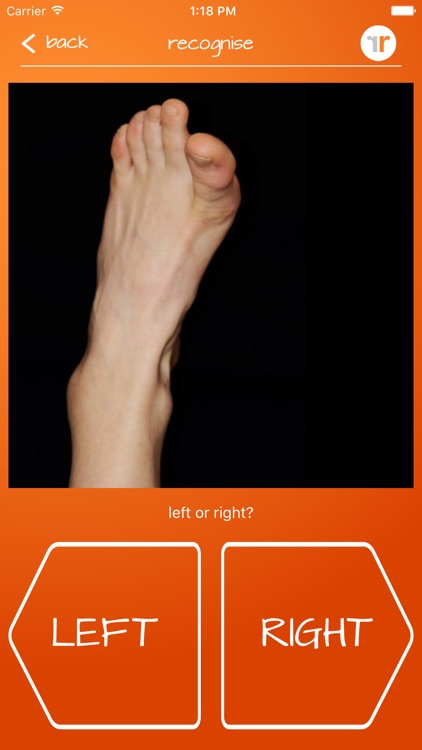
When I see a patient experiencing chronic pain of their ankle, I'm using an app created by the NOI Group called "Recognise Foot" (yes, spelled that way, because they're Australian and they don't like the letter Z).  The app shows you pictures of a foot and you have to identify if it is a left or a right one.  (They have apps for several different body parts).  You can change the settings to start with fairly simple images like this one --> with a black background in typical positions to more complex images with varied backgrounds that are covered in paint or wearing a cast or flipped upside-down and it's basically like playing a game to see how fast you can identify the side of the body and how accurate you are.  I've tested out the app for the hand (Recognise) and the app for the foot (Recognise Foot), each of which are $5.99 at the App Store.

A normal result would be at least 90% accuracy and symmetry between sides as well as response time of less than .2 seconds.  The app will tell you your scores and you can use it to assess the patient's ability to discriminate between left and right as well as treat them using the app. I've been adding this as a home exercise program component to patients who have been experiencing chronic pain and having them "play the game" several times per day in addition to doing some activities to try to get them moving towards less pain. 

A word of caution: the GMI Handbook does say that some people will experience pain just from using the app. This is not something I have experienced yet, but if it does occur, there are ways to change the settings on the app so the patient has more time to respond or less images. Also you can actually regress from this to watching other people move, focusing on the other person's body.  For example if your ankle pain was increased just by using the app, you could go to the mall and watch people walking and focus on their ankle instead.  There's science to support this regression and the book talks discovering this using monkeys who would watch people eat and some of their own brain cells that would be activated if they were eating would "light up" as if they were doing the activity themself. It's a less intense way for your brain to process information, watching someone else do an activity, because of the ways the sensory and motor cortexes of the brain are uniquely used with watching versus participating in activity.

Ultimately, GMI is a science that is still developing.  There is research to support some of the claims, but not all of them and the NOI group points out where there are holes in the evidence.  There is evidence to support using this treatment in specific patients, such as those with CRPS, and less evidence for others.  Some of my colleagues are using this treatment more frequently and with patients in more acute pain states.  Some colleagues don't use it because they don't know anything about it - like myself only a few months ago. The app is actually pretty fun and if you don't have pain doing it, who wouldn't benefit from some brain training?  I'm tempted to see if the basketball players I work with have any change in their reaction time by using this sort of brain training to try to use if for performance enhancement, but again, I have no evidence to support that thought and can't usually use them as guinea pigs.  I'm curious to know who else is using GMI in their clinical practice, how often, for what conditions, and what others have found with using it.  And I highly recommend that PTs read this book to learn about where we are on this type of patient care right now and to see if it might help some of your patients.  

Monday, January 20, 2020

What Do Physical Therapists Do? Installment #6: We Critically Appraise Research

Link
I'm long overdue for another installment of my "What Do Physical Therapists Do?" series.  I've previously written about the PT role in emergency response, return to sport participation, strength training, therapeutic alliance and listening, and assess biomechanics.

Have you ever seen a toothpaste commercial saying "100% of Dentists Recommend that particular brand?"  Do you think to yourself, 1) "Ooohh, I should go buy that right now!?"  Do you wonder, 2) "Would I like that flavor?"  Do you consider,  3) "I wonder if they surveyed one dentist or 1,000 dentists to get that outcome?"  Or do you 4) just let the commercial come and go and ignore it entirely?

I'm very particular when it comes to all things related to teeth... I hate when people walk around brushing their teeth, I can't stand the sound of the electric tooth brush, I gag in response to watching others floss in my presence. I can't understand why they made cinnamon or grape or bubble gum flavored toothpaste when it's clearly meant to be mint-flavored. Only. And chocolate with mint has been ruined.  Tragedy.  Today I'm giving these commercials more thought than they deserve.

I think that many people probably just follow option 4, completely ignoring the commercial and moving on with their show.  But that path ignores that behind that advertisement, there was some amount of research done, data was compiled, and the information was put out into the world for you to interpret.  So the purpose of this blog post is really about choice number 3) "I wonder if they surveyed one dentist or 1,000 dentists to get that outcome."  This isn't where my mind automatically goes, but it's the way that scientific research needs to be considered.  And it makes me nervous to think that there are physical therapists who don't read any research at all - or who read a paper but then ignore the findings entirely.  Just like option 4. 

Let's say you're a physical therapist and you're working with a patient who recently sprained their ankle.  What does the research say is the best thing to do for this patient?  Did one physical therapist present a case study that you read and you're taking their word for the best approach?  Have you, yourself, done a treatment with a similar patient before and found that it worked so you now think it's the best option for everyone with this condition?  Is there a journal article that says to do certain things, but other papers that show the opposite information?  Were the research tests done on a teenage male, like the patient you're working with, or were they conducted on a group of women in their 40's... and does that matter?  These are just the beginning of the thoughts involved in using Evidence-Based Practice in medical care and show why this is so complicated.  What does the research say?  What does it actually mean?  Is it clinically relevant to your patient? 

I've previously written about the changes that healthcare is experiencing here, but in that post, I didn't give enough credit to the transition in healthcare to more use of evidence-based practice.  I think use of research to support the decisions made with patients is very important, but I also find it to be incredibly difficult.  The example above with the patient with the ankle sprain is just one possible scenario out of tons of different ones to see in the clinic.  There isn't research to support all of our decisions, and even if there was research covering all aspects, there's no way I could ever read it all.

For myself, I work in pediatric orthopedics.  In a typical day, I will see eleven patients.  No two are the same, even if three of them are recovering from ankle sprains.  My job limits me to seeing patients between ages 5-21, which is far more restrictive than most people who work in an orthopedics setting.  But research on kids is often lacking, so to try to make decisions for kids based on research in adults tends to happen a lot.  I know that it may not be accurate - but I also know that I don't have anything else to base my decisions on.  While there is an increase in research available for teenagers with ACL tears, there are many conditions and treatment approaches that have not been well studied with matching characteristics to my patients.  And, again, even if I had all the time in the world and devoted it to reading, I could never read all the papers and really know what all the researchers recommend to make the most educated decisions possible.  So we work to make our best decision and review the literature as much as possible, and this requires the ability to critically appraise the literature.  Reading the papers is only the first step.  Understanding their meaning is even more complicated.

I mentioned in my last blog post (here) that I recently launched the Seattle Children's Hospital Sports Physical Therapy Journal Club.  So far, this project is in its infancy.  To get it started, I was advised by several physical therapists working elsewhere who already participate in a journal club to start by focusing on papers that help you critically appraise literature.  I followed their advice, but had to start with learning more about what that even meant. 

Journal of Sports Physical Therapy
According to the Center for Evidence Based Management, "Critical appraisal is the process of carefully and systematically assessing the outcome of scientific research (evidence) to judge its trustworthiness, value and relevance in a particular context. Critical appraisal looks at the way a study is conducted and examines factors such as internal validity, generalizability and relevance."  The Journal of Sports Physical Therapy (JOSPT) has been publishing a series of articles to help Critically Appraise Scientific papers here and as I've been reading through them and collecting information for the journal club, I've been finding that 1) the topic of critical appraisal of the literature is not very interesting, and as such, I have never previously given it much consideration to learn as a skill and better question the research I'm reading. Lack of interest is a poor excuse for something this important.  I'm also not interested in gymnastics, but I work with gymnasts so I need to take an interest in it to sufficiently work with that patient population. 2) There are a whole lot of ways for a scientific study to go wrong - without the researchers having that intent or despite their efforts to avoid it.  Things like bias, blinding study participants, misunderstanding confounding variables or inclusion and exclusion criteria for subjects, insufficient sample size, improper use of certain types of statistics, lack of awareness to the true definition of terms and what they mean in a scientific setting, and I'm sure more ways that I don't even know yet. 3) Research is super complicated and cannot be taken solely at face value.  Simply reading an abstract and the conclusions of a paper can be incredibly misleading if authors have put a spin on their findings or if the methods of the paper are ignored.  Critical Appraisal requires thought, analysis, interpretation, and questioning.  

As clinicians, I think learning about how to appraise the literature is something many of us need to do better.  As physical therapists, many of us did not have to go through the full research process to get to our clinical status.  This may be a shortcoming of our learning because too many of us are not considering whether or not the findings of a study really mean what is presented and whether or not a lab study actually applies to the clinical setting.   It seems like a lot of research principles come from the pharmaceutical world.  If a medication is provided to 100 people and nobody dies and an abstract for the paper says it saves lives, that is a misrepresentation of data.  What if the methods show that the criteria to select the participants in the study excluded people who would really need that medicine?  What if they only tested the medicine on people over age 75 and you work with children - would it also save them?  What if, when the study is expanded further to maybe 1,000 people, there are deaths in the bigger group?  This is a call for us all to be better about consideration of the research with a healthy skepticism towards methodology and interpretation.  

So the next time you want to do a treatment technique on a patient, have you considered the literature supporting or refuting the efficacy of that approach? This could be anything.  Dry needling.  Massage.  Cupping.  Specific types of exercise - maybe yoga or pilates.  Stretching.  Strength training.  Breathing.  Biofeedback. Foam rolling. Desensitization.  We have a lot of tools available to us - many with different levels of support in the literature. And have you looked to see if there is a paper that suggests outcomes to the contrary?  What do you think is the best option for this specific patient?  I'm struggling so much to read papers that, for example, suggest that manual therapy is no better than exercise.  Some patients really do seem to need manual therapy.  There are lots of papers that suggest it isn't useful, and there are also whole institutes, like the North American Institute of Orthopedic Manual Therapy (NAIOMT), who have evidence to support the exact opposite. A paper cannot study every circumstance, so the setting and the patient demographics and pathological condition have to be considered. 

I'm hoping this post just encourages you to question how you use research and evidence-based practice, which you should definitely be doing, and perhaps you can teach me ways to more critically appraise what I'm reading.  We can all get better at doing this.  And we can all hold each other accountable to be better clinicians. 

Wednesday, February 13, 2019

Conflicted

Hey everyone.  This past week I've been conflicted with something I use in my patient care.  Conflicted enough that I've brought up this conversation with my coworkers and a close PT friend and it's still weighing heavily on my mind. So now it's here for others to read and comment on. Please send your thoughts, fellow PTs.

There is a physiotherapist out of the UK named Adam Meakins who posts regularly about various physical therapy topics including issues with the profession, our techniques, and our shortcomings. He goes by "The Sports Physio" and has a very respectable social media following: 54.4K twitter followers and 76,000 followers on his blog... compared to my 270 twitter followers and 9 blog followers (plus my mom).  I present these numbers for the sole purpose of demonstrating that he's a well-known PT.  I have followed him and read his materials for about a year and have come to find that he challenges my thought processes, which is essential for my growth, though sometimes is hard to swallow.
ID 2530204


In the past week, two physical therapists who I respect - but also occasionally differ in opinion with - have mentioned Adam Meakins. One of them linked to a video Adam posted on Facebook which he further discussed in this recent blog post and he was also interviewed on this podcast about a different subject - so he's just come up a lot more this week than usual and his messages have been on my mind.

This post is not meant to be an attack on Adam.  He works hard to improve healthcare and physical therapy practices - noble efforts with messages I often agree with.  He expresses his perspectives confidently in an unapologetic abrasive manner that has a certain appeal for getting his message across.  (AKA - there's no bullshit.  He tells it like he sees it.  I love this about him.) He's a physio and he's trying to help people live healthier lives doing the things they love to do... so I respect him. I have never met him in person (yet), but I do pay attention to what he's posting because I think his perspective is really valuable, even if mine differs, like it does right now.  I wonder what it would be like to shadow him treating patients for a day.

The blog (and video) he posted discuss the use of palpation (evaluative touch) and how we present our findings to patients.  

Adam listed multiple studies as his references, many of which I have now read, which report that either more research is needed or that palpation techniques are not reliable. To my knowledge, there are not many papers that say the opposite, and my skills of critically appraising research are certainly inferior to Adam's, but this paper contradicts the research presented in Adam's blog post.  I had to search to find that one.  I searched because I have found multiple occasions where someone has told me to do something with patients because they read an article about it - and I was able to find multiple publications that stated the opposite information.  So when I read his post and immediately felt like it didn't sit right with me, I had to do some searching. Maybe I don't understand his message properly.  Maybe I'm too biased to see through my own thought processes.  Regardless, I am conflicted.

Adam points out that physical therapists are not good at palpating things like "knots" or "trigger points" or "tight bands" or "joint play at the spine" and that we are not consistent between providers or even consistent with our own practices.  In non-medical terms - if you smell pizza in the morning and identify that it is, in fact, pizza - but in the afternoon smell the same exact thing and identify it as a cheeseburger, you're not being consistent with your own findings.  And to tell someone that you have a cheeseburger when it's actually a pizza could be confusing or problematic.  Scientific research says that physical therapists touch patients to evaluate them but report different findings. The research also says that we cannot identify if parts of the spine moves abnormally or identify which level of the spine we're touching with consistent results.

Now... when I palpate a patient and feel like a segment of their lumbar spine feels hypomobile, I agree with Adam that it makes no sense for me to state the specific level of the spine to the patient, because I don't have XRAY vision to know I'm 100% accurate and, working with kids, it probably doesn't have much meaning to them anyways.  I worked with a patient with neck pain today and, as I've previously mentioned, I currently have a student.  So when I palpated a segment that I thought was hypomobile (and reproduced the patient's symptoms), I relayed to my student that she should look around where C3 would likely be because I can't actually be certain that it is C3.  I think it is, I'll document it as such, but the reality is - I don't actually care exactly what level it is.  I feel something, it reproduces my patient's symptoms, it's where I want to treat.  I don't know how I could have better directed my student to what I found for her to feel it herself, but the patient felt relief with mobilizations at this region.  Adam's post suggests that this confirms my bias to this being a useful technique.

Maybe it's more about the way the care is interpreted and explained to the patient than the actual identification of specific structures and the interventions that are applied that Adam has a problem with.  I agree with him that we really need to STOP TELLING PEOPLE their L5 is rotated or their back is out. What does it mean for you to throw your back out?  That is not medical terminology.  Can your back ever be in?

But... when I palpate, particularly at the spine, I do feel "something." Of course I'm biased on my opinion of my own patient care...it would be wrong of me to use interventions that I did not believe were helpful and, since I also manipulate the spine on occasion, I feel it is essential for me to use palpation to identify hypomobile segments of the spine.  I feel hypomobility in some regions compared to other regions in the same person.  While I don't generally compare spinal mobility person to person because I don't find that useful, I do correlate certain patient responses with what I'm feeling in soft tissues in my hands and compare that to what I've felt with others.  If a person laying on the table in front of me presents with a neck that is tender to palpation and their cervical and thoracic spine feel stiff compared to their lumbar spine, I want to treat this issue.  Maybe with manual therapy.  Maybe with exercise.  Maybe with both.

I used to do things very differently.  I no longer say to my patients, "Wow your neck is really stiff," or "Your 1st rib is stuck"- though I do sometimes feel a stiff neck and a hypomobile first rib... which I treat.  I don't say these things any more because it freaked out the patients.  They'd worry about their rib being a problem.

I used to look at the pelvis and tell patients that they had one leg longer than the other. All the time.  Guilty. I didn't know better, then! I used long axis distraction of a leg to distract the hip while simultaneously re-aligning the SI Joint.  That's what I truly believed.  I'm telling you that I used to regularly yank on people's legs. Maybe as often as daily. Wanna know why I did it so much?  Because sometimes IT ACTUALLY WORKED.  And they felt better.  And that's a bit of what Adam Meakins is saying... that we can be convinced that the care we're providing is beneficial, even when it is not supported by research. I eventually learned that it didn't work as much as I thought it did.  It didn't help enough people.  It could have been harmful to the patients and I constantly felt like I was doing something to patients to try to fix them rather than guiding them towards ways to fix themselves.

Humans can't be symmetrical if we have hand dominance and we move to get in and out of a car in the same way all the time but less frequently on the other side of the car. Our heart is not centered in our chest cavity.  There is only one spleen and one liver and they're not in the middle perfectly symmetrical....  So while Adam Meakins is practically pleading with physical therapists (and hopefully chiropractors and physicians) to STOP telling our patients that they have anatomical problems that are probably not actually problems, and I agree with that message... I still feel "something" when I palpate the spine.

If patients ask, I now use an explanation about the nervous system having a reason to try to protect that particular region of the body and that by using load management strategies, it may calm down. I explain that "hurt does not equal harm"... that the tissues of the body may hurt even though damage is not occurring.  The body uses pain to protect itself.  And then I give a home exercise program to guide them on restoring motion, strength, or function based on what I determine the patient needs... which I did by using palpation.

I remember sitting in PT school and being taught how to palpate the multifius and the transverse abdominus musculature to assess if they're contracting.  I could never feel the multifidi.  Never.  And then the PTs at my first job out of PT school encouraged me to focus on assessing the multifidi in various positions and using abdominal bracing and using electric stimulation in conjunction with abdominal bracing on my patients.  I tried to use that.  But I could not feel it.  This is what Adam seems to be describing but relevant to palpating the spine.  Is it possible that we have different skills with regard to palpation?  Is it possible that while I cannot feel the multifidi, I could feel hypomobility at the spine?  Is it possible that the issue is not about what we identify, but more in how we express it to our patients?  We are definitely impacting the beliefs of the patients we see.

The podcast interview goes a bit more into the discussion of the narratives that physical therapists (and healthcare providers) present to their patients and how this can negatively impact them.  I like that Adam states in the podcast that removal of pain is the wrong way for PT to be going as a profession.  We need to be empowering patients, give them realistic expectations, and help them operate within the constraints that their individual bodies allow.  The goal should be developing resilience and tolerance - not elimination of pain.  I agree with Adam on all these points.

I also agree that we are over-treating patients.  Too many visits.  Too many referrals from person to person rather than really understanding what's going on.
I also agree that the medical system doesn't operate in an ideal fashion.  Insurance companies limiting treatment influence the care that patients get.  This is wrong.
I also agree that sometimes the best treatment for a patient is NO TREATMENT.  I recently was working with a patient who was seeing so many different providers that I just sat her down and told her - I think you're trying to find too many solutions to a small number of problems and can't follow a single path to your recovery.  I recommended that she sit down and write a list of all the people she had been seeking answers from, and pick the one that she wanted to commit to.  Who do you believe is helping you?  Follow that person.  Get rid of the rest of us.  Everyone telling you different things is confusing and ineffective.   I don't actually care if physical therapy is her solution.  The best solution for every patient is the one they buy into and helps them find a way to get back to their function.  Period.

Even as I write this, I'm feeling my thought processes shift about what I say, but I"m not ready to throw away palpation yet.  I like that I'm trained to provide spine manipulations and have had some really great results using it. I use it selectively and in conjunction with movement.  And so, I'm unwilling to throw away a tool from my toolbox that I sometimes find essential.  At least for now.

Take Home Message: There are lots of really good physical therapists out there, many of which are creating content that is easily accessible and easy to apply.  The messages differ between them.  But patient populations differ and you have to believe in what you're selling to your patients.  I believe in a little Mike Reinold and a little Lenny Macrina and a little Lorimer Moseley and a little Adam Meakins and then I add some strength and conditioning with Eric Cressey and a little breathing from yoga practices and a little mental health... and I'm my own unique clinical provider because of all those influences... which is why I keep writing about all of them!  So use a variety of backgrounds and consider opposing opinions, try out different techniques, challenge your own beliefs and welcome growth along with failure.  Feel free to tell me if I'm wrong... I may not like that, but I'd like to think I'll be respectful and consider the alternatives.

Above all else - Do No Harm.


Sunday, June 3, 2018

What Do Physical Therapists Do? Installment #4: We Return Athletes to Sports Participation

Welcome to the fourth installment of "What Do Physical Therapists Do?" I chose to use this as a recurring segment because there are several common misconceptions about what we actually do, probably because we do so many different things! This 2006 paper noted that over 1/3rd of participants surveyed (college-aged potential physical therapy students) were unaware of PTs' ability to help decrease pain and promote health. That same paper mentions the lack of knowledge of the general public regarding the amount of education required to be a physical therapist and what that training would include. 

Overall, the key underlying action of a physical therapist is guiding our patients or clients back to their optimal function - whatever that function may be.  I often feel like people think our primary purpose is to help people get out of pain, despite the report from the previously mentioned 2006 paper.  While pain relief is a consideration, it's really more about the activities. So this recurring segment looks at various ways we help people get back to their chosen functional activities.  In the past, I've discussed that we strength train (#3) here, we listen to the needs of our patients (#2) here, and we examine body mechanics with different movement patterns (#1) here

One of the most common questions I'm asked by patients and their family members is "When can I get back to X activity?"  In this scenario, X can be anything.  Some are obvious functions or activities that aren't surprising... when can I run or exercise, when can I lift my toddler, when can I go back to work, when can I walk without crutches, when will I be able to reach the top shelf of my closet... an endless list.  Some activities have been less obvious (or less sensible)... when can I get back to head-banging at concerts was a surprising question I've been asked by a gentleman recovering from neck pain after a car accident.  It surprised me - but that's what he wanted to do.  And why a teenager who had a severe injury on a trampoline would ever want to get back onto a trampoline shocked me... but they ask! (Side note - if I ever have my own children, I hope to find a way to ban them from trampolines.  SO MANY injuries.)

The activities are frequently sports-related so it is a responsibility of a physical therapist to clear athletes to return to sports. This week, I was fortunate enough to present the new Upper Extremity Return To Sports Assessment that will be implemented at Seattle Children's Hospital to the Sports Medicine Team of Physical Therapists and Athletic Trainers.  The program we developed has not yet been thoroughly tested despite being based on published research, so it's still a work in progress.  It includes a group of tests to assess athletes who have had upper body injuries and/or surgeries as criteria to get back on the field/court.


Seattle Children's Hospital already has protocols for returning kids to sports after ankle and knee injuries, so we had a template to use of what has been helpful in the past.  I like using the lower extremity assessments because they make it easy for a kid and their family to understand that they can go back to their sports when they pass all their tests. There are benchmark goals that help them progress in activity as you go along so having a series of tests at the end fits into the way things progress along the way.  Using tests and goals motivates patients.  For example, with consideration for surgical protocols and healing timelines, I tell kids that they can stop walking with crutches when they can stand on their injured leg for 30 seconds with steady balance and when they can complete 10 straight leg raises without any bend in their knee.  Those are usually components of their home exercise programs and they often know if they're getting better and coming closer to meeting the goal. The goals help motivate them to work on their home exercises and they're measurable.

Did you know that if you are a healthcare provider - of any kind - and you clear an athlete to return to sports prematurely, you can be held liable if they get re-injured?  You can.  Did you know that a physician who clears an athlete back to their sports usually bases this on a tissue healing timeline whereas a physical therapist who clears an athlete back to their sports bases the decision on movement mechanics and other test criteria - such as the tests in this protocol - to make the decision?  Something I find interesting about myself as a healthcare provider is that I rarely tell a patient to stop participating in an activity if they're tolerating it enough - but when it becomes my responsibility to allow them to return to a sport that a physician has discontinued their activity from, I'm much more confident in my decision if they have to complete tests showing they're ready in a controlled environment.

A basic summary of the categories of tests included in the protocol for upper extremity injured athletes returning to sport are as follows:
1) Range of motion comparison between shoulders with consideration for the total arc of motion for internal and external rotation.
2) Strength testing comparison for shoulder internal and external rotation as well as for grip.
3) Endurance testing observing how many push ups can be done with proper form.  There are published normal values for this test by age and gender and, in the USA, this is part of the physical fitness testing conducted.
4) Upper body stability testing including the upper quarter Y Balance Test and the Closed Kinetic Chain Upper Extremity Stability Test
5) Power assessment using a seated shotput test.
6) Biodex testing as available.

Using numerous published papers on each of these tests, criteria were developed and the sports medicine crew at Seattle Children's will start to use the tests to determine if kids are ready to go back to their activities.  There is still not enough published evidence for returning athletes to sport from any injury, so developing a protocol like this is not only challenging, but needs to be supported by clinical judgment.  If you or someone you know is being treated by a physical therapist to get back to playing sports, you should ask them what criteria they use to determine if you are ready.  Feeling good and being pain-free isn't enough and we want to prevent future injury as much as possible.

Tuesday, May 8, 2018

Book Alert: Explain Pain

This lengthy post begins a series of posts exploring pain science based on my recent completion of Explain Pain, Explain Pain Supercharged, some articles on Pain Science, this TedX pain talk, and the upcoming visit of Lorimer Moseley to the University of Washington. If you're currently experiencing pain - or have ever had pain - buckle your seat-belt for this adventure.

Since my job change about a year ago, I've started seeing more patients with chronic pain - some diagnosed with conditions such as chronic regional pain syndrome (CRPS) or fibromyalgia - others coming in having had unsuccessful rehabilitation or where symptoms have progressed from something small into a loss of function.  While it seems that I'm working with more of these patients, the alternative perspective is that I've been spending a lot of time learning about pain, so perhaps I'm just recognizing things differently than before.  I can easily recall patients earlier in my PT career who likely would have benefited from pain education, but I didn't know it at the time.

Regardless of diagnosis or level of function - emotionally, I am sad for these patients, particularly when it's a kid.  A child who has had pain for months and has started to lose function or interest in activities because of their pain starts feeling hopeless about their future. This can be pain that has debilitated kids so that they cannot attend school or play their favorite sports or adults who can't tolerate their work day, ultimately losing income. Having recently learned about the positive benefits of teaching people about how pain works, I feel an obligation to guide these patients down the road of pain science.  This is a world that I am new to and have spent a lot of time learning about - only to discover that I have a lot more learning to go.   For example, I'm learning about the impact of the words I use to describe to a patient why they are hurting - and changing how you explain things is  a big challenge.  What I quickly learned was that physical therapy is the right place for people experiencing chronic pain, helping them find their way back to function even if it isn't their optimal level or their prior level of function.  One of my favorite things about being a physical therapist compared to most other healthcare professions is the regularity at which we interact with our patients and, because of this, the relationships we develop.

In my search to learn more about working with patients experiencing chronic pain, some of the themes I've come across are simple but vital:

1) These patients need to like their clinicians.  If we can't relate or connect, we'll have no impact on guiding them through their pain journey.  Fortunately, most of the kids find me funny... or at least funny looking... so they get comfortable working with me. On my neurological rehabilitation rotation in PT School, my clinical instructor sat me down and said "What you lack in knowledge, you overwhelmingly make up for with your personality."  She basically told me I was dumb, but that patients will like me because I can connect to them.  I like to think I've gotten smarter - but that my personality hasn't changed. 

2) Listen to the patient! They often tell you a lot of hints to help understand their pain experience so you can break it down. Also, many times, patients who have had pain for a long period of time have seen multiple healthcare providers and already know certain techniques that have not been successful for them in the past.  Why would you repeat that approach if it has already failed?

3) Based on the biopsychosocial model, pain is far more complicated than solely focusing on body healing processes, and if we don't give enough attention to the psychological components of pain, we're neglecting a major piece of the puzzle.

I've previously written about my interest in learning about chronic pain in relationship to the hip hinge course  as well as the chronic pain presentation I attended at Seattle Children's Hospital. I'm just touching the surface of my chronic pain learning. Today I'm focused on  this paper: A pain neuromatrix approach to patients with chronic pain - G.L. Moseley 2003 as well as his book with David Butler, Explain Pain.

In the journal article, Moseley describes assessment and treatment recommendations for patients with chronic pain.   He starts by defining "pain is produced by the brain when it perceives that danger to the body tissue exists and that action is required."  Studies have shown that there are multiple regions of the brain that release a pain signal, collectively referred to as the "pain matrix" but that these regions vary from person to person.  The brain holds an image of the body known as the "virtual body" which is constantly updated by interacting with the environment.  When pain persists, the virtual body adapts, often becoming more sensitive, so that less danger inputs are needed for the body to recognize threat level.

What do you do when this occurs?  The paper recommends treatment options with key focus on
"reduced input of threat," particularly pain education.  The more a person understands how pain works, the smaller impact pain has on their function.  If you have been experiencing pain, it may help you to learn more about how pain works.  Check out this entertaining Ted Talk for an introduction to pain science.  In the clinic, patient education using multiple forms such as pictures or metaphors or videos and not focused solely on anatomical considerations are necessary.  It is helpful to ask a patient what they think is causing their pain, and if they focus on an anatomical cause, to help them understand alternative narratives to explain their condition.

In addition, treatments need to toe the line of challenging the patient without overstimulating their pain matrix.  Body movement is beneficial, but the loading needs to be done in a progressive manner along with education.  The paper suggests finding the baseline amount of activity that is tolerated without increasing symptoms and making numerous small progressions rather than overshooting the level of tolerance.

The article (and some friends) ultimately convinced me to read Explain Pain, by Lorimer Moseley and David Butler.  Explain Pain is a book written to help the general population understand pain.  It is reader friendly and has cute illustrations that are helpful in simplifying the complexities of pain science.  Some key takeaways from the book:

1) The amount of pain you experience does not necessarily correlate with tissue damage.  It is possible to have pain without any tissue damage at all.  It is also possible to have extreme levels of tissue damage without having any pain.  Phantom limb pain - pain where a limb has been amputated and no longer is attached to the body - illustrates that pain does not correlate with tissue damage, as there is no tissue present to elicit a pain response.

2)  Pain depends on numerous factors and the brain decides whether or not something hurts, without exception.  Pain relies on context.  Signals go to the brain for processing and the brain weighs out these signals to determine if the body is in danger or not.

3) All pain is real.  All pain is normal.  It is a useful protector for your body.  As such, it should be respected - not feared.  It should be validated and considered in treatment programs.  And it should be considered an individualized experience where each person needs separate treatment to recognize their own pain response.

Once I read these resources, it triggered reading others.  More on them in an upcoming post.  For now, I hope that someone who is experiencing pain reads this and learns one thing that may help them with their pain.