Showing posts with label Lorimer Moseley. Show all posts

Tuesday, December 26, 2023

Zoe and Zak's Adventures to meet the PNW Trolls

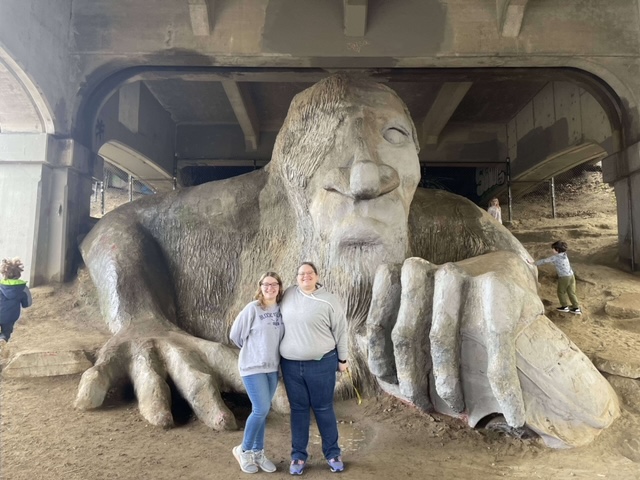
With my niece, Zoe, at the Fremont Troll
A few months ago, I was scrolling my social media when I came across a post announcing completion of the installation of five Dambo Trolls in Washington. These trolls are large pieces made from recycled materials designed and constructed by Danish artist Thomas Dambo. An unrelated troll has resided in Seattle under the Fremont Bridge since 1990, originally intended to deter homeless people from living in the area, which was a few blocks from my apartment when I moved here. I took many visitors to mee the 18-foot tall Fremont Troll sculpture, but didn't know if trolls had any significance to the area. Washington is more associated with Sasquatch (AKA Big Foot), and my research has shown that trolls aren't really connected to the PNW, but these new masterpieces seemed interesting, so I decided to visit them. 

1990's Troll Toy
I also decided to learn more about the history of these fantasy creatures. I remember liking The BFG (The Big Friendly Giant) by Roald Dahl, who wrote my favorite book, Matilda, but have no recollection of reading tales of trolls. My brother used to have a collection of trolls when we were little, with the famous neon pointed hair and gemstone belly buttons.  Interestingly, those troll toys were invented by a Danish man named Thomas Dam, and these led to the creation of the Trolls movies that star Justin Timberlake and Anna Kendrick. I couldn't figure out if Thomas Dam was related to Thomas Dambo, but those names are way too much of a coincidence if they're not family.

According to Wikipedia, Trolls come from Nordic Folklore and Mythology and the word has a few different possible meanings including fiend, demon, or mythical magician. Trolls typically live in isolation, in forests, mountains, or caves, and Dambo shared that his installations use recycled materials to help the planet and bring people outside to visit nature. He's creating a "bridge between cultural and environmental stewardship." As I read more about trolls, I thought about childhood adventures and fantasy tales, but the isolation so frequently depicted also reminded me of some of my patients with chronic pain. I frequently work with teenagers experiencing chronic pain or illness, and it's common to see them isolate as their condition worsens, transitioning into a period of hibernation.

Zoe and Zak's Pain Hacks
I decided to write about the five trolls along with a review of a new children's book series written by Dr. Joshua Pate, an Australian physiotherapist, called "Zoe and Zak's Pain Hacks." (Link to buy in the US.) Dr. Pate has written a TED talk called "The Mysterious Science of Pain," that's a great five-minute video clip.  
I first learned about Dr. Pate and his work with kids experiencing pain in November 2021. While preparing to give a talk to coworkers at Seattle Children's about treating kids with chronic pain, I couldn't find research indicating what age kids start to understand the pain neuroscience concepts recommended by the Explain Pain Books so frequently shared with adults. I tweeted what I was searching for, and Dr. Rachel Zoffness came to my rescue. 

Not only did Dr. Pate send me a copy of his (soon to be published, now available in a book) chapter called "Developmental Influences on the Meanings of Pain in Children," he offered to meet for a Zoom chat. He was very kind to spend an hour chatting with me about the work he was doing and that he had this series of children's books coming out soon. His research, and there's loads of it!, determined that kids start to understand pain concepts around age 8, and he also explained how he conducted some of his research and some of the interesting things he had discovered. I found his reference to this paper where children were asked to draw whatever the word "pain" made them think of particularly memorable. Dr. Pate found that in his small sample of kids, those who were experiencing chronic pain drew emotional components like a broken heart or tears, which kids who did not have pain did not draw.  
Pia the Peacekeeper
The boxed set of books arrived at my home soon after our call and I read them right away. They're beautiful and fun to read, despite being about pain. I started to write a blog post about them way back then without the trolls, but the post felt like it was just me spitting out pain research and I prefer to write my posts connecting different thoughts, so I stored the books on my shelf, alongside my other fabulous pain nerd books, until the epiphany came to pair the books with the trolls. So here's Zoe and Zak Zoppins on their adventures with me as we met the PNW Dambo Trolls.

The first book in the series is called "Zoe Zoppins Nails It." It tells the story of "A Tale of Two Nails." Zoe's Uncle Ozzie steps on a nail and has intense pain, only to later find out that the nail went between his toes and didn't injure his foot at all. This story is commonly used to show that pain doesn't always equal tissue damage, and the illustrations and rhyming make it easily understood even at a young age.  The first troll we visited was located on Bainbridge Island, across the Puget Sound just a little bit west of Seattle, and is named Pia the Peacekeeper. Located on Salish territory, the Muckleshoot and Snoqualmie tribes collaborated on the development of Pia. These trolls are quite massive, and I had an immense appreciation for the size of their hands and feet. Having Pia hold the book was the best way to demonstrate the scale, but of course my nerd thoughts went to the homunculus and how much sensory input these trolls would have from their massive hands.
Frankie Feetsplinters

Second in the series is "Zoe Zoppins Lights It Up" which is based on this research from Lorimer Moseley, author of the previously mentioned Explain Pain Books and mentor to Dr. Pate. This study examines pain under different contextual circumstances. Zoe is tapped on her hand by a cold metal rod and rates her pain when there is either a blue or a red light shining in the room. When the blue light shines, the pain is less intense, but when the red is illuminated, the pain increases. I wonder if Dr. Pate chose this book to have a blue cover because of the storyline. Similarly, I recently participated in the 30-day course The Embodied Clinician with Sheren Gaulbert who I met at the San Diego Pain Summit. We also discussed the relationship between colors and emotions, so naturally I sought research on this topic and found this paper, which suggests this science is in its infancy, but that red has been studied and found to relate to increased attention and outward focus and potentially has an impact on performance. 

Jakob Two Trees
The second troll I visited was Frankie Feetsplinters who lives in Ballard, a Seattle Neighborhood that houses the Nordic Museum. It makes sence that this would be the location for one of the trolls, as the Nordic countries include Denmark, home of the artist. Frankie was the last of the PNW trolls to be installed and was assembled in West Seattle and transported on a flatbed truck to Ballard. The blue-grey skies of Seattle and the more welcoming pose of this troll were certainly not scary. I've never actually gone into this museum, but I hear great things about it and have tickets to check it out in early 2024. (Seattle pals - you can get free tickets to many museums through your library card or directly through the museum! The Nordic Museum has free tickets on the first Thursday of every month).

"Zoe and Zak's Brainy Adventure" is the third book in the series.  I think the illustrations in this one might be my favorite from the set, though the art is really great for all of them. This story explains the numerous messages that are sent and received when an injury occurs and how quickly they're processed, all contributing to pain which is meant to protect us. In an acute pain situation, the protection from pain is helpful, but in a long-term situation when the pain persists, it can become over-protective. This story shares many Explain Pain concepts, like "Pain does not always mean tissue damage." It uses virtual reality to explore the brain, though it doesn't go into detail about how virtual reality can be used for pain - maybe that will be in the second series if Dr. Pate keeps writing these! The third troll I visited was Jakob Two Trees, located in Issaquah, who is simply magnificent at 14-feet tall. I think Jakob was my favorite troll - a short walk among the trees that protect you from the rain, just like pain is protecting our bodies - but there were SO many people visiting, that it was hard to get a close-up photo. It was really fun meeting others who were Troll Hunting on these adventures. 

Oskar the Bird King
Book number four is "Zak Zoppins Retrains His Brain." Zak is Zoe's cousin who shares that he has back pain while they're playing. They discuss how pain can change and isn't permanent using different strategies such as calm breathing and imagery to re-train the brain when it's used to having pain for too long. This is an important message to use with kids with chronic pain because a lot of the time they're fixated on their pain being permanent and that there isn't any hope for it to get better. They're not yet exposed to slow and steady progress for most things in life and are more immediate in their thought patterns, particularly the younger they are. This book, along with the previous and next ones don't refer to a specific research paper, but rather encompass many studies about pain. If you search for "Retrain Pain," you'll come up with several papers, including an online company, that offers a certification for rehab providers which looks interesting (though I'm not familiar with it, so I can't recomend the program).

The fourth troll was Oskar the Bird King, located on Vashon Island. Oskar was the farthest troll from my house and of course it wasn't raining when I departed, but by the time I arrived, it was POURING. Typical Seattle. Oskar is the most intimidating of the trolls in the PNW, pointing at you and with eyes that seem to follow you no matter where you're standing. He's just as awesome as the others, even with the rain, but I didn't want my book to get wet! It's hard to tell from this photo, but Oskar is wearing a crown of birdhouses and sitting on a throne. There are actually birdhouses near the other trolls and Thomas Dambo's earlier work was to install birdhouses all around Denmark. He uses scraps of material from making the trolls to create the birdhouses and at some of the locations, they are painted and posted to indicate the troll is nearby. 

Bruun Idun with the whole set
The fifth and final book is "Zoe Zoppins' Action-Packed Action Plan." In this story, Zoe shares her action plan to use if she's having pain and applies it to different scenarios, like her belly ache when she's nervous about giving a speech in school or when she gets hurt playing soccer.  It's got some similarities to the previous book in that it's sharing some strategies that might be helpful for a kid experiencing pain and how to try to treat it. I particularly liked the focus on all the different activities that Zoe CAN do, rather than on things she can't because of her pain.  This is an approach I frequently use, encouraging patients to participate in whatever they can, particularly if it's fun, as the activities might help reduce their pain in the long-term. 

And the last troll I visited was Bruun Idun, located in the most scenic setting of the PNW trolls in a coastal spot of Lincoln Park in West Seattle. If you plan to go visit, you could take an easy walk from the parking lot, or you could have no sense of direction like me and turn it into a nice two-mile hike through the woods, culminating in a gorgeous view. Bruun Idun is playing songs for the orca whales living in the nearby Puget Sound. Music is one of the things that I often use with my patients with chronic pain as something to help them move and sometimes even let out their feelings.  We talk about matching music to moods, yelling along with songs that help them let out frustrations or crying along with songs that might also be sad. We talk about trying to go for walks that last the length of their favorite song as a way to incorporate movement throughout their day, potentially including the distraction of pairing it to something more pleasant if the movement is uncomfortable. And sometimes, I give patients the homework of listening to their favorite songs and coming up with lyrics that are positive for them to post around their house as a reminder of better days to try to bring hope and momentary happiness. Everyone could use more joy in their day, but sometimes when kids are sick for so long, it's really hard to find that. 

All in all, it took me three months, four ferry rides, and one very wet outing to complete my visits to all the trolls. Zoe and Zak's tales helped me to think about pain from a different perspective and taking them on adventures helped me to enjoy the PNW in the early part of this year's rainy season. I'm hoping to make a trek down to the Portland, Oregon Troll, Ole Bolle, who is 19 feet tall at some point, but of now, thanks for the good reads, Dr. Pate, and thanks for the beautiful artwork, Mr. Dambo.

Sunday, November 21, 2021

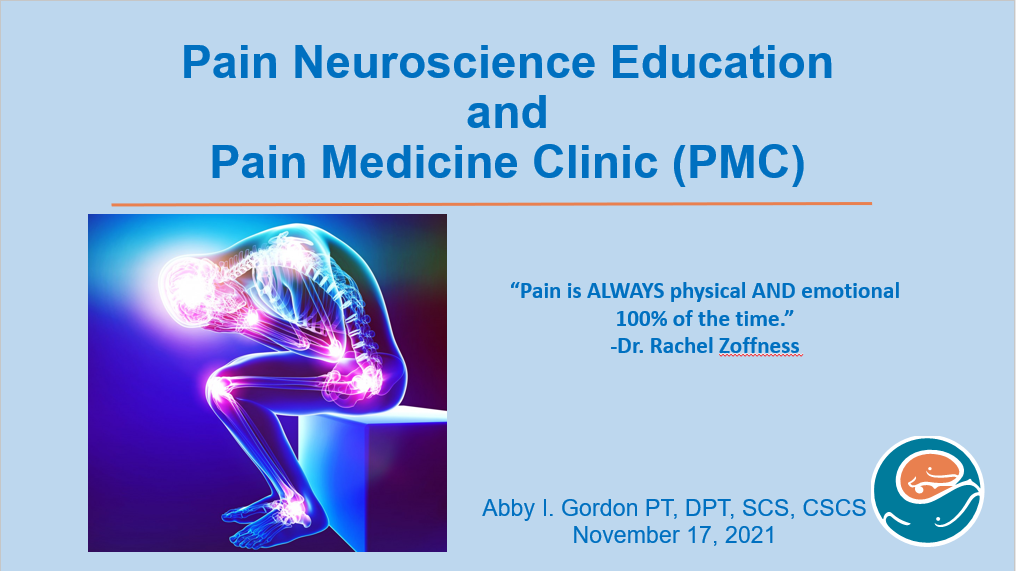
"Pain is ALWAYS both physical AND emotional 100% of the time."

As a Sports Physical Therapist at Seattle Children's Hospital and a member of their Pain Medicine Team, I work with many kids experiencing chronic pain. Most often, that includes seeing teenagers who can't tolerate going to school, hanging out with their friends, or participating in their favorite extracurricular activities. Sometimes it's even worse: kids who haven't been able to put a shoe or sock on (or walk) for many months because of chronic regional pain syndrome, which means a very long road back to their previous level of function.  Their pain could have started long ago with an injury or illness, and will hopefully improve with graded exposure to movement while learning about pain.  These patients can experience massive improvement in their lives if things go well.  I'm not crazy enough to think I can help everyone, but I've grown to embrace this work, including when I can't help my patients break their pain patterns.  To help kids with chronic pain with any success has required a commitment to collaboration with other healthcare providers and dedication to learning about pain neuroscience and pain management. To do that, I read. A lot. 

I also read a lot when I'm preparing to give a presentation.  This week, I was invited to talk about Pain Neuroscience and the Pain Medicine Clinic to the Seattle Children's Regional Rehabilitation Team. I like presenting because it requires me to focus learning on a specific subject and makes me seek out new resources. Educating clinicians is very different than patient care and it helps me consider my own beliefs, biases, and treatment approach.  I was fortunate to be partnered with Hematology/Oncology Physical Therapist Dr. Jacob Ross, who spoke about the intensive Pain Rehabilitation Program (PReP) where I sometimes refer patients when they need more care than 1 or 2 hours per week in my clinic will achieve.  If you're seeing Jacob at PReP, you're undergoing rehab or mental health or some school work Monday through Friday from 8AM-4PM for anywhere between two and four weeks! Based on this website, there are 83 pediatric pain clinics around the world, mostly (65%) in the United States, existing in 25 states plus Washington, D.C.  That means half of the states and the majority of the world doesn't have this available at all - and if you consider that the states who do offer these type of services only have it in a small number of places, tons of kids with chronic pain have no access to this care! In Seattle, I've worked with families from Alaska, Montana, Idaho, and Washington - and there are probably patients from many more places that my team members have worked with. 

If you're interested in learning about pain, I recommend you start with the work of Lorimer Moseley.  I've previously written about his books: Explain Pain, Explain Pain Supercharged and the Graded Motor Imagery Handbook, and I wrote about hearing him lecture and meeting him at the University of Washington, here. The NOI Group, who published those books, announced a new one coming out in December, "Pain and Perception: A Closer Look at Why We Hurt" which will be my next pain-related read.  From a different perspective, I also wrote about The Gift of Pain, which describes what happens when people are without the ability to experience pain. You don't pull your hand away from a hot pan or stop walking on a broken leg if you can't experience pain - a very dangerous scenario.  If you came upon this post looking to learn about pain management, any of those resources would be great places to start, but they're more about educating clinicians and, though they may be helpful for patients, I've now read a workbook more specifically intended for patients and think it's a great addition to this list.  

$19.95 on Amazon!
In preparation for our presentation, Jacob asked if I had heard of Dr. Rachel Zoffness. "Why yes, Jacob, I have. I follow her on all the social media and listen to her podcast episodes (OMG listen here or here or here or definitely my favorite: here), and I just finished reading one of her books."  The Chronic Pain &Illness Workbook for Teens was published in 2019 and was the first new resource I read for my presentation. Dr. Zoffness is a Pain Psychologist who teaches for multiple higher education institutions, she is the Co-President of the American Association for Pain Psychology, and she is on the Board of Directors for the Society of Pediatric Pain. Oh, and she treats patients experiencing chronic pain and has written two books. (She also wrote The Pain Management Workbook which I'm currently reading.) She's also released an $80 Workshop "Foundations of Pain Psychology" and more from that series are coming soon! Hopefully I'm not starting to look like a creeper because I've been fan-girling and re-sharing all her posts, podcast episodes, and books, so writing a blog about her work is probably the icing on the cake. When you find someone who can directly impact your patient care and knowledge, with easily digestible tools and clear, consistent messaging, I think you have to tell everyone.   

If this is your first time reading one of my blogs, you might not know that I write to organize and synthesize information I'm learning to refer back to or share with others.  Today's post starts with a look at a few of my favorite points from Dr. Z's Teen Workbook paired with information from two of the research papers I read for my presentation and it wraps up with a look at another pain management workbook from Dr. Greg Lehman. 

If you're a person living with chronic pain OR a clinician who works with patients experiencing chronic pain, in-person multidisciplinary care is the best treatment option, but that isn't available or affordable or feasible for so many people. The Teen Workbook could be a solution for patients who need something they can do independently.  It doesn't replace physical therapy or mental health counseling (or the many other treatments that may be appropriate and necessary), but it can certainly help educate patents and initiate behavior change that may be life changing.  

Jull 2017
1) Let's start with my favorite quote from Dr. Zoffness:"Pain is ALWAYS both physical AND emotional, 100% of the time."  This is the biopsychosocial (BPS) model at its heart and connected well to this image from Jull 2017 that I spent a lot of time discussing in my presentation. The Jull paper is a commentary on the BPS model and shows the idea that 3 different patients may have different amounts of biological - psychological - and sociological needs.  But also, the same patient at time 1, time 2, and time 3 has different amounts of these domain needs, too.  Today, for example, I might have a mild headache and I'm hungry but my mental health is good and I got to spend some time with friends so my social bucket has been filled, but my biological bucket may need more attention (maybe a sandwich for my blood sugar).  Tomorrow, I might have eaten enough for breakfast but be stressed about my pain presentation at work and spending a longer day at the office missing out on game night with friends - so my biological needs have been met, but not the social pieces that keep me going. You can't just look at your patient and think they only need biological care or mental health care at your evaluation and then assume it stays the same for all of their treatment.  I

The Workbook is clear about the role of the mind-body connection with regard to pain and explains what parts of the brain are involved.  It provides concrete examples, intentional questions for patients to consider, and a roadmap of strategies to try to better understand your own pain triggers from each of the three circles and identify solutions to try to reduce your pain volume.  Some of the pain books I mentioned above were really complex but this one is, without question, the easiest to understand and most user-friendly option for the general population, particularly when considering teenagers.  Too often the "Bio" portion is treated alone, with Physicians and PTs attributing pain to tissue damage or disease, but that (biomedical) approach ignores two major domains that impact the patient's presentation (Psych and Social circles). The unity of physical and emotional care is essential to patient success and Dr. Zoffness is screaming this message from the rooftops for everyone to hear.  I'm happy to amplify her message as often as possible to whoever will listen.  I actually ask my patients  "How's your mental health today?  Anything stressful going on?  When are your exams?  Have you done anything fun with your friends lately?"  If it's OK to ask them how their ankle is after they've sprained it, it should certainly be OK to also ask these questions.  Clinicians: please consider adding this to your day to day interactions with family, friends, and patients - and I don't just mean handing them the depression questionnaire and glancing at it.  Look them in their eyes and ask them how they're doing.  And mean it!

Tale of Two Nails
2) Metaphors, Analogies, and Stories help teach pain. It's no surprise that Lorimer Moseley is a mentor to Rachel Zoffness (and Greg Lehman) because they all use many of these to get their points across. I presented a few in my talk, also, but have a few favorites I use with patients.  One example that I liked from the Teen Handbook is about practice.  Think about an activity you wanted to learn. She uses playing piano, but I'm using basketball. At first, your hands struggle to dribble without staring at the ball and using your palm instead of your fingertips and the ball might bounce off your foot or miss the rim when you take a shot.  As a novice the task is more difficult and requires more effort and concentration.  So you practice.  And over time, you get better and better, until at some point, you've stopped looking at the ball and can run while handling it and can make shots from farther away and your form looks more consistent as it becomes automatic.  Your brain has developed new patterns that have been repeated enough times that the task is now easy.  With chronic pain, you're unintentionally practicing pain and your brain develops patterns that make it easier or more automatic to have pain.  The beauty of this is that with the appropriate treatment, the pain and learning can change.  Another example Dr. Z has written about, is "The Tale of Two Nails" which tells two really great stories that can inform our understanding of pain - but you should read those directly from her - so check out the article or buy her other book, because it's in there!

When Dr. Z is talking about practicing pain, she's explaining central sensitization, a phenomenon that I previously was struggling SO MUCH to understand. Central sensitization is a common characteristic of chronic pain, where you have an increased response to sensory stimuli resulting in hyperalgesia (increased sensitivity/bigger pain response to the same sensory input) AND allodynia (painful response to something that is normally not perceived as painful like hurting when you're touched by a feather on your skin.) Your nervous system changes when you experience pain for a long time. 

For my presentation, this 2011 Clifford Woolf paper depicts normal sensation compared to central sensitization.

Normal Sensation: On the left side there is an input - either something noxious (potentially dangerous - top) or a light touch (feather, bottom). Notice the black arrows for the top path (pain) and the bottom path (touch) don't converge and the brown blob (brain) is the same color as the rest of the  nerves.
Central Sensitization: Here, the same sensory stimulus occurs at the far left, but now the black arrows merge to the same destination (brain) and the color has changed because the system has adapted resulting in hyperalgesia and allodynia responses. 

3) It's a workbook: there are pages for you to do work.  This isn't just a book of education about pain. This is a guide with explanation of a key pain-related concept followed by actionable items to help improve your experience.  Sometimes I feel like patients who have had pain for a really long time are desperate for a physical therapist to DO whatever we can TO THEM hoping to dull the pain for just a few minutes.  What we really need is to serve as a guide, showing patients what THEY can DO on their own to turn down the pain.  They have to take control of their lives and do the work for any success to occur.  Physical therapists in chronic pain management should be cheerleaders, rooting on our patients as they make 1% progress day after day. People don't need to be 100% to live their lives fully, and often a really small amount of progress gets the ball rolling for a lot more progress to occur. I don't think patients realize how much control they have over their pain until someone empowers them to trust the process and themselves to get moving.  

Link

So, let's say you like the idea of a workbook and want to have multiple options to choose from, or you're an adult and want something a little deeper into the science. As I mentioned, I haven't yet finished Dr. Zoffness's other book, but I expect it might target that audience a bit more. There's another workbook I really like and was using prior to reading Dr. Zoffness's book. Dr. Greg Lehman's "Recovery Strategies" Pain Guidebook is available for patients or clinicians to access online.  I've previously written about attending his "Reconciling Biomechanics with Pain Science" course here and have appreciated learning from him both at the course and from his online presentations and social media. 

The workbooks are similar in their intent and both include key focus on the BPS model, describe how pain works, and provide action items for you to follow.  And both have many metaphors, analogies, and stories.  In particular I liked his metaphor for what happens to the brain with chronic pain: Consider that our brain is like a map of our body, and that a good map would be really clear, showing all the roads and rivers, but that with pain, things get smudged, almost as if you've spilled coffee on the map and the details get a little fuzzy.  The details of our body can get a little fuzzy with chronic pain, but with exercise and movement, we can clean up the coffee mess and the map gets clearer.  Overall, though, they're really quite different.  Dr. Lehman's book is written as a series of infographics, almost a choose your own adventure graphic novel, where you can take a single page out of it to educate your patient.  It includes pages of mythbusters, examining common misconceptions about various topics like "bones out of place," or how tissue damage found on imaging like an MRI doesn't always correlate with pain.  I think Greg's goes into more detail on how pain processes occur, looking deeper into the science of the nociceptive system, the spinal cord, and the brain, but he also acknowledges that it's meant to be used for patient and provider together because of its level of complexity. 

Also, I think that because Greg is a biomechanist, chiropractor, and physiotherapist, his handbook comes through from a more musculoskeletal lens. Though he fully emphasizes the BPS model, he's more from a bio background and gives adequate attention to the other bubbles.  Rachel is a pain psychologist who comes from a more psycho-social background, and thoguh she gives adequate attention to the bio, it's super interesting to look at their two workbooks and consider how they're trying to reach the same outcome for patients from different angles.  I think that patients would absolutely benefit from both. 

That's all for now.  December's blog post is about grief.  It's another long one and recommends several books on that topic, too. So if you're looking for holiday gifts that are books on pain, start with Dr. Zoffness's books - or if grief books might help one of your loved ones, there are several being reviewed next month.  Stay tuned!

TL;DR:

1) "Pain is ALWAYS both physical AND emotional, 100% of the time." 

2) Your nervous system changes when you experience pain for a long time.  This is called central sensitization which is characterized by hyperalgesia and allodynia. 

3) Teaching people about why we have pain and how the pain process works has been shown to help improve pain.  Multiple resources are listed to learn more about pain, often using metaphors, analogies, and stories to demonstrate complex concepts and make them more easily understandable.

4) The biopsychosocial model indicates necessity in attention to the biological, psychological, and social domains in treatment of chronic pain. 


Tuesday, February 18, 2020

Book Alert: Graded Motor Imagery Handbook

How is it already mid-February?  I swear each year flies by faster and faster... and yes, I realize that's a cliche thing to say.  I did some really fun volunteering earlier this month that took up my usual blogging hours, so I'm long overdue for a post today.  I'll be writing about those experiences soon, but today I've got a Book Alert on the Graded Motor Imagery Handbook, by Lorimer Moseley, David Butler, and their crew with the NOI Group.   The NOI Group is the Neuro Orthopedic Institute of Australasia that teaches a variety of topics related to neuroscience and pain.  I've previously written about their books Explain Pain and Explain Pain Supercharged as well as my experience meeting Lorimer Moseley here. You might call me a NOI Group Superfan at this point since I think I've read all their books, but not their research articles because there are hundreds of those.  Working on it.  This topic was fueled by my work with the Seattle Children's Hospital Pain Management Team, and every time I read one thing, I identify tons more to learn about.  Definitely falling down the chronic pain rabbit hole over here.

The Graded Motor Imagery (GMI) Handbook was on my list of six books I wanted to read in 2020 which I'm tracking on the right side of the blog for the year.  One down, five more to go!  Now that I've read it, I've already started incorporating the concepts into practice, and if you're a physical therapist, I highly recommend you read this, particularly if you treat patients experiencing chronic pain or CRPS, but also this probably should be considered with more of our patients. This topic, as are all the topics that come from the NOI Group, is complicated, so I'm trying to share my understanding of what I read.

I've chosen one example to use to demonstrate the concepts of GMI throughout this post.  GMI can be applied to injuries anywhere in the body, though.  I've used it more in extremities than in the spine, but I also don't treat many patients with chronic neck or back pain in the clinic.  Let's say you sprained your left ankle playing soccer yesterday.  It hurts.  You've just injured it!  It is reasonable to have pain right now and the amount of pain seems appropriate based on the mechanism you experienced. Tissues may have some damage - maybe your anterior talofibular ligament has a few fibers that were damaged.  This is the most commonly injured ligament in an ankle sprain and you've probably already hurt it before if you're playing soccer.  Maybe you see some bruising, swelling, and are having a little difficulty walking.  The XRAY says you didn't break anything.  The doctor at urgent care puts you in a boot and tells you that you can do as much activity as you can tolerate and that you can wean out of the boot in a week or two. 

In this acute phase of a recent injury, your brain is processing many inputs from your injured ankle and it does so in the "typical" way.  The brain processes the sensory inputs from the ground and the boot and produces your pain experience.  Maybe you don't have much pain because the injury has occurred and ended, no additional threat is perceived, and you know that you've had this experience before and that things will recover quickly.  You think you'll be ready for the soccer tournament next month without any issues.  This is when you think, "phew, it's not broken and it's not really even hurting that much.  I'll just wear this boot and be back to normal soon."  You probably won't even see a physical therapist, though I've previously written here why you should, even if it's just a minor ankle sprain. 

But what happens if, for a variety of possible reason(s), the pain doesn't go away, or maybe even worsens. Your simple ankle sprain from playing soccer persists longer than you think it should.  You find yourself unable to wean out of the boot after several weeks of wearing it and you've gone back to the doctor who does an MRI that says there's some mild damage but your pain level has remained higher than it should be.  You've finally gone to your physical therapist and they have been able to get you walking a bit more, but you still can't really tolerate activities and pain is worse than what you expect.  Maybe swelling persists and you're still having trouble walking a few weeks later. Sometimes you could even experience a cold, sweaty, purple foot with weird growth of your leg hair or toenails on that side.  You've stopped playing soccer and are spending less time out with your friends because that's where you would typically see them.  Maybe you've declined invitations to hike and are even losing sleep sometimes because your ankle hurts.  Your job is being affected because your work requires you to stand for extended periods of time and you can't tolerate that because your ankle still hurts.  All of this from a little ankle sprain that isn't healing the usual way.

The research in the GMI Handbook (of which there is A LOT) explains that people who experience chronic periods of pain sometimes lose their ability to differentiate between their right side and their left side.  The brain is affected by your ankle injury.  In some patients, you might even start feeling pain on the other ankle.  If you're thinking what I was thinking when I first read about this, you might be thinking "No way!?!?!?! How?!?!"  That's how I felt, at least.  

Now that I've started using GMI assessments and treatment tools in the clinic, I can actually see that patients have difficulty doing this. I wouldn't have believed it if I hadn't seen it for my own eyes.  Ive worked with patients, particularly with foot/ankle injuries, who haven't put their foot on the ground in months.  MONTHS!  They're spending time on crutches or even worse - in wheelchairs.  They exhibit fear towards walking, standing, or even having their feet touched.  The brain is processing input signals - maybe even caused by being in a boot - for far too long and starts to understand the input signals differently.  Not only does your brain start to confuse things, but it also starts to react to stimuli in new ways.  Things that wouldn't typically hurt most people, like the feeling of your sock on your ankle, now hurt. This is called allodynia: a central pain sensitization in which neurons exhibit increased response to normally non-painful stimuli.  Basically - you experience pain to a stimulus which typically would not be painful.  I see allodynia frequently in the clinic and have actually experienced it for myself.  About eight years ago, I badly cut my finger on one of those apple corer things while helping my sister cook Rosh Hashanah dinner for our family.  Sometimes even now if I touch that old cut, I might feel a sharp pain and pull my hand away, but usually I don't even notice it.  Patients who have had chronic pain sometimes cannot tolerate me touching their foot with my hands or even a towel because it feels too painful. They pull away or shout or cry or sometimes even kick me (unintentionally, I'm sure), and they recognize that their response to what I'm doing doesn't make sense.

Graded Motor Imagery is a tool to try to restore the brain's proper understanding of left versus right while exercising the brain.  The book outlines a series of steps starting with understanding left versus right, followed by imagined movements where the patient concentrates on their injured ankle while mentally picturing themself doing activities like walking, followed by the use of mirror therapy to almost trick the brain into thinking that their injured limb is moving without pain while you're moving your non-injured limb while looking into a mirror.  

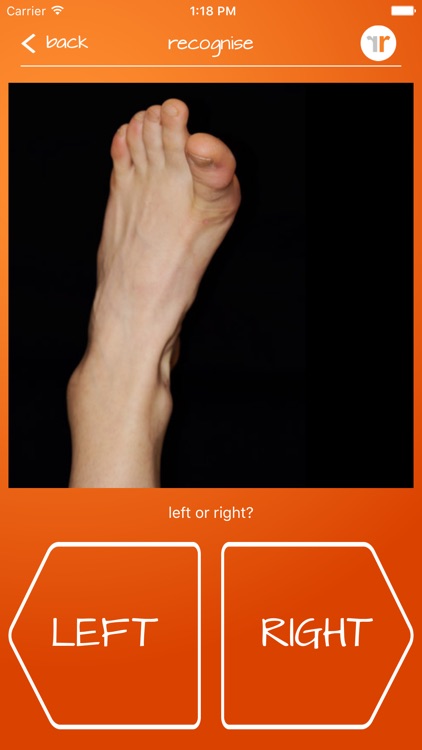
From the Recognise App
When I see a patient experiencing chronic pain of their ankle, I'm using an app created by the NOI Group called "Recognise Foot" (yes, spelled that way, because they're Australian and they don't like the letter Z).  The app shows you pictures of a foot and you have to identify if it is a left or a right one.  (They have apps for several different body parts).  You can change the settings to start with fairly simple images like this one --> with a black background in typical positions to more complex images with varied backgrounds that are covered in paint or wearing a cast or flipped upside-down and it's basically like playing a game to see how fast you can identify the side of the body and how accurate you are.  I've tested out the app for the hand (Recognise) and the app for the foot (Recognise Foot), each of which are $5.99 at the App Store.

A normal result would be at least 90% accuracy and symmetry between sides as well as response time of less than .2 seconds.  The app will tell you your scores and you can use it to assess the patient's ability to discriminate between left and right as well as treat them using the app. I've been adding this as a home exercise program component to patients who have been experiencing chronic pain and having them "play the game" several times per day in addition to doing some activities to try to get them moving towards less pain. 

A word of caution: the GMI Handbook does say that some people will experience pain just from using the app. This is not something I have experienced yet, but if it does occur, there are ways to change the settings on the app so the patient has more time to respond or less images. Also you can actually regress from this to watching other people move, focusing on the other person's body.  For example if your ankle pain was increased just by using the app, you could go to the mall and watch people walking and focus on their ankle instead.  There's science to support this regression and the book talks discovering this using monkeys who would watch people eat and some of their own brain cells that would be activated if they were eating would "light up" as if they were doing the activity themself. It's a less intense way for your brain to process information, watching someone else do an activity, because of the ways the sensory and motor cortexes of the brain are uniquely used with watching versus participating in activity.

Ultimately, GMI is a science that is still developing.  There is research to support some of the claims, but not all of them and the NOI group points out where there are holes in the evidence.  There is evidence to support using this treatment in specific patients, such as those with CRPS, and less evidence for others.  Some of my colleagues are using this treatment more frequently and with patients in more acute pain states.  Some colleagues don't use it because they don't know anything about it - like myself only a few months ago. The app is actually pretty fun and if you don't have pain doing it, who wouldn't benefit from some brain training?  I'm tempted to see if the basketball players I work with have any change in their reaction time by using this sort of brain training to try to use if for performance enhancement, but again, I have no evidence to support that thought and can't usually use them as guinea pigs.  I'm curious to know who else is using GMI in their clinical practice, how often, for what conditions, and what others have found with using it.  And I highly recommend that PTs read this book to learn about where we are on this type of patient care right now and to see if it might help some of your patients.  

Monday, January 6, 2020

I'm a Book Nerd

I really love to read.  I don't think anyone who knows me would be surprised to hear this, and I've written a bit about this in the past.  I've written a few book reviews (you can search the blog for those easily if it interests you), and I wrote about my anti-library here.  I constantly have a book in my bag, an audio book in the car, a creased journal that I'm mid-way through reading usually on the back seat of the car, on the side table in the living room, and in my laptop bag.  There are things to read everywhere!  I even occasionally have an audio book on my phone to listen to, now that I figured out how easy it is to connect an app on my phone to my library account.  The ways to access knowledge continue to skyrocket and I feel like I just keep devouring more and more, but each thing I read just shows me multiple new sources I can add to my list.  I remember fondly the days when I only read fiction, many years ago, and I'm embracing the transition that I've gone through to make it so I'm about 60% non-fiction and 40% fiction reader now.  I love getting lost in a tale of unique characters or far away places and won't really ever stop reading fiction entirely, but the non-fiction and the science are so fascinating, too!  I read about a huge variety of topics  But I also like reading things that help me grow as a physical therapist and as a person.

Last week I was working with a teenage patient in the clinic who I have had the opportunity to work with over more than two years following multiple surgeries.  She was telling me about her most recent Netflix binge and asked what I was watching.  When I told her that I didn't have a TV or a Netflix account, her jaw hit the floor.  It's not like I don't waste plenty of time on Facebook or goofing off on my phone or watching movies or occasional shows.  For certain, I do. Some days I want to go back to my old flip phone so I could have less access to all the distractions my Smartphone provides.  When I told her I read books, she called me a nerd.  And I wear that title with pride.

Until now, I've kept a running list of books I want to read on Goodreads and as I get close to finishing one, I just pick the next one. Sometimes a friend or coworker recommends a book and I pick it instead of what's been on my list for a while. I'm a regular at the local library and when they don't have something I'm interested in getting, I can use the Seattle Children's Hospital Inter-Library Loan System to get my more sciency books.  I've had a list of the "Top Five To Read Next" books on my list for years... but some of those books have never moved off the list because I read others first.  I've never really wanted to commit to making a plan of topics or books to read and sticking to it because I liked the flexibility, because I don't want reading to feel like an obligation, and because I have been reading so much, that I didn't think it really mattered.  But I'm not reading some of the things I really want to get to, so I'm going to try a plan this time.

For 2020, I'm picking a few work-related topics ahead of time with the goal of reading at least one book for each of those topics.  The books have all been on my list, some for years.  They've been recommended by people I respect.  Some match my personal beliefs and some are a bit more contrary. They seem interesting from their descriptions.  They're bound to help me grow as a physical therapist, and also likely as a human being.  Though I've written them as if they are in some sort of order, that may change.

Graded Motor Imagery Handbook + Mocha = JOY
The first book is "The Graded Motor Imagery Handbook" by Lorimer Moseley, David Butler, Timothy Beames, and Thomas Giles. You may have read my previous post about when I met Lorimer Moseley as his team studies pain extensively and he's written several books, which I've also written about here and here.  I don't actually know what topic this specifically falls under.  Maybe pain, maybe physical therapy treatment, maybe neuroscience.  Either way, this book has been on my list for a long time.  I just started it and can already tell it's going to be a journey. I expect this experience will be like climbing the mountain that "Explain Pain Supercharged" was.  In the event I decide to dig even deeper into this topic, I'll read some of the resources or books recommended within it, such as "Phantoms in the Brain" by V.S. Ramachandran, or one of his other books.  This is how I start to fall down the rabbit hole.  Speaking of which, I hope to read "The Adventures of Alice in Wonderland" in 2020, also.

The second topic will be pain.  Shocker, right?  The pain saga continues.  I've been wanting to read "Gift of Injury" by Stuart McGill which is about recovery from lower back injury and if I'm able to get access to it, I'll also read his book "Back Mechanic" to make a more focused reading cluster about low back pain.  And I also have "The Gift of Pain" by Dr. Paul Brand and Phillip Yancey on my list.

The final subject will bring me back to the basics: a look at Anatomy by reading "Anatomy Trains" by Thomas Myers.  Hopefully a refresher on the basics of anatomy with new learning about the fascial system.  I think this book is going to go against some of my biases, but I'm not sure yet. The list of these six books is now at the right side of the blog and I'll be checking them off as I complete them throughout the year.

In addition to these books, I recently launched the Seattle Children's Hospital Sports Physical Therapy Journal Club.  After recommendations from many of the physical therapists I met at the AASPT Fellowship I wrote about here, a few editions have already gone out looking at the "Linking Evidence to Practice" series in JOSPT written by Dr. Stephen J. Kemper that teach readers how to critically evaluate scientific literature.  I won't lie... those papers were a bit dry, but they're important. Too often we read a journal article and take every word of it like it's gospel when in reality there are other papers that share opposing views or the methodology is not really sound.  I'm guilty of this myself, and hope to learn more about the biases I fail to recognize in my own treatment methods. I'm really looking forward to getting into some more interesting papers that have been recommended and I hope to share some of those here on the blog, also.  Specific topics I'm looking forward to reading about in the scientific literature include: the basics of tendon structure and healing, more about evaluation and treatment for concussions, therapeutic alliance, the mechanisms of manual therapy (this will be the next paper, thanks for the recommendation Jarod Hall), and looking at different conditions we treat in the clinic.  Anybody who wants to join in on our journal club emails, just say the word and I'm happy to share.

I guess I've been blogging more and more about PT-related topics, though once the WNBA season starts back up, I'll still write about basketball... or maybe about things that interest people that are not physical therapists.  Until then, I'm loving all this PT learning and personal growth and want to know what others are reading to help grow their clinical practice.  Or just books you liked.  There's always room for more on my list.


Wednesday, February 13, 2019

Conflicted

Hey everyone.  This past week I've been conflicted with something I use in my patient care.  Conflicted enough that I've brought up this conversation with my coworkers and a close PT friend and it's still weighing heavily on my mind. So now it's here for others to read and comment on. Please send your thoughts, fellow PTs.

There is a physiotherapist out of the UK named Adam Meakins who posts regularly about various physical therapy topics including issues with the profession, our techniques, and our shortcomings. He goes by "The Sports Physio" and has a very respectable social media following: 54.4K twitter followers and 76,000 followers on his blog... compared to my 270 twitter followers and 9 blog followers (plus my mom).  I present these numbers for the sole purpose of demonstrating that he's a well-known PT.  I have followed him and read his materials for about a year and have come to find that he challenges my thought processes, which is essential for my growth, though sometimes is hard to swallow.
ID 2530204


In the past week, two physical therapists who I respect - but also occasionally differ in opinion with - have mentioned Adam Meakins. One of them linked to a video Adam posted on Facebook which he further discussed in this recent blog post and he was also interviewed on this podcast about a different subject - so he's just come up a lot more this week than usual and his messages have been on my mind.

This post is not meant to be an attack on Adam.  He works hard to improve healthcare and physical therapy practices - noble efforts with messages I often agree with.  He expresses his perspectives confidently in an unapologetic abrasive manner that has a certain appeal for getting his message across.  (AKA - there's no bullshit.  He tells it like he sees it.  I love this about him.) He's a physio and he's trying to help people live healthier lives doing the things they love to do... so I respect him. I have never met him in person (yet), but I do pay attention to what he's posting because I think his perspective is really valuable, even if mine differs, like it does right now.  I wonder what it would be like to shadow him treating patients for a day.

The blog (and video) he posted discuss the use of palpation (evaluative touch) and how we present our findings to patients.  

Adam listed multiple studies as his references, many of which I have now read, which report that either more research is needed or that palpation techniques are not reliable. To my knowledge, there are not many papers that say the opposite, and my skills of critically appraising research are certainly inferior to Adam's, but this paper contradicts the research presented in Adam's blog post.  I had to search to find that one.  I searched because I have found multiple occasions where someone has told me to do something with patients because they read an article about it - and I was able to find multiple publications that stated the opposite information.  So when I read his post and immediately felt like it didn't sit right with me, I had to do some searching. Maybe I don't understand his message properly.  Maybe I'm too biased to see through my own thought processes.  Regardless, I am conflicted.

Adam points out that physical therapists are not good at palpating things like "knots" or "trigger points" or "tight bands" or "joint play at the spine" and that we are not consistent between providers or even consistent with our own practices.  In non-medical terms - if you smell pizza in the morning and identify that it is, in fact, pizza - but in the afternoon smell the same exact thing and identify it as a cheeseburger, you're not being consistent with your own findings.  And to tell someone that you have a cheeseburger when it's actually a pizza could be confusing or problematic.  Scientific research says that physical therapists touch patients to evaluate them but report different findings. The research also says that we cannot identify if parts of the spine moves abnormally or identify which level of the spine we're touching with consistent results.

Now... when I palpate a patient and feel like a segment of their lumbar spine feels hypomobile, I agree with Adam that it makes no sense for me to state the specific level of the spine to the patient, because I don't have XRAY vision to know I'm 100% accurate and, working with kids, it probably doesn't have much meaning to them anyways.  I worked with a patient with neck pain today and, as I've previously mentioned, I currently have a student.  So when I palpated a segment that I thought was hypomobile (and reproduced the patient's symptoms), I relayed to my student that she should look around where C3 would likely be because I can't actually be certain that it is C3.  I think it is, I'll document it as such, but the reality is - I don't actually care exactly what level it is.  I feel something, it reproduces my patient's symptoms, it's where I want to treat.  I don't know how I could have better directed my student to what I found for her to feel it herself, but the patient felt relief with mobilizations at this region.  Adam's post suggests that this confirms my bias to this being a useful technique.

Maybe it's more about the way the care is interpreted and explained to the patient than the actual identification of specific structures and the interventions that are applied that Adam has a problem with.  I agree with him that we really need to STOP TELLING PEOPLE their L5 is rotated or their back is out. What does it mean for you to throw your back out?  That is not medical terminology.  Can your back ever be in?

But... when I palpate, particularly at the spine, I do feel "something." Of course I'm biased on my opinion of my own patient care...it would be wrong of me to use interventions that I did not believe were helpful and, since I also manipulate the spine on occasion, I feel it is essential for me to use palpation to identify hypomobile segments of the spine.  I feel hypomobility in some regions compared to other regions in the same person.  While I don't generally compare spinal mobility person to person because I don't find that useful, I do correlate certain patient responses with what I'm feeling in soft tissues in my hands and compare that to what I've felt with others.  If a person laying on the table in front of me presents with a neck that is tender to palpation and their cervical and thoracic spine feel stiff compared to their lumbar spine, I want to treat this issue.  Maybe with manual therapy.  Maybe with exercise.  Maybe with both.

I used to do things very differently.  I no longer say to my patients, "Wow your neck is really stiff," or "Your 1st rib is stuck"- though I do sometimes feel a stiff neck and a hypomobile first rib... which I treat.  I don't say these things any more because it freaked out the patients.  They'd worry about their rib being a problem.

I used to look at the pelvis and tell patients that they had one leg longer than the other. All the time.  Guilty. I didn't know better, then! I used long axis distraction of a leg to distract the hip while simultaneously re-aligning the SI Joint.  That's what I truly believed.  I'm telling you that I used to regularly yank on people's legs. Maybe as often as daily. Wanna know why I did it so much?  Because sometimes IT ACTUALLY WORKED.  And they felt better.  And that's a bit of what Adam Meakins is saying... that we can be convinced that the care we're providing is beneficial, even when it is not supported by research. I eventually learned that it didn't work as much as I thought it did.  It didn't help enough people.  It could have been harmful to the patients and I constantly felt like I was doing something to patients to try to fix them rather than guiding them towards ways to fix themselves.

Humans can't be symmetrical if we have hand dominance and we move to get in and out of a car in the same way all the time but less frequently on the other side of the car. Our heart is not centered in our chest cavity.  There is only one spleen and one liver and they're not in the middle perfectly symmetrical....  So while Adam Meakins is practically pleading with physical therapists (and hopefully chiropractors and physicians) to STOP telling our patients that they have anatomical problems that are probably not actually problems, and I agree with that message... I still feel "something" when I palpate the spine.

If patients ask, I now use an explanation about the nervous system having a reason to try to protect that particular region of the body and that by using load management strategies, it may calm down. I explain that "hurt does not equal harm"... that the tissues of the body may hurt even though damage is not occurring.  The body uses pain to protect itself.  And then I give a home exercise program to guide them on restoring motion, strength, or function based on what I determine the patient needs... which I did by using palpation.

I remember sitting in PT school and being taught how to palpate the multifius and the transverse abdominus musculature to assess if they're contracting.  I could never feel the multifidi.  Never.  And then the PTs at my first job out of PT school encouraged me to focus on assessing the multifidi in various positions and using abdominal bracing and using electric stimulation in conjunction with abdominal bracing on my patients.  I tried to use that.  But I could not feel it.  This is what Adam seems to be describing but relevant to palpating the spine.  Is it possible that we have different skills with regard to palpation?  Is it possible that while I cannot feel the multifidi, I could feel hypomobility at the spine?  Is it possible that the issue is not about what we identify, but more in how we express it to our patients?  We are definitely impacting the beliefs of the patients we see.

The podcast interview goes a bit more into the discussion of the narratives that physical therapists (and healthcare providers) present to their patients and how this can negatively impact them.  I like that Adam states in the podcast that removal of pain is the wrong way for PT to be going as a profession.  We need to be empowering patients, give them realistic expectations, and help them operate within the constraints that their individual bodies allow.  The goal should be developing resilience and tolerance - not elimination of pain.  I agree with Adam on all these points.

I also agree that we are over-treating patients.  Too many visits.  Too many referrals from person to person rather than really understanding what's going on.
I also agree that the medical system doesn't operate in an ideal fashion.  Insurance companies limiting treatment influence the care that patients get.  This is wrong.
I also agree that sometimes the best treatment for a patient is NO TREATMENT.  I recently was working with a patient who was seeing so many different providers that I just sat her down and told her - I think you're trying to find too many solutions to a small number of problems and can't follow a single path to your recovery.  I recommended that she sit down and write a list of all the people she had been seeking answers from, and pick the one that she wanted to commit to.  Who do you believe is helping you?  Follow that person.  Get rid of the rest of us.  Everyone telling you different things is confusing and ineffective.   I don't actually care if physical therapy is her solution.  The best solution for every patient is the one they buy into and helps them find a way to get back to their function.  Period.

Even as I write this, I'm feeling my thought processes shift about what I say, but I"m not ready to throw away palpation yet.  I like that I'm trained to provide spine manipulations and have had some really great results using it. I use it selectively and in conjunction with movement.  And so, I'm unwilling to throw away a tool from my toolbox that I sometimes find essential.  At least for now.

Take Home Message: There are lots of really good physical therapists out there, many of which are creating content that is easily accessible and easy to apply.  The messages differ between them.  But patient populations differ and you have to believe in what you're selling to your patients.  I believe in a little Mike Reinold and a little Lenny Macrina and a little Lorimer Moseley and a little Adam Meakins and then I add some strength and conditioning with Eric Cressey and a little breathing from yoga practices and a little mental health... and I'm my own unique clinical provider because of all those influences... which is why I keep writing about all of them!  So use a variety of backgrounds and consider opposing opinions, try out different techniques, challenge your own beliefs and welcome growth along with failure.  Feel free to tell me if I'm wrong... I may not like that, but I'd like to think I'll be respectful and consider the alternatives.

Above all else - Do No Harm.


Thursday, December 27, 2018

2018 Year in Review

The last blog post of 2018! Since I started writing in November 2017, Abby's World has had 14,000 visitors.  I still don't like the title... Some posts were really popular... four posts had over 400 readers, others had less interest... and that's ok.  I think it's safe to say that I'm still figuring things out a bit to narrow down the scope, but I'm enjoying the variety of topics right now.  Thank you, so much, to everyone who has stopped by! I hope you've learned something and that I've been helpful to you in some way.

Today's post will serve as recap of 2018 - both personally and professionally - and a look back at some of my favorite posts of 2018.  As for 2019, I don't think I'm going to write a plan or set goals - other than to keep writing.
The Seattle Storm and UConn Connection
My 2018 biggest moments:
I'll start with the Seattle Storm winning the WNBA Championship, which I wrote about here.  I was so fortunate to be able to attend WNBA Finals Game 3 in Washington, D.C. with my brother, and still love basketball despite my poor skills at playing the game. I'm already looking forward to next season and it's still several months away.

Dear Evan Hansen, New York City, July 2018
As great as the championship was, my family celebrated a huge milestone this year.  In May, my niece and nephew became B'nai Mitzvah, which is a Jewish coming-of-age or right of passage.  They're thirteen years old, now!  The actual events for the B'Nai Mitzvah were incredible and I'm so proud of them for their accomplishment and hard work, but more special was the opportunity to celebrate them each in their own individual way.  I asked them a few months before-hand what they would want most, and I love how different they are and what they chose.  I celebrated my niece by taking her, my sister, and my mom to see the musical Dear Evan Hansen in New York City.  If you haven't heard much about this story, I encourage you to check it out, particularly if you have teenagers in the house. I'm so glad we could do that together, and that it was what she wanted to do - with her aunt, mom, and grandma.  I celebrated my nephew at the Denver Broncos versus Seattle Seahawks game in Denver, CO.  He's been a Broncos fan since birth because he liked the color orange and had always wanted to see their stadium.  As a sports fan myself, I really loved watching him experience something he had wanted to so much... and the rivalry of rooting for opposite teams but in a mature manner.  It was a chance to spend time with my favorite people as they head into teenage-hood and, soon, adulthood.  Next year they'll both attend Cheshire High School, the same school I graduated from fifteen years ago.  I remember holding them when they were born and all of these events were a flood of pride and emotions.   Because of them, I spent more quality time with my family in 2018 than I had since I moved to Seattle.  That was the best part of 2018.
Seattle Seahawks @ Denver Broncos, September 2018
Some of my other favorite things from 2018 that have nothing to do with Physical Therapy:
I saw the Goo Goo Dolls perform their 20th Anniversary celebration of Dizzy Up The Girls.
I rode in a helicopter for the first time. Total trip time was about 3 minutes.  It was awesome.
I read the first five books of the Harry Potter Series and watched the first three movies... my first time for all of that.  Don't worry, book six is in progress and I'll finish all of it in 2019.
I read a lot of books in 2018, actually.  Some really deep, sciency stuff.  Some much lighter and more relaxing.  I have come to embrace the audio book for commutes. I read The Origin of Species which I wrote about here and definitely do not recommend others read, but feel like I can read anything if I could get through that.
I got addicted to yoga.  And then dropped out of yoga.  I miss yoga.

My 2018 Physical Therapy Continuing Education was primarily focused on three areas.
1) Orthopedics from Mike Reinold, Lenny Macrina, and Eric Cressey.  I took Mike's shoulder seminar, which I wrote about here, Lenny's knee seminar which I wrote about here (and his elbow course), and Eric's shoulder course which I wrote about here.  I'm so grateful that there are mentors willing to share their expertise and knowledge online, and who also have made trips out to the West Coast for me to learn from in person.

2) Chronic Pain, primarily from Lorimer Moseley and Adriaan Louw.  I've written about those experiences here - from reading Explain Pain, and here from reading Explain Pain Supercharged and from meeting Lorimer Moseley at his presentation at the University of Washington.  Starting in two weeks, I'll be working with the Seattle Children's Pain Clinic as part of a collaborative team to help kids experiencing chronic pain.  I'm looking forward to putting all that learning to good use.

3) Strength and Conditioning.  I passed the CSCS (Certified Strength and Conditioning Specialist) exam in 2018, which I wrote about here and took a Medbridge Education Course instructed by Sue Falsone on this topic as well.  This has definitely made an impact on how I treat patients, specifically by loading them more and manipulating rep/set schemes a little bit more than I did in the past.  A few PTs have asked me if I thought this process was worth it, and for my patient population and side gigs, I feel that it is definitely useful.  I work in Pediatric Sports Medicine so my patient population is mostly athletic and getting back to sports.  They've generally never worked with a strength and conditioning coach or a physical therapist and don't understand any of the key basics of movement or how the body works.  I love having this background knowledge to educate them!

I feel like I spent a lot of time working towards growing as a physical therapist in 2018, but when I look back, it wasn't even close to what was most important.

Looking forward to 2019:  I'd be lying if I pretended that 2018 was perfect. Social media sometimes has that impact...  nobody posts their tears and struggles on Facebook and Instagram.  I certainly only post the happy times and the beauty I see around me. In truth, 2018 was a hard year.  I'm not sure 2019 will be easier... but there will be more family time and more hard work and growth.  And for all that, I'm grateful.

Happy New Year!