Showing posts with label book review. Show all posts

Wednesday, January 1, 2025

2024: The Year I Didn't Blog

Happy New Year! 2024 has come and gone seemingly in the blink of an eye. Somehow I managed to read far more this year with audio books on faster speeds during my commutes and travels. I read so much – and wrote a little bit in other places – but I didn’t write any blog posts here! I’ve missed my blog and hope to return more in 2025, but I'm also planning on writing a book! Now that I'm sharing that with everyone, hopefully this will keep me committed to the goal. 

My first book will be "It depends." Anyone whose gone through PT School - or probably any professional medical education - will likely tell you stories of how they asked questions in school only to be repeatedly told, "it depends." Though frustrating, with the hindsight of a decade of clinical practice, it's now a lot easier to recognize that this is the best answer, and now I can come up with a whole host of considerations that the question would depend on. This is a chance to tell some clinical stories to shed light on why working in healthcare is so complex, and also highly entertaining. So hopefully I'll be able to write the book while keeping up with my blogging!

Early in 2024, I was invited to give some talks at different conferences, so I dedicated the early part of the year to a lot of reading and developing those presentations. The biggest talk was alongside colleagues Dr. Karen Litzy and Dr. Devra Sheldon at the American Physical Therapy Association Combined Sections Meeting in Boston about Complex Regional Pain Syndrome. I also spoke at the TRIA Orthopedic and Sports Medicine Conference in Minneapolis about Rehabilitation for the Adolescent Athlete thanks to an awesome colleague recommending me for the job. In 2025, I'm working on giving a talk at the Seattle Children's Hospital Rheumatology Conference where I'm partnering with a physician and we're talking about differentiating between rheumatological conditions and chronic sport-related pain in young athletes. 

My writing in 2024 was limited, but looking back it was all fun. I wrote three articles for The Next Hoops and some blog posts for Pain Geeks. The Next publishes everything you could ever want to read about women's basketball. They're fantastic. If you're a fan of the WNBA or any college team, I highly recommend you check them out and subscribe. My articles for them included coverage of last year's Apple Cup where University of Washington played Washington State University, something that will be more difficult to achieve as the college conferences were realigned heading into this current season. 

I also teamed up with fellow physical therapist and writer Lucas Seehafer where we reviewed the 2023 WNBA injury stats heading into the 2024 season.  I'm excited to continue to partner with Lucas in the future as more data is collected and hope that next year, the League manages to stay healthier! 

My final piece for The Next was an exploration of how the WNBA medical staffs have been expanding as the League has been growing. It included spotlights on several of the medical providers around the League.  It gave me a chance to meet new athletic trainers, physical therapists, and strength coaches working in the WNBA as well as to catch up with some of the providers I have known for more than 15 years. They're an awesome group of people and it was really fun giving them the spotlight, though most of them are pretty happy being behind the scenes. 

For Pain Geeks, I was invited to lead their fall book club discussion choosing the book, "When Breath Becomes Air" by Paul Kalanathi. For this I wrote two blog posts leading up to the meeting. Part 1 and Part 2. The book is gut wrenching and heart breaking while simultaneously beautiful and inspiring. I rarely read books twice, but I really felt that this one deserved discussion and it was fun chatting about it with the other Pain Geeks. PT pals - if you're working with patients experiencing chronic pain and want to really grow your community of medical providers, the Pain Geeks are all over the world and our group meetings continue to make me a better clinician. Check them out. 

I guess since I've mentioned a book I loved in 2024, I'll also write about what I read last year. Thanks to audio books, I broke personal records completing 76 books! Incorporating a bit more fiction seems to make me read faster, and I read more of those than usual because several people kept telling me to jump into Sarah J. Maas's books. Let me just get this out of the way: I liked the "A Court of Thorns and Roses" Series. I did not like the "Throne of Glass" series and didn’t finish it. I like other genres far more than these and don't know if I will read any romantasy in 2025... but if that's your jam, please do enjoy it! I can already feel the daggers coming from some of my friends who thought these books were  life changing. Sorry, friends!

What books did I like the best in 2024? 

I listened to several biographies or memoirs and also read a few. In a lot of cases, the narrator was also the author and I love when that happens. Incredible athletes like A’Ja Wilson who shared her relationship with her grandma alongside her basketball journey made me want to root for her even though she’s not on the team I cheer for. I felt like The Terminator was sitting in the car right next to me as Arnold Schwarzenneggar described his childhood and how he ended up in body building. It was so much better than hearing my own internal monologue. Dancer/actress Kelly Bishop’s tales of her life and career on stage as the main character in A Chorus Line before she became Emily Gilmore, matriarch in Gilmore Girls. I learned a lot and as a Gilmore Girls fan was so glad she read it herself. My heart broke learning about Britney Spears and how she was basically tortured by her parents and also hearing Matthew Perry describe his ongoing battles with drugs. And there were several others that were all really fantastic, but these were the most memorable from that genre.

I read several books about Israel, Gaza, antisemitism, Judaism, and Hamas. In the wake of the October 7, 2023 massacre at the Nova Music Festival, I found myself involved in numerous conversations about the Middle East, a place I have been, a place  I lived and worked as an Emergency Responder, and a place that is very important to me. "Israel" and "Uncomfortable Conversations with a Jew" both were filled with detailed history of the conflict, but I thought it was important to read from a different perspective. For that, I read “Son of Hamas” and “I Shall Not Hate” as well as some graphic novels about the Middle East.  

In the past, I primarily read non-fiction books, but I do love fiction and my temporary commitment to
flying faeries was fun for a while. I think my brain needed somewhere to chill out after all the journal articles and novels helped me recover. My favorite non-fictions this year came from Emily Henry and Taylor Jenkins Reid and I've been working my way through another Greg Iles book that's super long but I love his work. I also liked, "Everyone in my family has killed someone" by Benjamin Stevenson.

And my favorite non-fictions this year were "Rare Gems," by Howard Megdal - Minnesota Women's
Basketball History at its finest, "Unreasonable Hospitality," by Will Guidara - which aligns with my commitment to therapeutic alliance with my patients and going out of my way to make others feel special. Though it fits as a memoir, Kate Fagan's "All The Colors Came Out" where she talks about her basketball life along with the relationship it facilitated with her father was perhaps the best book I read all year. Tears and laughter. 

So there's 19 of my favorite books from last year... and it was even hard to choose those! 

What am I most excited to read in 2025? 

Biographies: Maya Moore's Love and Justice and Brittney Griner's Coming Home

Fiction: the new prequel for the Hunger Games that explores the back story of Haymitch - Sunrise on the Reaping - by Suzanne Collins and novels by Abby Jimenez

Non-Fiction: Jay Shetty's 8 Rules of Love and Louis Gifford's Aches and Pains series. 

I like to read a classic and/or banned book and this year I think it'll be Brave New World

Beyond that - here's to lots of fun 2025 travels and meet ups with friends with outings planned in Maui, San Francisco, and Austin already... but more for sure to come.  Who wants to get together?  Let's make some plans! I'm sure there will be plenty of basketball games to attend, hopefully some more Goo Goo Dolls concerts, and fun adventures around the PNW.  Happy New Year, all!


Tuesday, December 26, 2023

Zoe and Zak's Adventures to meet the PNW Trolls

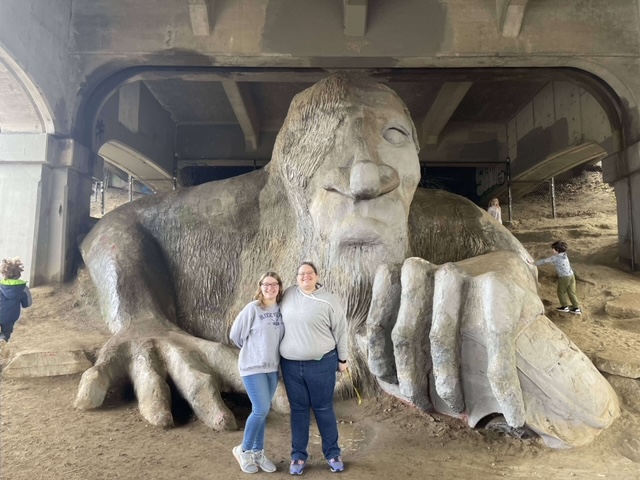
With my niece, Zoe, at the Fremont Troll
A few months ago, I was scrolling my social media when I came across a post announcing completion of the installation of five Dambo Trolls in Washington. These trolls are large pieces made from recycled materials designed and constructed by Danish artist Thomas Dambo. An unrelated troll has resided in Seattle under the Fremont Bridge since 1990, originally intended to deter homeless people from living in the area, which was a few blocks from my apartment when I moved here. I took many visitors to mee the 18-foot tall Fremont Troll sculpture, but didn't know if trolls had any significance to the area. Washington is more associated with Sasquatch (AKA Big Foot), and my research has shown that trolls aren't really connected to the PNW, but these new masterpieces seemed interesting, so I decided to visit them. 

1990's Troll Toy
I also decided to learn more about the history of these fantasy creatures. I remember liking The BFG (The Big Friendly Giant) by Roald Dahl, who wrote my favorite book, Matilda, but have no recollection of reading tales of trolls. My brother used to have a collection of trolls when we were little, with the famous neon pointed hair and gemstone belly buttons.  Interestingly, those troll toys were invented by a Danish man named Thomas Dam, and these led to the creation of the Trolls movies that star Justin Timberlake and Anna Kendrick. I couldn't figure out if Thomas Dam was related to Thomas Dambo, but those names are way too much of a coincidence if they're not family.

According to Wikipedia, Trolls come from Nordic Folklore and Mythology and the word has a few different possible meanings including fiend, demon, or mythical magician. Trolls typically live in isolation, in forests, mountains, or caves, and Dambo shared that his installations use recycled materials to help the planet and bring people outside to visit nature. He's creating a "bridge between cultural and environmental stewardship." As I read more about trolls, I thought about childhood adventures and fantasy tales, but the isolation so frequently depicted also reminded me of some of my patients with chronic pain. I frequently work with teenagers experiencing chronic pain or illness, and it's common to see them isolate as their condition worsens, transitioning into a period of hibernation.

Zoe and Zak's Pain Hacks
I decided to write about the five trolls along with a review of a new children's book series written by Dr. Joshua Pate, an Australian physiotherapist, called "Zoe and Zak's Pain Hacks." (Link to buy in the US.) Dr. Pate has written a TED talk called "The Mysterious Science of Pain," that's a great five-minute video clip.  
I first learned about Dr. Pate and his work with kids experiencing pain in November 2021. While preparing to give a talk to coworkers at Seattle Children's about treating kids with chronic pain, I couldn't find research indicating what age kids start to understand the pain neuroscience concepts recommended by the Explain Pain Books so frequently shared with adults. I tweeted what I was searching for, and Dr. Rachel Zoffness came to my rescue. 

Not only did Dr. Pate send me a copy of his (soon to be published, now available in a book) chapter called "Developmental Influences on the Meanings of Pain in Children," he offered to meet for a Zoom chat. He was very kind to spend an hour chatting with me about the work he was doing and that he had this series of children's books coming out soon. His research, and there's loads of it!, determined that kids start to understand pain concepts around age 8, and he also explained how he conducted some of his research and some of the interesting things he had discovered. I found his reference to this paper where children were asked to draw whatever the word "pain" made them think of particularly memorable. Dr. Pate found that in his small sample of kids, those who were experiencing chronic pain drew emotional components like a broken heart or tears, which kids who did not have pain did not draw.  
Pia the Peacekeeper
The boxed set of books arrived at my home soon after our call and I read them right away. They're beautiful and fun to read, despite being about pain. I started to write a blog post about them way back then without the trolls, but the post felt like it was just me spitting out pain research and I prefer to write my posts connecting different thoughts, so I stored the books on my shelf, alongside my other fabulous pain nerd books, until the epiphany came to pair the books with the trolls. So here's Zoe and Zak Zoppins on their adventures with me as we met the PNW Dambo Trolls.

The first book in the series is called "Zoe Zoppins Nails It." It tells the story of "A Tale of Two Nails." Zoe's Uncle Ozzie steps on a nail and has intense pain, only to later find out that the nail went between his toes and didn't injure his foot at all. This story is commonly used to show that pain doesn't always equal tissue damage, and the illustrations and rhyming make it easily understood even at a young age.  The first troll we visited was located on Bainbridge Island, across the Puget Sound just a little bit west of Seattle, and is named Pia the Peacekeeper. Located on Salish territory, the Muckleshoot and Snoqualmie tribes collaborated on the development of Pia. These trolls are quite massive, and I had an immense appreciation for the size of their hands and feet. Having Pia hold the book was the best way to demonstrate the scale, but of course my nerd thoughts went to the homunculus and how much sensory input these trolls would have from their massive hands.
Frankie Feetsplinters

Second in the series is "Zoe Zoppins Lights It Up" which is based on this research from Lorimer Moseley, author of the previously mentioned Explain Pain Books and mentor to Dr. Pate. This study examines pain under different contextual circumstances. Zoe is tapped on her hand by a cold metal rod and rates her pain when there is either a blue or a red light shining in the room. When the blue light shines, the pain is less intense, but when the red is illuminated, the pain increases. I wonder if Dr. Pate chose this book to have a blue cover because of the storyline. Similarly, I recently participated in the 30-day course The Embodied Clinician with Sheren Gaulbert who I met at the San Diego Pain Summit. We also discussed the relationship between colors and emotions, so naturally I sought research on this topic and found this paper, which suggests this science is in its infancy, but that red has been studied and found to relate to increased attention and outward focus and potentially has an impact on performance. 

Jakob Two Trees
The second troll I visited was Frankie Feetsplinters who lives in Ballard, a Seattle Neighborhood that houses the Nordic Museum. It makes sence that this would be the location for one of the trolls, as the Nordic countries include Denmark, home of the artist. Frankie was the last of the PNW trolls to be installed and was assembled in West Seattle and transported on a flatbed truck to Ballard. The blue-grey skies of Seattle and the more welcoming pose of this troll were certainly not scary. I've never actually gone into this museum, but I hear great things about it and have tickets to check it out in early 2024. (Seattle pals - you can get free tickets to many museums through your library card or directly through the museum! The Nordic Museum has free tickets on the first Thursday of every month).

"Zoe and Zak's Brainy Adventure" is the third book in the series.  I think the illustrations in this one might be my favorite from the set, though the art is really great for all of them. This story explains the numerous messages that are sent and received when an injury occurs and how quickly they're processed, all contributing to pain which is meant to protect us. In an acute pain situation, the protection from pain is helpful, but in a long-term situation when the pain persists, it can become over-protective. This story shares many Explain Pain concepts, like "Pain does not always mean tissue damage." It uses virtual reality to explore the brain, though it doesn't go into detail about how virtual reality can be used for pain - maybe that will be in the second series if Dr. Pate keeps writing these! The third troll I visited was Jakob Two Trees, located in Issaquah, who is simply magnificent at 14-feet tall. I think Jakob was my favorite troll - a short walk among the trees that protect you from the rain, just like pain is protecting our bodies - but there were SO many people visiting, that it was hard to get a close-up photo. It was really fun meeting others who were Troll Hunting on these adventures. 

Oskar the Bird King
Book number four is "Zak Zoppins Retrains His Brain." Zak is Zoe's cousin who shares that he has back pain while they're playing. They discuss how pain can change and isn't permanent using different strategies such as calm breathing and imagery to re-train the brain when it's used to having pain for too long. This is an important message to use with kids with chronic pain because a lot of the time they're fixated on their pain being permanent and that there isn't any hope for it to get better. They're not yet exposed to slow and steady progress for most things in life and are more immediate in their thought patterns, particularly the younger they are. This book, along with the previous and next ones don't refer to a specific research paper, but rather encompass many studies about pain. If you search for "Retrain Pain," you'll come up with several papers, including an online company, that offers a certification for rehab providers which looks interesting (though I'm not familiar with it, so I can't recomend the program).

The fourth troll was Oskar the Bird King, located on Vashon Island. Oskar was the farthest troll from my house and of course it wasn't raining when I departed, but by the time I arrived, it was POURING. Typical Seattle. Oskar is the most intimidating of the trolls in the PNW, pointing at you and with eyes that seem to follow you no matter where you're standing. He's just as awesome as the others, even with the rain, but I didn't want my book to get wet! It's hard to tell from this photo, but Oskar is wearing a crown of birdhouses and sitting on a throne. There are actually birdhouses near the other trolls and Thomas Dambo's earlier work was to install birdhouses all around Denmark. He uses scraps of material from making the trolls to create the birdhouses and at some of the locations, they are painted and posted to indicate the troll is nearby. 

Bruun Idun with the whole set
The fifth and final book is "Zoe Zoppins' Action-Packed Action Plan." In this story, Zoe shares her action plan to use if she's having pain and applies it to different scenarios, like her belly ache when she's nervous about giving a speech in school or when she gets hurt playing soccer.  It's got some similarities to the previous book in that it's sharing some strategies that might be helpful for a kid experiencing pain and how to try to treat it. I particularly liked the focus on all the different activities that Zoe CAN do, rather than on things she can't because of her pain.  This is an approach I frequently use, encouraging patients to participate in whatever they can, particularly if it's fun, as the activities might help reduce their pain in the long-term. 

And the last troll I visited was Bruun Idun, located in the most scenic setting of the PNW trolls in a coastal spot of Lincoln Park in West Seattle. If you plan to go visit, you could take an easy walk from the parking lot, or you could have no sense of direction like me and turn it into a nice two-mile hike through the woods, culminating in a gorgeous view. Bruun Idun is playing songs for the orca whales living in the nearby Puget Sound. Music is one of the things that I often use with my patients with chronic pain as something to help them move and sometimes even let out their feelings.  We talk about matching music to moods, yelling along with songs that help them let out frustrations or crying along with songs that might also be sad. We talk about trying to go for walks that last the length of their favorite song as a way to incorporate movement throughout their day, potentially including the distraction of pairing it to something more pleasant if the movement is uncomfortable. And sometimes, I give patients the homework of listening to their favorite songs and coming up with lyrics that are positive for them to post around their house as a reminder of better days to try to bring hope and momentary happiness. Everyone could use more joy in their day, but sometimes when kids are sick for so long, it's really hard to find that. 

All in all, it took me three months, four ferry rides, and one very wet outing to complete my visits to all the trolls. Zoe and Zak's tales helped me to think about pain from a different perspective and taking them on adventures helped me to enjoy the PNW in the early part of this year's rainy season. I'm hoping to make a trek down to the Portland, Oregon Troll, Ole Bolle, who is 19 feet tall at some point, but of now, thanks for the good reads, Dr. Pate, and thanks for the beautiful artwork, Mr. Dambo.

Thursday, December 9, 2021

Let's Talk About Grief, Baby

I'm pretty sure when Salt-N-Pepa wrote this memorable song "Let's Talk About Sex" in 1990, they didn't think it would be parodied by a tiny blog discussing grief.  Have you ever seen this music video? The lyrics begin with "Yo, I don't think we should talk about this. People might misunderstand what we're trying to say, you know?...  Ya, but that's a part of life..." I think we need to talk more about "all the good things AND the bad things," which includes death, dying, and grief. The idea of "not talking about something" makes it scarier and allows for stigmatization.  There should be no guilt or shame when it comes to grief, but for that to happen, we need to talk about it.

The Fam <3
If you happen to know me IRL, follow me on social media, or you've read my previous blog post here, you know that both of my parents died from complications from Covid-19, fourteen days apart, in December 2020 and January 2021. (Get vaccinated already, for heaven's sake!)  In the same year, my family also said goodbye to my Uncle Pete (November 2020), and my Aunt Marilyn (my mom's sister, November 2021), not related to Covid-19, but terribly sad just the same. They're the four seated in the front row of this photo from our family reunion a few summers ago, all too young and too special to be gone. In the year this was all occurring, there has been incredible love and kindness towards my family and to me, including gifts of several books about grief. Now that I've read them, this post shares a little about each one, hopefully helping you if you're grieving, or if you're wanting to show you care to someone who has recently experienced loss.  

Source.
First, a definition.  There are many- but what stuck out to me was the third bullet on this one: Grief is "a NORMAL, natural, necessary, and adaptive response to a loss."  I initially felt entirely crazy in my grief. I was a different person and couldn't recognize myself.  Nothing about the grief experience feels normal. I started running late and losing track of time when I'm typically way too early for everything.  I forgot about commitments, getting texts asking where I was, only to realize that I totally spaced it. I said no, when I typically would say yes. I didn't want to help other people, and that's what I do for a career, and typically love. I was angry, I cried hysterically in the middle of Target, I had to pull over on the side of the road because I couldn't see through tears to drive, I couldn't sleep - when normally I'm the ultimate sleeper, I couldn't get out of bed, I stopped cooking, and I went into isolation. I'm about as extroverted as it gets and I didn't want people around me. These behaviors were far from my normal, so for someone to say it was a "normal" response was helpful. 

If you're also grieving, it is likely that your experience will differ from mine.  My brother, sister, and I were going through it together, but we each had (and still have) different responses to our losses. It doesn't do ANY good for us to compare to each other, because the person you're grieving held a personal meaning to you, and the family members I'm missing held personal meaning to me.  I talked to my mom on my drive home from work 3-4 times per week for seven years.  The drive home form work is one of the worst times ever for me... my brother doesn't have that same experience.  Fortunately he'll answer if I call him at that time, knowing what's going on.  Even for the family members grieving over the same people, the hole in your heart and soul doesn't feel the same for each of you. For me, grief has been fear and anger and frustration and sadness and confusion and loneliness all rolled into a ball. And pain. So much pain. I've written many blog posts about pain in the past, but grief is the first time I've experienced so much pain that was 100% connected to my psycho-social experience. There was nothing wrong with the anatomical structure or physiological function of my heart, but there was SO much pain and it was very real. (Come to find out, about 3 months after my mom died, I was diagnosed with pulmonary emboli - so it's possible that there was something going on anatomically, then, too, but that's a story for a different day.) None of my learning about pain prepared me for the pain of heartache.

All the pain and emotions came with gratitude, appreciation, reflection, and love for the people we lost and those who cared about our family. I hope that in your grief, you can find these positives - but they don't shine through every day. At the beginning, almost all of the days felt very dark, with very little time for light. As time has passed, there has been more time for light, and the dark has been less frequent and less intense. Perhaps you'll find one of these books or an idea in this post to be helpful for navigating this unmarked territory. Or at the very least, maybe you'll laugh at something in the music videos and have a brief period of light to disrupt your dark. 

Purchase Here
Book #1; "Healing After Loss" by Martha Hickman was the first grief book I started reading about two weeks after my mom's funeral. A good friend from high school who experienced heartbreaking loss sent it to me with the sweetest note. "Abs - people sent lots of stuff after what happened. This book was the only one I could handle. Short and simple. One page a day. If it helps, great. If not, use it as kindling.  Love ya." <3 My sister actually received it as a gift from one of her friends, too.

I have so much gratitude that I was able to take a leave of absence from work because I could not have been a functional physical therapist - or human - during that early time.  At the beginning, I know I was breathing, but I wasn't really alive.  I would see my therapist and she would ask me how eating, showering, and sleeping were going, and would ask if I had done any body movement at all.  We decided focusing on those basics initially was the best way to go, and beyond those, I set the goal to read a single page each day.  Accomplishing that goal was the first step to a long pathway back to returning to life. This book is set up like a calendar, one page per day of the year with a quote and a meditation related to grief and loss. In the beginning, I didn't have the ability to focus. For someone who reads about 40 books per year, it shocked me that I couldn't read a full sentence, let alone pages or chapters. My mind would wander or I'd just end up staring off into space. I spent a lot of time in the fetal position and, at the recommendation of my cousin, watched the entire series of Lost to occupy time and distract me between phone calls with my family. A book where I could read a single page was ideal - and honestly sometimes I had to re-read the same page several times to get through it and retain anything. Some of the quotes felt applicable and helpful.  Suggestions to move my body to get me out of my head - even if it meant getting up to get a drink of water and then curling back up buried under a pile of blankets. Acknowledgements and appreciation for the people who've been lost, knowing that early on, that's really hard, but that as time passes, the memories won't be as sad and there will be happiness and joy recalling time we spent together.  Recognizing that grief is hard and heavy but that there is life to live if you can manage to move through it is a common theme.  I liked this book, but also read it a page at a time, and once I returned to work, I sometimes would miss a few days, so I still have some left to get through, but I'll finish it eventually.

My therapist gave me "It's OK That You're Not OK" by Megan Devine. She recommended I purchase this book a few times, but I couldn’t put myself together enough to order it or get it from the library. I was still having all my meals delivered and not leaving my house except to see her every week. Beyond basic survival, I didn't do anything except watch Lost and talk to my family with occasional friend visits, still incredibly fearful of the stupid Coronavirus. So when I arrived at a therapy session, about two months into my grieving, and she handed me a copy of this book, I finally understood how much she thought I'd benefit from reading it and by then, I was capable of reading for longer stretches.

This book was really good because it presents a first-hand experience from the author, who is a therapist, who suddenly lost her husband. She shares her grief and lets you find places where it matches your own. She shares many of the things commonly said to someone who is grieving and explains why some are helpful - and others are painful.
What I'm writing here is what I experienced, but the book explains similar situations, why they're painful, and what to do instead. For example, at the beginning, nobody else could understand what my siblings and I were experiencing. Tons of people said "I can't imagine what you're going through." I have a shoebox full of condolence cards that say that sentence. It's probably an accurate statement, said with good intentions, but instead of saying this, people could have asked what I was experiencing, helped me to process in some small way, and share in my grief. This is semantics... but as I preach in healthcare, the words we use matter, and these circumstances cemented that belief in me. Another common case of good intentions but hurtful words in our situation was "at least they're together." Remember, my dad died, and then fourteen days later my mom did, too.  I don't know about my brother and sister, but initially, I tried to find solace in knowing that they were together, but that never made me feel better. They didn't both need to die. Why couldn't my family at least have one of them, still? 

From "It's OK that you're not OK."
A few people told me they didn't know what to say to me, but they planned to keep showing up hoping that it was good enough. Trust me... it was. It is. The random text messages of my friends' kids on their back yard swing set, late night phone calls, invitations to get together even though I would likely decline, just dropping by to say hello, bringing over homemade dinners, offering to pick up Dairy Queen since you're going with your kids and they'll be quiet eating it in the minivan long enough for you to give me a quick hug? Asking how I was and not accepting "fine" as an answer, making me truly share how I was, and telling me that it was OK to cry, despite my embarrassment... that mattered. Those were really thoughtful and helped me feel like I wasn't forgotten while I wasn't able to live my own life. Friends took care of my house and made sure my mail was picked up, plants didn't die, and had a house cleaner come in while I was traveling for funerals. Showing up, however you do it tells the grieving person that you know they're hurting, and that you're willing to sit with their pain. You're not trying to take it away. You're keeping us company while we try to find air in our lungs. It's proof that we're not alone. Asking about memories so we can feel our loved one with us is even better. A grieving person is thinking about their loved one non-stop anyways... you bringing it up might be hard, but it provides for an outlet.

Purchase Here
The end of this book contains a short essay "How to Help a Grieving Friend."  My favorites: "4. Be willing to witness searing, unbearable pain." "5... Your friend cannot show up for their part of your relationship very well.  Please don't take it personally, and please don't take it out on them."  and "6... Do not say 'Call me if you need anything,' because your friend will not call.  Not because they do not need, but because identifying a need, figuring out who might fill that need, and then making a call to ask is light years beyond their energy levels, capacity or interest." Saying "What can I do" to someone who has a gaping hole in their heart doesn't work. They want their loved one back - nothing you can do will achieve that. Want to bring over a meal?  Offer it on a specific date and time. Want to sit with your friend while they cry? Tell them when you plan to show up. Send a note, a drawn picture from your kids, a text message just saying you're thinking about them. Recognize that your life is continuing with little change, but theirs is frozen in time.  

Book #3: 
Another friend send me this book, a favorite in her family, that is an illustrated story about, "The Boy, the Mole, the Fox, and the Horse." It's a sweet story about kindness and friendship with beautiful drawings.  Though it's the shortest book of the group, it took me a while to be ready to read it because the cover felt like it would be sad, and I was already sad! This one can be read as a book or you can just open up to a page and enjoy the individual messages - it's designed to be read either way. It probably would be a good choice early on, particularly if you're not capable of concentrating very much. And then I sent it to a friend who experienced loss of a special pet, and she seemed to really appreciate it, too. 

Book #4: Last but not least, "Finding Meaning." arrived with a note recommending I wait a bit before diving in and reminding me how many people cared about me. Ten months into life without my parents, I decided I was ready to read it.  I sat in my therapist's office telling her that we were nearing a year of grieving, that I thought it was time for me to decrease the frequency of our sessions after getting through the anniversaries, and that I was going to read my final book about grief before moving on. And then I read Chapter 2 of this book which shares that grief doesn't end at a year or any arbitrary length of time. When asked "how long should someone grieve," the answer is "as long as I'm alive without the person I loved."  It may not hurt as much or as frequently, but that emptiness and sadness exists and can be triggered forever.  The book uses this as part of it's main theme - that Kubler Ross' 5 Stages of Grief end in Acceptance, but that she missed the 6th stage: Meaning. Meaning in the life (lives) that have been lost and in your own life moving forward without them.  Meaning helps make sense of grief.  It can look like gratitude, commemoration, honoring, shifting behaviors after the realization that life is short, or something else entirely.

Purchase Here
Finding Meaning shares the benefits of expressing your grief.  I've written about my grief once before, and spoken about it quite a lot, including discussions with my family about my preference to continue including my parents in our future life experiences, even though they're not here. Some people lose loved ones and they keep their emotions inside and private.  That could be ok for them, but it isn't what feels right for me.  I wouldn't be who I am if it hadn't been for the way my parent's raised me. They'll always get a little bit of the credit for whoever I become, and I will intentionally acknowledge that. This book seemed to examine death more than the others. How our society looks at death as a failure - despite the fact that 100% of people die. It explains that grief is inevitable where there was love, but that suffering is ultimately a choice that we can individually control, though that seems impossible at the beginning of this road. I know I still experience moments of suffering, when the pain overtakes me as I accidentally go to call my mom on my drive home from work, or I want to ask my dad a question, and forget for a moment that I can't. I don't suffer as much as I did before, and I think it's important to share that for anyone who might be grieving and comes upon my post.  Yes - I miss my parents - every single day, but I can continue living and keep them part of my life even though they're gone.

Honorable mentions: I also read Michael Rosen’s “Sad Book,” a book about grief appropriate for little kids written about the loss of his son, and Tom Hart's “Rosalie Lightning,” a graphic novel with incredible artwork depicting the loss of his young daughter. While all of these books helped me in different ways, I didn’t read any specific to loss of a parent, and definitely not two of them fourteen days apart with the added loss of two more close family members, and for certain not during a global pandemic where it was impossible to mourn with the rest of our family.  I would think more people lose parents than spouses or children, but maybe they're not usually as traumatic and they're more expected that less books are written about that?  Above all, I’m so grateful for these gifts, particularly the notes that accompanied each of them, and I can appreciate that others, including many in my family, have felt loss in a deep way this past year.

Added June 9, 2022: At the suggestion of a friend who was also experiencing grief, I read "Welcome to the Grief Club: Because you don't have to go through it alone" by Janine Kwoh.  New in 2021, I was already a year into my grief process when I read it, and liked it.  This book was different than the others and deserves inclusion in my post because it was helpful, supportive, validating, and used multiple mechanisms such as a short page or two of text, questions with answers, characters with speech bubbles, and even graphic representations to help process thoughts and emotions.  I think I would purchase this one to send to someone experiencing grief because it was easily digestible in small chunks, and, considering the topic, it was the easiest to relate to. 

Typical of me, this post has gone on far longer than I intended.  Music often enhances situations, but the anthem of this post can't be "Let's Talk About Sex."  At my Aunt's funeral, my cousins chose to play "You Are My Sunshine," which my Aunt sang to them - and my Mom sang to my sister, brother, and me. I couldn't believe the snow that started falling while a song about sunshine was playing. For me, I tend to cling to a song during emotional times, particularly if the lyrics seem to fit the situation.  Later on, if I happen to hear that song, I flash back to that time and appreciate the memory having a theme song to accompany it. Since my parents died, I've been cherishing the comfort from my family and my oldest friends, and so for many months, I've been playing Ben Rector's "Old Friends" on repeat. Those friends who are more like family, like my cousins who also feel like friends, all of which knew my parents. People who were sad about what was happening for their own reasons and grieving alongside me. I think people who are sad need to find what feels most comfortable, and for me this was what felt right. "Cuz no one knows you like they know you and no one probably ever will, you can grow up, make new ones, but the truth is, there's nothing like old friends... I've got some good friends now, but I've never seen their parents' back porch. Wouldn't change how things turned out, but there's no one in this time zone who knows what in-line skates I wore..." Some awesome lyrics on repeat for many months filled with sweatpants, blankets, tea and LOTS of tissues and FaceTime.  So why not post two different songs with entirely different tones and messages to round out the same blog post? 

If you're grieving, I'll keep it real and tell you this sucks. So much. And it hurts, right where your heart is beating in your chest. But it's normal to feel this way if you've had love in your life. You're not alone. And while you'll continue missing your people, there is life worth living even without them, and you can bring your memories of them along with you.  Take photos with your loved ones when you see them next... you'll be glad later.  And tell people you love that you love them. 

If you need help, here's the Crisis Grief Text Line for you to get help right now.
Sending love to Aunt Marilyn, Uncle Pete, Mom, and Dad. Always. TTHAS. 

Sunday, November 21, 2021

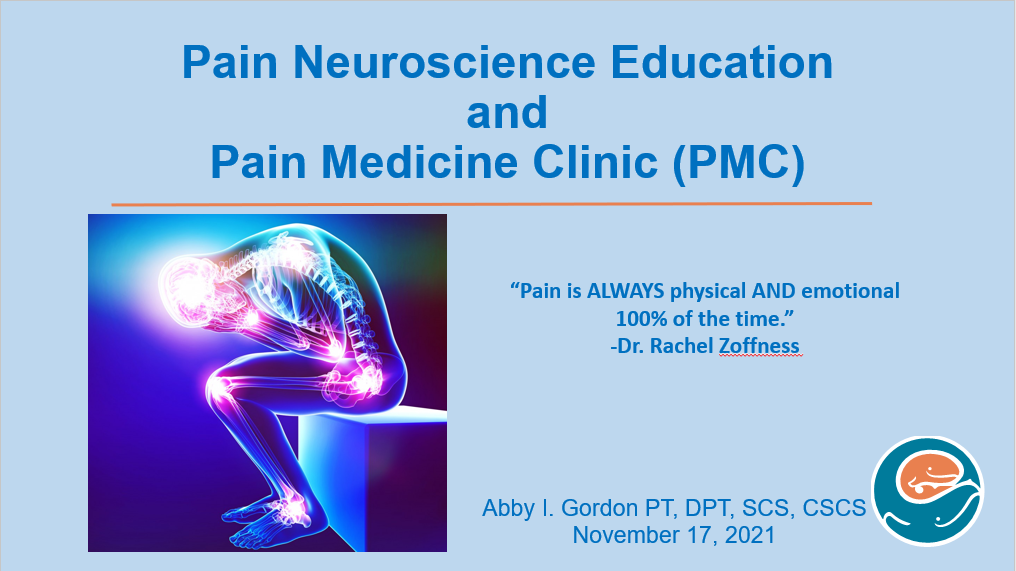
"Pain is ALWAYS both physical AND emotional 100% of the time."

As a Sports Physical Therapist at Seattle Children's Hospital and a member of their Pain Medicine Team, I work with many kids experiencing chronic pain. Most often, that includes seeing teenagers who can't tolerate going to school, hanging out with their friends, or participating in their favorite extracurricular activities. Sometimes it's even worse: kids who haven't been able to put a shoe or sock on (or walk) for many months because of chronic regional pain syndrome, which means a very long road back to their previous level of function.  Their pain could have started long ago with an injury or illness, and will hopefully improve with graded exposure to movement while learning about pain.  These patients can experience massive improvement in their lives if things go well.  I'm not crazy enough to think I can help everyone, but I've grown to embrace this work, including when I can't help my patients break their pain patterns.  To help kids with chronic pain with any success has required a commitment to collaboration with other healthcare providers and dedication to learning about pain neuroscience and pain management. To do that, I read. A lot. 

I also read a lot when I'm preparing to give a presentation.  This week, I was invited to talk about Pain Neuroscience and the Pain Medicine Clinic to the Seattle Children's Regional Rehabilitation Team. I like presenting because it requires me to focus learning on a specific subject and makes me seek out new resources. Educating clinicians is very different than patient care and it helps me consider my own beliefs, biases, and treatment approach.  I was fortunate to be partnered with Hematology/Oncology Physical Therapist Dr. Jacob Ross, who spoke about the intensive Pain Rehabilitation Program (PReP) where I sometimes refer patients when they need more care than 1 or 2 hours per week in my clinic will achieve.  If you're seeing Jacob at PReP, you're undergoing rehab or mental health or some school work Monday through Friday from 8AM-4PM for anywhere between two and four weeks! Based on this website, there are 83 pediatric pain clinics around the world, mostly (65%) in the United States, existing in 25 states plus Washington, D.C.  That means half of the states and the majority of the world doesn't have this available at all - and if you consider that the states who do offer these type of services only have it in a small number of places, tons of kids with chronic pain have no access to this care! In Seattle, I've worked with families from Alaska, Montana, Idaho, and Washington - and there are probably patients from many more places that my team members have worked with. 

If you're interested in learning about pain, I recommend you start with the work of Lorimer Moseley.  I've previously written about his books: Explain PainExplain Pain Supercharged and the Graded Motor Imagery Handbook, and I wrote about hearing him lecture and meeting him at the University of Washington, here. The NOI Group, who published those books, announced a new one coming out in December, "Pain and Perception: A Closer Look at Why We Hurt" which will be my next pain-related read.  From a different perspective, I also wrote about The Gift of Pain, which describes what happens when people are without the ability to experience pain. You don't pull your hand away from a hot pan or stop walking on a broken leg if you can't experience pain - a very dangerous scenario.  If you came upon this post looking to learn about pain management, any of those resources would be great places to start, but they're more about educating clinicians and, though they may be helpful for patients, I've now read a workbook more specifically intended for patients and think it's a great addition to this list.  

$19.95 on Amazon!
In preparation for our presentation, Jacob asked if I had heard of Dr. Rachel Zoffness. "Why yes, Jacob, I have. I follow her on all the social media and listen to her podcast episodes (OMG listen here or here or here or definitely my favorite: here), and I just finished reading one of her books."  The Chronic Pain &Illness Workbook for Teens was published in 2019 and was the first new resource I read for my presentation. Dr. Zoffness is a Pain Psychologist who teaches for multiple higher education institutions, she is the Co-President of the American Association for Pain Psychology, and she is on the Board of Directors for the Society of Pediatric Pain. Oh, and she treats patients experiencing chronic pain and has written two books. (She also wrote The Pain Management Workbook which I'm currently reading.) She's also released an $80 Workshop "Foundations of Pain Psychology" and more from that series are coming soon! Hopefully I'm not starting to look like a creeper because I've been fan-girling and re-sharing all her posts, podcast episodes, and books, so writing a blog about her work is probably the icing on the cake. When you find someone who can directly impact your patient care and knowledge, with easily digestible tools and clear, consistent messaging, I think you have to tell everyone.   

If this is your first time reading one of my blogs, you might not know that I write to organize and synthesize information I'm learning to refer back to or share with others.  Today's post starts with a look at a few of my favorite points from Dr. Z's Teen Workbook paired with information from two of the research papers I read for my presentation and it wraps up with a look at another pain management workbook from Dr. Greg Lehman. 

If you're a person living with chronic pain OR a clinician who works with patients experiencing chronic pain, in-person multidisciplinary care is the best treatment option, but that isn't available or affordable or feasible for so many people. The Teen Workbook could be a solution for patients who need something they can do independently.  It doesn't replace physical therapy or mental health counseling (or the many other treatments that may be appropriate and necessary), but it can certainly help educate patents and initiate behavior change that may be life changing.  

Jull 2017
1) Let's start with my favorite quote from Dr. Zoffness:"Pain is ALWAYS both physical AND emotional, 100% of the time."  This is the biopsychosocial (BPS) model at its heart and connected well to this image from Jull 2017 that I spent a lot of time discussing in my presentation. The Jull paper is a commentary on the BPS model and shows the idea that 3 different patients may have different amounts of biological - psychological - and sociological needs.  But also, the same patient at time 1, time 2, and time 3 has different amounts of these domain needs, too.  Today, for example, I might have a mild headache and I'm hungry but my mental health is good and I got to spend some time with friends so my social bucket has been filled, but my biological bucket may need more attention (maybe a sandwich for my blood sugar).  Tomorrow, I might have eaten enough for breakfast but be stressed about my pain presentation at work and spending a longer day at the office missing out on game night with friends - so my biological needs have been met, but not the social pieces that keep me going. You can't just look at your patient and think they only need biological care or mental health care at your evaluation and then assume it stays the same for all of their treatment.  I

The Workbook is clear about the role of the mind-body connection with regard to pain and explains what parts of the brain are involved.  It provides concrete examples, intentional questions for patients to consider, and a roadmap of strategies to try to better understand your own pain triggers from each of the three circles and identify solutions to try to reduce your pain volume.  Some of the pain books I mentioned above were really complex but this one is, without question, the easiest to understand and most user-friendly option for the general population, particularly when considering teenagers.  Too often the "Bio" portion is treated alone, with Physicians and PTs attributing pain to tissue damage or disease, but that (biomedical) approach ignores two major domains that impact the patient's presentation (Psych and Social circles). The unity of physical and emotional care is essential to patient success and Dr. Zoffness is screaming this message from the rooftops for everyone to hear.  I'm happy to amplify her message as often as possible to whoever will listen.  I actually ask my patients  "How's your mental health today?  Anything stressful going on?  When are your exams?  Have you done anything fun with your friends lately?"  If it's OK to ask them how their ankle is after they've sprained it, it should certainly be OK to also ask these questions.  Clinicians: please consider adding this to your day to day interactions with family, friends, and patients - and I don't just mean handing them the depression questionnaire and glancing at it.  Look them in their eyes and ask them how they're doing.  And mean it!

Tale of Two Nails
2) Metaphors, Analogies, and Stories help teach pain. It's no surprise that Lorimer Moseley is a mentor to Rachel Zoffness (and Greg Lehman) because they all use many of these to get their points across. I presented a few in my talk, also, but have a few favorites I use with patients.  One example that I liked from the Teen Handbook is about practice.  Think about an activity you wanted to learn. She uses playing piano, but I'm using basketball. At first, your hands struggle to dribble without staring at the ball and using your palm instead of your fingertips and the ball might bounce off your foot or miss the rim when you take a shot.  As a novice the task is more difficult and requires more effort and concentration.  So you practice.  And over time, you get better and better, until at some point, you've stopped looking at the ball and can run while handling it and can make shots from farther away and your form looks more consistent as it becomes automatic.  Your brain has developed new patterns that have been repeated enough times that the task is now easy.  With chronic pain, you're unintentionally practicing pain and your brain develops patterns that make it easier or more automatic to have pain.  The beauty of this is that with the appropriate treatment, the pain and learning can change.  Another example Dr. Z has written about, is "The Tale of Two Nails" which tells two really great stories that can inform our understanding of pain - but you should read those directly from her - so check out the article or buy her other book, because it's in there!

When Dr. Z is talking about practicing pain, she's explaining central sensitization, a phenomenon that I previously was struggling SO MUCH to understand. Central sensitization is a common characteristic of chronic pain, where you have an increased response to sensory stimuli resulting in hyperalgesia (increased sensitivity/bigger pain response to the same sensory input) AND allodynia (painful response to something that is normally not perceived as painful like hurting when you're touched by a feather on your skin.) Your nervous system changes when you experience pain for a long time. 

For my presentation, this 2011 Clifford Woolf paper depicts normal sensation compared to central sensitization.

Normal Sensation: On the left side there is an input - either something noxious (potentially dangerous - top) or a light touch (feather, bottom). Notice the black arrows for the top path (pain) and the bottom path (touch) don't converge and the brown blob (brain) is the same color as the rest of the  nerves.
Central Sensitization: Here, the same sensory stimulus occurs at the far left, but now the black arrows merge to the same destination (brain) and the color has changed because the system has adapted resulting in hyperalgesia and allodynia responses. 

3) It's a workbook: there are pages for you to do work.  This isn't just a book of education about pain. This is a guide with explanation of a key pain-related concept followed by actionable items to help improve your experience.  Sometimes I feel like patients who have had pain for a really long time are desperate for a physical therapist to DO whatever we can TO THEM hoping to dull the pain for just a few minutes.  What we really need is to serve as a guide, showing patients what THEY can DO on their own to turn down the pain.  They have to take control of their lives and do the work for any success to occur.  Physical therapists in chronic pain management should be cheerleaders, rooting on our patients as they make 1% progress day after day. People don't need to be 100% to live their lives fully, and often a really small amount of progress gets the ball rolling for a lot more progress to occur. I don't think patients realize how much control they have over their pain until someone empowers them to trust the process and themselves to get moving.  

Link

So, let's say you like the idea of a workbook and want to have multiple options to choose from, or you're an adult and want something a little deeper into the science. As I mentioned, I haven't yet finished Dr. Zoffness's other book, but I expect it might target that audience a bit more. There's another workbook I really like and was using prior to reading Dr. Zoffness's book. Dr. Greg Lehman's "Recovery Strategies" Pain Guidebook is available for patients or clinicians to access online.  I've previously written about attending his "Reconciling Biomechanics with Pain Science" course here and have appreciated learning from him both at the course and from his online presentations and social media. 

The workbooks are similar in their intent and both include key focus on the BPS model, describe how pain works, and provide action items for you to follow.  And both have many metaphors, analogies, and stories.  In particular I liked his metaphor for what happens to the brain with chronic pain: Consider that our brain is like a map of our body, and that a good map would be really clear, showing all the roads and rivers, but that with pain, things get smudged, almost as if you've spilled coffee on the map and the details get a little fuzzy.  The details of our body can get a little fuzzy with chronic pain, but with exercise and movement, we can clean up the coffee mess and the map gets clearer.  Overall, though, they're really quite different.  Dr. Lehman's book is written as a series of infographics, almost a choose your own adventure graphic novel, where you can take a single page out of it to educate your patient.  It includes pages of mythbusters, examining common misconceptions about various topics like "bones out of place," or how tissue damage found on imaging like an MRI doesn't always correlate with pain.  I think Greg's goes into more detail on how pain processes occur, looking deeper into the science of the nociceptive system, the spinal cord, and the brain, but he also acknowledges that it's meant to be used for patient and provider together because of its level of complexity. 

Also, I think that because Greg is a biomechanist, chiropractor, and physiotherapist, his handbook comes through from a more musculoskeletal lens. Though he fully emphasizes the BPS model, he's more from a bio background and gives adequate attention to the other bubbles.  Rachel is a pain psychologist who comes from a more psycho-social background, and thoguh she gives adequate attention to the bio, it's super interesting to look at their two workbooks and consider how they're trying to reach the same outcome for patients from different angles.  I think that patients would absolutely benefit from both. 

That's all for now.  December's blog post is about grief.  It's another long one and recommends several books on that topic, too. So if you're looking for holiday gifts that are books on pain, start with Dr. Zoffness's books - or if grief books might help one of your loved ones, there are several being reviewed next month.  Stay tuned!

TL;DR:

1) "Pain is ALWAYS both physical AND emotional, 100% of the time." 

2) Your nervous system changes when you experience pain for a long time.  This is called central sensitization which is characterized by hyperalgesia and allodynia. 

3) Teaching people about why we have pain and how the pain process works has been shown to help improve pain.  Multiple resources are listed to learn more about pain, often using metaphors, analogies, and stories to demonstrate complex concepts and make them more easily understandable.

4) The biopsychosocial model indicates necessity in attention to the biological, psychological, and social domains in treatment of chronic pain. 


Saturday, April 10, 2021

COVID19 is the WORST

I haven't written a blog post since December 2020 and had dramatically reduced my writing during the pandemic because I didn't think anything I had to say was nearly as important as what was happening in the world.  My last blog post came shortly after my dear Uncle Pete passed away and COVID was surging as people traveled for the holidays, celebrating Thanksgiving and Christmas without taking proper precautions.  

Glacier National Park July 2020
In late December, I started writing this post and I've kept a few parts because it's how I felt at that time. I really wanted to say that 2020 was the worst year ever but some great things also happened.  Babies were born, people got engaged and married, we bought condos and houses, passports were tucked away and exploring the beautiful national parks of the United States increased, there was time to complete home improvement projects that would otherwise remain on To Do lists, The Seattle Storm won the 2020 WNBA Championship in an isolated bubble, and the demon in the White House was evicted.   Instead, I'll say that COVID19 is the absolute worst.  The SARS-CoV-2 virus has destroyed millions of lives around the world, imploded economies and closed small businesses forever, had permanent impacts on relationships, and exposed real systemic weaknesses in the United States and in the world.  And it took both of my parents. 

I've missed blogging. I like organizing my thoughts this way.  Many of my past blog posts have tried to make connections between two things which may seem unrelated.  I like to draw these connections.  With this post I'm seeking ways to heal my broken heart and hoping that someone might learn something from my family's experience.  Perhaps I've gotten some of the facts wrong... the stress level was unbearable and I'm forgetting details.  It isn't intentional.  At the time of this writing, over 560,000 people have died in the US and 2.92 Million people worldwide from the Coronavirus.  (That makes the US about 20% of the deaths from the virus worldwide).  I'm sure others have similar stories of loss and sadness from the virus or from losing loved ones during the pandemic where they wouldn't be together.  My heart goes out to every single person who has lost someone they loved during the pandemic. I think it always must be hard to lose someone, but the inability to say a real goodbye or be surrounded by loved ones while mourning seems to hurt just a little bit more.  Here's how I remember what happened to my parents.

In December 2020, nine months into wearing masks, physical distancing, a lot of isolation, restricted travel, and not eating out, my Mom and Dad were hospitalized in Florida. Dad was admitted on 12/18/2020 and my mom followed the day after, 12/19/2020, which happened to be my dad's 76th birthday.  They both tested positive for COVID19, and they both had pre-existing conditions that put them at higher risk for getting sick and having a negative outcome.  They knew they were at high risk.  In fact, my Mom had been sick for almost the entire year of 2020.  They promised us they were being extremely careful.  They would drive over to friend's houses and stay in their car and talk to their friends over the phone just to see friends but not get close to them. They have such great friends who have been so supportive to us through this tragedy.

Most people asked right away "How did they get it?"  Honestly, we'll never know.  Dad worked at Home Depot, coming as close as he possibly could to his childhood dream of owning a hardware store.  He was "The Paint Man" and he promised he wore a mask during all of his shifts, washed his hands, and would even come home, remove his clothes next to the laundry machine and go straight to the shower so he wouldn't go near my mom until he was clean. There was a whole bin of Clorox wipes, gloves, disposable masks, and hand sanitizer right next to the door when we arrived at their home to pack it up... and cough medicine and tissues on the counter. They seemed well prepared. (They also had a TON of toilet paper.)  Perhaps Dad missed a hand wash.  Or maybe he ate a snack near someone asymptomatic but sick in the break room.  Or maybe his mask slipped down under his nose while his hands were covered in paint and he couldn't fix it.  He was admitted to the hospital first, but for sure they were both sick for several days at home.  I ordered a pulse oximeter while we were Skyping when I heard them both coughing maybe three days before they were admitted thinking there was really nothing more I could do to help them.  It was waiting when my siblings and I arrived to clean the place out.  I had been too late.

Thanksgiving 2019

Mom could have contracted the virus, too.  As I mentioned earlier, 2020 was a medically complex year for her, in and out of medical facilities and the hospital, so being around lots of sick people while also being vulnerable could have gotten her sick. They always shared things, so whoever got it was thoughtful enough to give it to the other one.  My heart kept telling me to get on a plane to help them, but I couldn't get over the fear of seeing all my own patients and their families at work and then getting on airplanes to travel more than 3000 miles to see my parents, knowing I could get them sick myself.  So I never went.  The last time I hugged them was Thanksgiving 2019. 

Initially when they were admitted to the hospital, my brother, sister, and I were able to video chat with each of them for a few days. Piece of advice: if you EVER go to the hospital and have the ability to bring your phone charger along, do it. Dad was on a COVID floor and put on oxygen right away and told me he felt crummy.  He said he was bummed they didn't give him chocolate pudding on his birthday - he got applesauce instead - so his sense of humor was intact.  Mom was admitted directly to the ICU because her blood counts were so low, but that was her baseline all last year, so she didn't really seem that different from her usual self.  (Side note: It's mindboggling that our healthcare system doesn't share information so that their medical records were not readily available. Why do I have to tell an ICU nurse my mom's list of diagnoses when she's in the hospital and her doctor's office is a few miles down the street?! I wonder how many people have died just because the US Healthcare System is so messed up. I digress.) 

Thankful for Video Chats
Mom had a blue ice pop and stuck her tongue out on a video call while my niece and nephew were around, never wanting anyone to worry.  She wasn't willing to allow people to "see" her without her hair done or her makeup on - saying she only wanted to video chat with us and my cousin Brad.  He was always her favorite and I'm so glad he was able to keep her company, too. We rotated who called them around our work schedules to occupy time and help us through and also called many times all together.  We spoke to every nurse who came into contact with them, asking how they were doing, getting updates every few hours or asking them to help us get in touch with Mom because she couldn't figure out how to use her phone, and then they would walk us down the hall with her phone so we could say hi to Dad. I spoke with the physical therapist who had seen both of them, and she advised me not to plan to take my mom home directly from the hospital and to let her go to rehab because she was so deconditioned. 

Soon we learned that Dad also had pneumonia and difficulty breathing. Mom was moved into Dad's room, having been deemed medically stable and no longer needing the ICU.  We were so glad they were together, but that was short-lived (unlike their 53 year marriage).  He turned a corner that night and took her place in the ICU needing a BiPAP to help him breathe and getting agitated if the oxygen wasn't at full flow.  On a BiPaP, you can't really talk - though you can move your mouth.  For a few days he was able to see us and respond to us and tried saying some words, including mouthing that he loved us, which will forever be his last words in my mind.  And then he got worse and we had to make really hard decisions. 

Here's where I hope we can be helpful to someone else.  Piece of advice: If your parents have comorbidities or are over 65 years old, sit down with them while they're healthy, while they're not in a medical crisis, while everyone is calm, and ask them about how they want things to go in the end. It is a HARD conversation, but it makes a huge difference when a stressful moment comes.  Tell them the importance of having a living will and sharing with you what their wishes are and where they're keeping the paperwork. Get copies if you can.  A living will (or advance directive) is a paper that indicates your wishes for medical care and should go with them if they ever need to go to the hospital so the hospital knows their wishes, too.  Let them handle the hard decisions for you and have it decided in advance.  Fortunately, we had sorta done that with our own parents, though they didn't bring the paperwork to the hospital and there was confusion in the heat of the moment, but still... we weren't completely in the dark.  Mom's oxygen stayed mostly normal throughout her whole hospital stay, but she had starting getting really confused right when things were happening to Dad, which I think was a blessing, but which also left it up to the three of us to decide what to do. 

Backing up for a moment, in 2018, I read Atul Gawande's book, "Being Mortal: Illness, Medicine and What Matters in the End." The basic premise is that Dr Gawande, the author, is a physician whose father is nearing the end-of-life.  He realizes that not only does he not have enough of the answers for his own family, but that he also does not guide his own patients down some paths that could ultimately help them. This was the first time I seriously considered that when someone is very sick, they may not want every single medical approach used to try to keep them alive. Some medical approaches can keep you in a coma for a long time and, while that’s your choice to use those options, it’s possible you’d prefer to allow life to end more quickly as the likelihood of recovery from those extreme medical treatments may be less successful with more comorbidities or older age.  This was exactly the scenario we faced with Dad, first, and then Mom two weeks later.  Both were presented with options.  One option would have kept them alive, but almost definitely would not lead to them ever going home and returning to their prior existence.  We really only considered these options while waiting to find out if the facilities they were in would let us come and say goodbye to them, but when we were told that would not be an option, we didn't want them to suffer.  This quote from the book stood out to me: “We’ve been wrong about what our job is in medicine. We think our job is to ensure health and survival but really it is larger than that. It is to enable well-being. And well-being is about the reasons one wishes to be alive. Those reasons matter- not just at the end of life- but all along the way.”  

The book lists questions that should be asked nearing end-of life such as "what are your fears?" and "what are your hopes?" and "what is your understanding of the situation and its potential outcomes." It also talks about weighing short term versus long term options, considering risks versus benefits, and gives praise to hospice and palliative care, which are not the same, and which are often misunderstood.  It was the beginning of my learning about end-of-life care and it led to a family meeting with my parents, sister, and brother, where we talked about some really key things, including their living will.  We also talked about their legal will and found that it was long overdue for being updated. (It still had my sister as my legal guardian if something happened to my parents.  I was 33 at the time!).  We discussed where they kept their finances, but they elected not to share their financial circumstances with us.  We should have asked them to add one of us as a beneficiary to the accounts in addition to them, but the likelihood of both of them dying two weeks apart like they did was really tiny so who could have known?!  We knew their life insurance policy company and numbers and knew where they kept their passwords for online information.  These are all things that we did right that I think other people need to discuss and made things easier for our family.  I had a manila envelope with a copy of their will and living will, a copy of their life insurance policy, their social security numbers, and a list of contacts they thought were important for us to reach out to if something happened to them such as their lawyer and accountant.

Anyways, I'm pretty sure it was Christmas Day when Dad tried to ask the nurses for something and they gave him a notepad to figure out what he was trying to say. He wrote "milkshake." He wasn't allowed to eat or drink on the BiPap, so they couldn't give him one and I'm shocked he was able to manage legible handwriting since it always looked like squigglies to me. My Dad ALWAYS loved Chocolate Milkshakes from McDonalds so when the nurse asked if that had any meaning to us, we all had to laugh.  I'm sure he probably thought life wasn't worth living if he couldn't have his favorite treat. 

Another piece of advice: find yourself a best friend who is an Emergency Medicine Physician and loves your parents as much as you do so that when you ask her for help with complex medical decisions, you know it's the best recommendation possible for your family.  This piece of advice will be nearly impossible for most people to achieve because you can't have my best friend and she's the world's greatest human, so maybe just find some medical friends you trust for advice when it's needed and know that making these decisions is really hard so having people to discuss them with is really helpful.  My sister also has a best friend who is a nurse who gave us helpful advice throughout this experience and is part of our family, too.  Having healthcare provider friends is just the best and really helps with big medical decisions. 

We said goodbye to our Dad, all three of us together, on a video chat arranged by a very kind nurse, about an hour before he passed away on 12/26/20.  The nurses were so helpful to us having already missed their Christmas time with their families to be with ours, and certainly having witnessed countless other people die in the preceding months. She asked us for a list of important names for her to tell him who was with him before they took him off the BiPap.  My Mom was somewhere in the same building, unable to be there with him, and not knowing what was happening.  I like to think he knew that we were with him and that it was OK for him to leave us behind.  (To be clear, I'm not OK with living life without him, but he didn't need to know that.)

So now, my mom is in the hospital in Florida, testing negative for COVID but still disoriented and confused, my sister is in Connecticut, my brother is in Washington DC, and I'm in Seattle. We need to get my Dad transported from Florida to Connecticut for his funeral.  And we can't have family or friends there - just immediate family up to 12 people.  And... we have to tell my mom what has happened.  Because she doesn't know.  And when we tell her, at first she doesn't understand, and then she doesn't remember.  And so, we have to tell my mom, via video chat, three days in a row, that our Dad - her beloved husband and best friend for over 50 years, has passed away.  Talk about watching someone's heart break.  Repeatedly.  Her heart was actually screaming, I think. The sounds that come from such intense heart break are unique and hard to describe. Even a few days later, on one of our calls just between the two of us, she asked me about Dad again to make sure it was true, begging me to tell her that he had not suffered, almost like she heard it in a dream and couldn't bring it to reality.  And then her nurses tell us they want to discharge Mom to rehab for her to get stronger and eventually go home, but of course she doesn't want to go home if he won't be there. I cannot even begin to express how much agony those moments held and how I keep replaying them over and over in my head.  My heart broke for her so many times and none of us could be with her - or even with each other.  The medical facilities all kept saying we wouldn't be able to come in and be with her - and for us to even try to fly there only to be turned away seemed like even more risk of getting sick or transmitting the stupid virus.  

I haven't gone into much detail about what the day-to-day looked like while they were in the hospital.  Honestly it was a bit of a blur.  I was talking to nurses or doctors between 4AM and 5AM PST (Seattle) because they did shift changes at 7AM EST (Florida) and then I would see my own patients.  Sleep cycles were disrupted, the stress of everything made eating habits and exercise routines fall apart.  My brother, sister, and I were in constant contact with one another and I would sit in my car during my lunch hour trying to video chat with my Mom as much as I could, and, early on, hoping to get some time to chat with Dad.  We quickly figured out the best times to call nurses and how to set it up so we could actually see Mom and Dad through various video chatting options.  Since we don't all have iPhones, we figured out that we had to do our video chats through Facebook or WhatsApp and knowing our options was important, otherwise we had to leave someone out and it was hard to take in all the information and then repeat it again later on. 

So Mom went to rehab.  She started to get better, but she was really, really sad.  So were we. She always had told us that she couldn't live without Dad and we all worried for her because we knew she couldn't stay in Florida alone.  My sister was looking for a place for her to live in Connecticut, calling around to all the local facilities, because Mom was pretty sure she didn't want to stay with any of us even though she didn't want to be alone.  My brother was on-deck, waiting to head to Florida to pack up all their stuff for a move.  I applied for FMLA to take time off when she was cleared to go home after my second vaccine shot and told her she better rest up because Abby's Boot Camp was going to be hard work.  (It's probably not a good idea for physical therapists to treat their family members, but I think that's because we would work them harder than our patients!) Everyone fell into roles and pulled their weight to get things going while we were also preparing for Dad's funeral which was going to be on 12/31/20.  I think it brought Mom a lot of happiness to see us all together in Connecticut.  I had flown home and wouldn't take off my mask the whole time I was with my family because so many people in the airports and on the plane weren't wearing masks and having watched my Dad die from COVID, I was horrified of getting the virus and spreading it. The day before his funeral, I Facetimed Mom and explained that we were going to have his funeral the next day and who we had invited. I asked if she wanted to attend virtually but I hated that none of us could be with her for it and thought it was reasonable if she didn't want to go through that alone. She chose to watch, so the next day, I Facetimed her from the cemetery so she could attend my Dad's funeral.  Was this the worst it was going to get?  Because it was horrible.  I had headphones in so she could talk to me and I could be with her, but the only thing she asked was to see her grandkids and my sister and brother for a minute to look away while my Dad was lowered into the ground.  That night as the rest of the world rang in the New Year, eager for 2021 to start, I sat alone in my hotel room on Facetime with my Mom, crying, talking about things we would try to do as soon as we broke her out of rehab.

Mom wanted out of rehab SO badly and we all wanted to bust her out, too.  She asked me what I thought she needed to be able to do in order to go home and, the true Physical Therapist I am, I told her she needed to be able to walk to the bathroom without help.  The minute she walked to the bathroom with a walker and only a little help, she called and told me I had better get ready to go to Florida.  But that night she started having pain.  All year long when she had been sick, she had been having some pain on and off, but she said this was a lot worse.  Talk about feeling helpless - what could I do?  I stayed on the phone while she waited for nurses to come in and try to get her pain medicine.  She was moaning and crying out.  I had to hang up to go to the bathroom and in the time I was gone, she left me a voicemail saying she wasn't going to make it through the pain she was having.  In the morning, she was taken to the hospital.  She tested positive for COVID19 again and was found to have other health complications.  It was time for difficult conversations, yet again. The doctors asked for our opinion on treatment versus hospice, but we knew her chances of survival even with surgery were not good and when we asked Mom, she very clearly told each of us that she loved us and that she was going to go be with Dad. I couldn't believe my ears.  Now my heart was doing the screaming. And so she was transferred to Hospice and we said goodbye and she passed away two weeks after Dad, on 1/9/21. A few days later, I flew back from Seattle to Connecticut, stood at the same cemetery, and watched my Mom join my Dad, feeling like I should have been Facetiming her like I had two weeks earlier. 

RIP Mom and Dad <3
I'm sure there's more that I could share that would probably help others in the future, but my heart has broken too many times writing this much.  I think you have to cry some serious tears to move through grief, and I've been doing my fair share. I hate crying in front of other people, but unfortunately I can't seem to avoid it these days. The aftermath of losing both of them so close together has been incredibly long and challenging and still continues.  It feels quite like an open wound that keeps re-opening every day or two as more paperwork or phone calls or bills are managed.  I've never been so grateful to have siblings and my niece and nephew.  We all had our breakdown moments and different struggles through the past three months.  We have different support systems, different jobs, and different home responsibilities.  At the end of the day, we've been there for each other, and that has made all the difference.  I can't wait for the pandemic to end so we can all be together and appropriately honor my parents.  The rest of my extended family and so many of their friends need their opportunity to mourn, too, and that has been neglected during the pandemic.  I hope that someone finds a way to put our pain to good use, and I can't wait for the pandemic to be under control.  Please get vaccinated when you have the opportunity and continue to wear masks and stay distanced.  It's not time to party yet.  Don't let your family members suffer the way mine have.