Showing posts with label training. Show all posts

Thursday, September 23, 2021

The CALU Summit

Hey followers!  It's been a little while. How are you all doing?  Have you checked in with yourself to make sure you're taking time to relax, breathe, eat, sleep, and move?  If you have any nurses or doctors in your life, send them a nice note or bring them a coffee because they're working so much harder than they've ever had to.

Today I'm writing about the CALU Summit which I recently attended virtually.  The name CALU comes from the combination of Clinical Athlete and The Level Up InitiativeI've attended A LOT of continuing education courses over the past seven years as a PT and I'm certain this was the most fun learning I've ever experienced.  This was my first CALU Summit - their second time holding the event - but I have interacted with both groups in different ways for many years.  In the past, I went through the Level Up Initiative's mentorship program and then served as a mentor and am planning to again. I've previously written about them here. Clinical Athlete puts out podcast episodes that I've listened to and I've participated in some of their journal clubs.  Both groups have loads of social media worth following and are led by super smart physical therapists who believe in educating healthcare providers.  These two networks have impacted my patient care and helped me develop as a physical therapist. In my opinion, both groups are MUST FOLLOW accounts for physical therapists, strength coaches, athletic trainers, and any new grad healthcare provider - but would also be great options for sport coaches, athletes, and parents of athletes to check out! (Specific names to search for on Instagram include: @thelevelupinitiative @clinicalathlete @zakgabor.dpt @stephallen.dpt @quinn.henochdpt @jared.unbreakablestrength @rebuild_stronger - sorry if I missed anyone!) Here are some of my favorite take-aways from the Summit! (Disclaimer - this is what stood out to me, not direct quotations.)
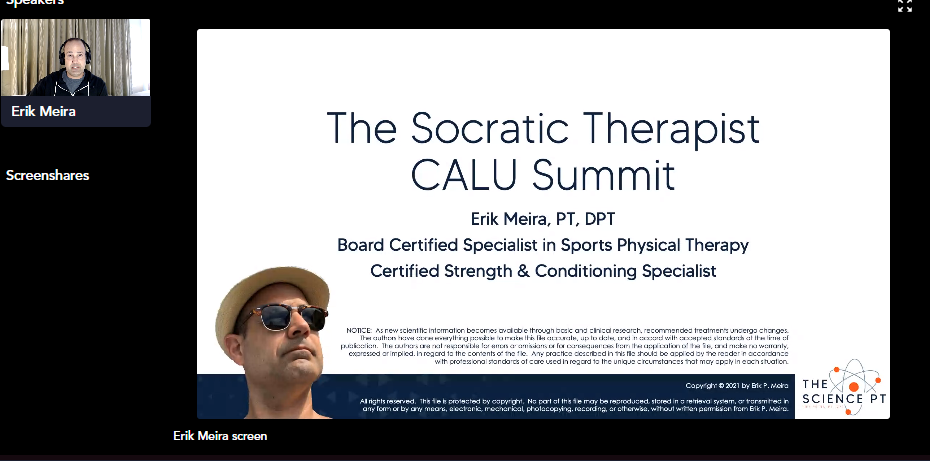
Each day of the Summit had a theme: barbell athletes, endurance athletes, and ACL rehabilitation, with two presentations on each topic.  There was key focus on the biopsychosocial approach, communication, and on case study discussion. The keynote speaker kicking off the weekend was Erik Meira, The Science PT whose talk was "The Socratic Therapist." He quoted Socrates, "What I do not know, I do not think I know," starting us off with philosophical thinking and the understanding that healthcare providers who dedicate themselves to continuous learning are simply working to be "Less Wrong" every day.  None of us can really ever know for certain that what we're doing is the absolute best option for our patients, but with scientific experimentation and consideration of evidence, we can get closer to being right by increasing our knowledge. There were several moments during the course where I had the chance to think back to how my practice has evolved based on what I've learned.  This was the first instance of that reflection. Erik offers his own courses, both online and in person, one of which I'm about to start after I finish ACL Study Day (there aren't enough hours in the day!).  Definitely check him out.  (IG: @erikmeirapt)

Day 1: The Barbell Athlete:  

Presenter  #1 was Stefi Cohen - a super strong woman, competitive powerlifter, and physical therapist who founded the Hybrid Performance Method and coauthored the book Back In Motion.  She described her experience with a low back injury with consultations from from both Stu McGill and Greg Lehman - well known Canadian practitioners in the rehab space who have different approaches despite Greg having been a student of Stu's.  Stefi shared the outcomes and her take-away understanding from those providers.  She discussed that she spent four hours doing special tests with Stu McGill and ultimately was in a lot of pain for an extended period of time after her examination and that his approach to avoid certain movements and take time away from her sport didn't resonate with her - but that she appreciated his estimate on the amount of time it would take for her to get back to her previous level of competition.  His timeline turned out to be fairly accurate, from what Stefi described.  In contrast, she saw Greg Lehman virtually and found a rehab approach that aligned with her own beliefs and with the understanding of finding safety in movement and progressing from there.  

Presenter #2 was Quinn Henoch - founder of Clinical Athlete, competitive weight lifter, podcaster, presenter, coach, and physical therapist.  Quinn's talk, "A process to help barbell sport athletes get back to those gainzzzzz" described a roadmap to coach/rehab barbell athletes.  The path has bookends starting from where an athlete's current physical function is and working towards what's "done" for them. Initiation of the plan requires the physical therapist (or coach) to define their role and set expectations based on the stated goals of the athlete.  Completion of training needs to be valuable to the patient - not the therapist.  For some clients, "done" with a program is able to complete 1 activity or task or be able to tolerate a certain position or load.  When an athlete has a specific goal in mind, we as practitioners should understand the target and guide to that.  It's just like all the kids are saying these days: "Understand the assignment."  It doesn't matter what I think "done" should be for my patients - if they haven't reached their goal, I've missed the mark.  I definitely have fallen into this trap in the clinic where I've wanted someone to be capable of doing something that they're not interested in doing.  Or, right now, I'm working with a teenager whose parent wants them to start running after an injury, but the kid wants nothing to do with running at all. Done for this patient is walking, going up and down the stairs, and participating in PE without pain.  The approach has to fit the goals of the patient - not their parent and certainly not what I think matters.   
Throughout the weekend, there was an ongoing chat that allowed participants to interact with each other.  I particularly enjoyed the witty banter between the powerlifters and the weightlifters throughout the weekend.  As a person who likes to deadlift but who is fearful of destroying my living room if I try to snatch in my home gym, it was easy to see which side of those discussions I was on.  

Day 2: The Endurance Athlete
Presenter #3: was Ellie Somers (IG: @thesisuwolf), owner of Sisu Physical Therapy and Performance,  physical therapist, coach for running, strength, and businesses, and I'm proud to say, my friend, whose talk was "Communication with the Endurance Athlete." She previously worked at Seattle Children's Hospital. Ellie paired her own wit with the wisdom of Ted Lasso.  Ellie also emphasized the need to have a plan with a specific purpose that is meaningful to your clients and encouraged practitioners to highlight the strengths of their patients.  Too often in medicine we look at our patients and find all the things that are wrong with them.  That has to change!  Why can't we look at our patients and observe all the things that are great and empower them?  I've emphasized this approach in my patient care and loved the quote she shared "You're not in pain because you're weak, but getting stronger can help change your pain."  

Ellie also shared this article "The enduring impact of what clinicians say to people with low back pain" which I've read in the past and which is essential for young clinicians to read.  It's a 2013 study from New Zealand summarizing open-ended interview questions regarding healthcare interactions and beliefs from 12 patients with acute low back pain and 11 patients with chronic low back pain.  One theme was that patients had high trust in their clinicians and their beliefs were strongly influenced by what their medical providers said.  However, some patients did not find their clinicians to be competent or found the medical message to be a mismatch to their beliefs and rejected what the medical providers advised.  Almost subtle, a heartbreaking anecdote is a response from a study participant who shared that so many providers kept telling her back pain came from a weak core, she had an abortion because she thought she was too weak to carry and deliver a healthy baby. 


Presentation #4 was Chris Johnson, owner of Zeren Physical Therapy, triathlete, presenter, running coach, and physical therapist who performed a spoken word presentation which was a unique alternative to typical presentations.  Talking about running injuries, he dropped some true gems like "Tendons love tension; tendons take time (to rehab/heal)"  He talked about bone stress injuries with clinical pearl: Pain with unloading the leg should evoke a high index of suspicion for a bone stress injury (BSI) and when BSI is a potential diagnosis, no progression to running should occur until walking is pain-free. Another pearl was to stop worrying so much about footwear and foot strike position with running and consider other variables such as the sound of running instead.  I'll be very honest - I'm not an auditory learner, so I'm looking forward to re-reading the presentation when it gets sent out so I can further internalize the key messages and expand even further.  

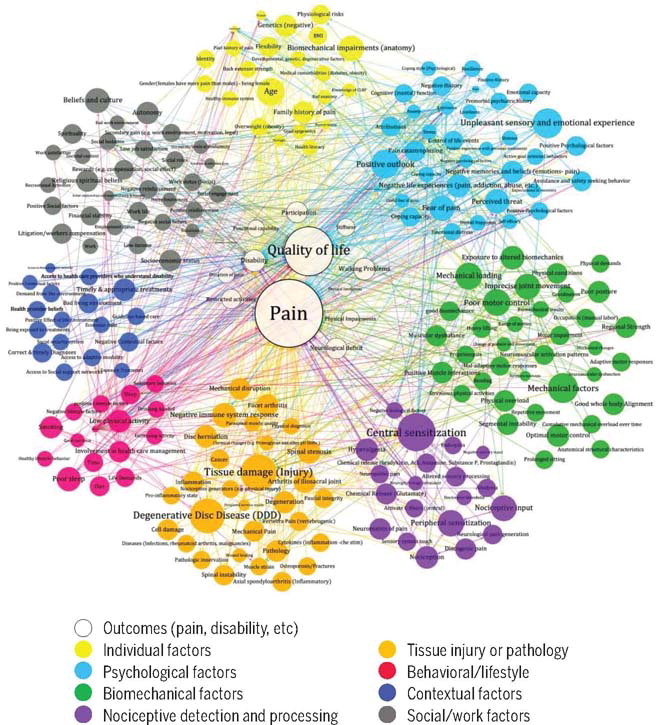
Throughout the Summit, this same image appeared three times.  Isn't it nice that the presenters were so like-minded that this could happen?  The picture shows contributors to low back pain (and likely applicable to most pain) from this JOSPT paper from 2019. Too hard to read?  Doesn't that emphasize the point that pain is incredibly multi-factorial and the orange colored tissue-related factors are a relatively small contributor when you consider the big picture?  
In my opinion, the virtual format was excellent because no travel was needed, however that does lose some of the in-person benefits like networking events and dinners.  The organizers tried to combat that with a virtual Happy Hour on Day 2 where many clinicians hung out and chatted about whatever we wanted - which of course included the sports teams we support, where we're all at in the world, and lots of other interesting topics. 

Day 3: ACL Injury and Rehabilitation

Presenter #5 was Derek Miles a physical therapist with Barbell Medicine who is well known for his posts about pieces of meat (representing the human body) being poked, prodded, needled, scraped, taped, or treated with other common rehab approaches to demonstrate how some of these approaches are not doing what we think they are. (IG: @derek_barbellmedicine).  Derek kicked off day three's focus looking at the biopsychosocial approach for ACL injury.  He reiterated the need to have a plan with rehab, outlining that the first step after an injury is to get the patient back to being a human, then an athlete, and last should be consideration for their specific sport.  Walk, then run, then play basketball.  How do we achieve this? Post ACL injury or surgery, there's a long list of things that people can't do. Patients should know that, but clinicians can direct their attention and focus on all the things they CAN do.  Keep your athletes around their teams and with their teammates as much as possible.  Send them to practice with clear understanding of what they are able to participate in.  It's hard because there's a lot of discussion about what they shouldn't do, but make the injury an opportunity to learn the sport in a different way. 

Early ACL rehab may be boring, but it's the foundation to the later steps and often these athletes can do more than they think they can.  The ACL injury only directly impacts one limb... but there is another leg, two arms, a torso and a head that all need to continue functioning and training and should not be ignored.  If your clinic doesn't have sufficient equipment to load these athletes and get them stronger, sufficient space to get them moving, and have a way to test the athlete - you probably don't have enough to adequately rehab an ACL injury. The key takeaway: LOAD HEAVIER!  As Erik Meira so eloquently puts it, "It's the quad until it's not the quad."  Derek said he tells his athletes to do quad sets ALL THE TIME and then, when you hate them, do 5 more, and repeat again tomorrow.  No reps and sets.  Just constant.  I think I'll just writing 1,000,000 sets on my Medbridge HEP sheets from now on!

Presenter #6 was Laura Opstedal, owner of Build Physio in Montana who does lots of ACL Rehab and research and also previously worked at Seattle Children's Hospital. Laura reiterated Derek's points about quad strengthening and how important that is to athletic movements as well as the importance of testing athletes who have had an injured ACL prior to allowing them to return to activity.  For me, one particular quote stuck out from this presentation. "Look at your entire ACL rehab program as preventing a hip strategy and forcing a knee strategy.  Keep the trunk upright." I know I valued quad strength and testing before seeing this presentation, but I definitely was not doing a sufficient job avoiding the hip strategy.  In fact, I've been guilty of encouraging it sometimes, but Laura addressed the inferior patella pain that some patients feel with a knee strategy that I previously was avoiding, acknowledging that sometimes these athletes are going to have a little bit of pain and we need to know when that should matter and when it's ok to continue. ACL hip strategy study. It's only been two weeks and I've already changed this in the clinic. Also encouraged were achieving passive terminal knee extension within 10 days of surgery, having at least an 80% LSI before returning to run, don't ignore calf strengthening in our patients with knee injuries, and do more open chain knee extension. There were considerations for the slow stretch shortening cycle compared to the fast stretch shortening cycle and training them separately... yup, I never thought of my rehab in those terms before, though I do have some drills I like that focus on both, the new perspective is going to make a big difference for my patients. 


I definitely didn't do these presenters justice, but hopefully this "small" taste will encourage those of you who are rehab providers to start following some new clinicians and those of you who aren't in rehab who, for some reason, like to see what I have to say, hopefully learned about the complexity of pain and can gain some appreciation for the effort that any of your medical providers are putting in to maintain their licenses through continuous education and growth.   

One final note: "When a measure becomes a target, it ceases to be a good measure."  Using certain tests which are meant to be used to show progress and not to show culmination of progress is not the best approach.  I know I often feel like my return to sport tests are the end of my rehab.  This might be fine for some injuries like an ankle sprain where the athlete has been playing their sport without issue and I'm looking for a way to determine if symmetry has been restored.  But in the case of an ACL injury, the RTS testing often occurs to allow the athlete to start playing their sport.  This isn't good enough - and it's another chance to be less wrong tomorrow. 


Thursday, April 25, 2019

It Takes a Village


ID 6052480

© 

| Dreamstime.com
Happy Thursday, blog followers!

Warning: In this week's blog post, I'm being selfish.  I'm making a situation that has nothing to do with me, entirely about me.  But it's OK to do that if you admit it up front, right?

This past week, I received some terrible news. The instructor of my weekly Turbo Kick class, Meg, informed our class that she is moving away.  I’m sure she’s making all the right decisions for her family, but to me, this was crushing, devastating, drop me to my knees in tears while unnecessarily over-reacting, punch me in the gut, painful news. I didn’t see this coming. I’m not prepared.  Do I have enough time to get used to the idea of a new instructor coming in?  It took me SO LONG to psych myself up into attending her class in the first place! And it just can't be the same with another instructor.  Say it ain't so!

So, this week I'm writing about the village of people I've assembled to help me get my health in order as well as the positive impact of attending group exercise classes. This was a great reminder that you might be changing someone else's life without knowing it.  Sometimes I forget this when I'm working with my patients.  I have no clue how I've impacted people other than with their physical therapy, but I hope I've helped others the way Meg has helped me.

I joined the YMCA in August 2018 as part of my elaborate and carefully plotted plan to combat my eating disorder and body image issues, which I first discussed here.  I had been in severe denial about what was going on in my life, blissfully ignorant to reality, and had started seeing my therapist at the same time.  I decided to create a small village of people to help me with my journey: a therapist, a dietitian, someone to revamp my physical fitness - who ultimately became Meg - along with some family and close friends. I was entirely unmotivated to move my body - which I was currently hating - and I was sick of my training routine. I wasn't looking for group classes when I joined, hoping could manage my physical health myself, but considerd I might need another person in my village to oversee that, too.

I was initially opposed to group classes because I experienced a particularly uncomfortable CrossFit situation when the instructor told me that "a girl of my size should be lifting a lot more weight." To some extent he was correct - I could squat and deadlift a lot more than I was using there.  But at that time I hadn't been training much and knew the planned workouts included high repetitions and the volume was too much for me to load up the barbell as they recommended.  They pushed me to lift more, I pushed back saying I wasn't ready, and it was ultimately an embarrassing and painful situation.  It is specifically why I treat my own patients meeting them where they are - not where I want them to be.  So I had that experience, plus, I hate the idea of people seeing my body moving.

2008 CT Sun Yoga Class

Those reasons led to apprehension for group classes with the exception of yoga. In 2008 I went to a group yoga class with the Connecticut Sun and have been able to continue with yoga intermittently since then. I wrote about my recent return to yoga here, but, as I previously wrote, I only do hot yoga where I get high (or delirious) from oxygen deprivation that I basically can't tell anyone else is in the room.  Group exercise class?  For sure the others would notice that I'm fat, that I can't jump, that I will get tired, that I sweat a lot and breathe heavy, and that I'm not very coordinated.  Now, many months later, I'm here to tell you none of this occurred.  It was all in my head!

In October 2018, after walking by Meg's class on several preceding Mondays, I finally talked myself into trying her class.  I told myself that I knew the music was good and that I had to complete the class but that if I absolutely hated it, I would try one different class before swearing off group classes for the rest of eternity.  Dramatic much? Thankfully, Meg ran up to me that first day, super spunky and upbeat, introduced herself saying that her class was super fun and that it didn't matter if I knew any of the steps, just keep moving however I wanted to. I've been hooked ever since.

Here’s why Meg’s departure hit me like a ton of bricks.  I was in a deep dark hole of emotions and confusion when I started this journey and quickly learned that I needed to ask for a lot of help. I built my village including three smart, beautiful, strong women to help me pick myself up off the floor and put my pieces back together.  My therapist and dietitian knew each other, use similar approaches for treatment, and know all about my issues. I don’t think they intend to be sympathetic towards me, but sometimes they are, and sympathy isn't what I want or need.

But Meg is different.  She's not sympathetic towards me because she has no reason to be. She doesn't know why I'm in her class or what I'm dealing with. She barely knows anything about me, really, and that's just how I liked it. She's empowering and motivating because that's in her nature. And yes, it's her job, but there are other instructors in there with totally different vibes. I've walked by their classes a bit, too, wondering if I should add to my routine. Choosing her class was not a mistake. She welcomed me in, kick started most of my Mondays since October with high energy, a positive attitude, motivation, and joy. I purposefully attend her class right before going to see my therapist because turbo kick is basically a class where you can punch and kick your problems in the gut and my G-d I needed that.  It also lets out a lot of energy, which calms me and helps me organize my thoughts before saying them out loud.  When I started pairing turbo kick with therapy, I was really struggling to see my therapist because it was so vulnerable. Dance fighting with a room full of strangers is vulnerable, too, but way more fun than one on on conversations in a room with a couch and too many boxes of tissues.  I can’t actually tell which “treatment” has helped me more over the past six months, but I can tell you what this class did for me.

First- a group class has other people working towards their own goals- but the goals can be kept private as you work towards them together. I don’t know if people in the class are trying to lose weight, get stronger, let off some anger issues, or hear some current music. I don't know if they secretly wish to be a performer on a stage - but instead work as an accountant because they need to pay their bills. I don't know if they want to learn ways to protect themself if they were attacked, because truthfully, I would definitely use the moves I've learned there if someone came at me. I don’t actually care why they’re there. It doesn’t matter. We’re all going to do the same moves and at the end be disgustingly sweaty and high five each other with a sense of accomplishment towards our own goals.  I can go deadlift and have an awesome lift on my own, but there won't be anyone to high five me when I'm done. And because people start recognizing each other, it really does start to feel like community. Like if you missed a week, someone might ask if you were OK, or if you went on a nice vacation. Sometimes you just need that!

Second- all my concerns about other people watching me were entirely unfounded.  Nobody else is looking at what I'm doing in this class. They don't care. Once we get started, I barely even notice there are other people in the room, except to watch out for kicking my neighbor and to follow Meg instructing the moves.  Everyone is trying to get the steps right for themselves.  The rule is to keep moving even if you don't know the steps... but sometimes I know the steps and choose to do something different. For example, I CAN do burpees... but I hate them... so when there’s a burpee in the routine, I do jumping jacks or squats or whatever I want. Because for me, the whole point is to move. Not get better at burpees. Once I stopped exercising to lose weight and started doing it because it made me feel good, things in my life started to get a whole lot better. It’s still a struggle to make myself move regularly, so I attend a weekly dance party with some uppercuts and roundhouses thrown in and I actually feel like I’m prepared to conquer the week - whatever it may throw at me.

Third- and probably most important for my personal journey- the room is lined with a wall of mirrors. For the first several weeks, it disgusted me to see myself in the mirror. I was sure others could see how gross my body was. When I was diagnosed with my eating disorder, my testing suggested that I didn't have any body image issues. This was apparently very wrong. I've learned it was/is a huge problem. Prior to facing my issues, I didn't realize I was avoiding mirrors.  We have them at work, too, and I didn't even notice how much I put my back to them.  If I lifted at the gym, I didn’t want to see myself doing it. I don’t have a full length mirror at home and have never had one since I moved to Seattle.  I didn't actually realize how much I had been avoiding looking at myself until one class I caught myself in the mirror while doing a punching move and realized holy crap! That's me!  That's my body! It's doing all these things.  It's working hard and feeling pretty good. I’m actually able to tolerate looking in the mirror and smile at myself a little now.  That may not sound big... but for someone who went from not knowing what their body looked like at all and hating her own skin to tolerating her body and appreciating the things it’s capable of, I think it's huge. I’m sure somewhere down the road, there will be a time when I might like my body- and maybe even love it. That's not where I'm at right now, but I’m sure that the road started with the mirror in turbo kick.

And so, while I am sad to know my village is evolving, I’m eternally grateful for the role Meg played in it at the beginning.  Can't wait for the next Turbo Kick class.

Thursday, December 20, 2018

Anatomy Semantics

I got an email from someone who has recently gotten into a regular workout routine, trying to get into better shape with some weight loss and increased strength.  He was wondering if I would look at the program he's been using for a while and make some recommendations on how it could be improved for better gains.  The program was made from snippets he put together from men's health magazine.  So we set up a phone call to go through the program.  I've previously written a little bit about strength training in this post, entitled "What do physical therapists do? We Strength Train."

Biceps - Two Muscle Bellies 

The strengths of the program he already had going were three:
1) He was regularly participating in exercise and the workouts were planned and programmed with ways he could progress them.  In my opinion, the best training program is one you will do consistently.  But once you've got consistency down... all programs are not created equal.
2) Pretty much all the body parts were covered in some way.
3) He had learned to squat and deadlift.  Though we've previously worked on his form via Skype when he was having some pain doing it.  I had him using a broom in his house to hip hinge and weight shift and change his set up and we had a blast doing that probably two years ago.

The key weaknesses that I noticed were:
1) The program was separated out into six different days: arms, shoulders, chest, back, legs, and core.  He spent 1 hour focusing on that body region when he did that training day, and he strength trains about 3 times per week.  Because of that, each body region was only getting targeted twice per month - and that was only if no days were missed due to scheduling complications.
2) There were several single muscle exercises including wrist curls and wrist extensions or hamstring curls that would be fine for some training goals, but really didn't optimize him reaching the goals he stated.  In my opinion, these take up time and energy from bigger bang-for-your-buck activities.  They have a place - and I use them with patients sometimes - but in general I'm team multi-joint exercise.
Triceps: Three Muscle Bellies
3) There were no single leg activities.  I use single leg exercises a lot with patients and have also written about the seven key movements a la John Rusin here. squat, deadlift, lunge, upper body push, upper body pull, and carries.  One of those key movement patterns is the lunge... and this program didn't include those. I really like single leg activities because it gives you a chance to work on balance which also incorporates the core and because it changes the stability demands that aren't present with a double leg exercise.  Also, life requires us to operate on one leg fairly often - going up/down stairs, walking, a curb, getting in/out of the car, playing sports... it's functional to train on one leg.  And when I mentioned this, he noted that he didn't like single leg exercises because of poor balance... soooo obvious solution.
4) It was a very high volume program... three sets of 15 for each of five different exercises that he then repeated a second time through.  He probably got some cardiovascular system development from this scheme, and maybe even some muscle toning, but felt that he wasn't making considerable strength gains, which makes sense.  With a volume like that, you're not recruiting enough muscle fibers.

Since he has no background in strength training or anatomy, we discussed some of the key concepts of training.  Ideas like the three planes of the body, push versus pull, horizontal versus vertical actions, pairing exercises a little more purposefully to either alternate body parts: like a bicep curl to a triceps extension or to overload the same one in different ways.  And then he said - "Oh ya, I've been meaning to ask you about that.  I recently was thinking about muscles while working out and wanted to know more about the semantics of the names biceps, triceps, and quadriceps. Bi = 2, tri = 3, quad = 4... of what?!" This was the moment. 

Quadriceps: Four Muscle Bellies
This was the moment when I realized that there have to be loads of people who go through life never studying anatomy or how the body works.  Working in pediatrics, I generally assume my patient population has not yet learned about anatomy.  Most haven't. Some know a little from playing sports.  But I've taken at least seven anatomy classes in my life and didn't think it was possible for an adult to have gone through all of their schooling (he has a bachelor's and two master's degrees!) without ever taking anatomy. I don't know how to write computer code or how to wire a light fixture or fix a leaky sink... why should I expect that everyone understands basic anatomy?  We're all capable of learning these things... but we don't all know them.  Talk about being a bit close-minded!

This was the moment I realized how much education it takes to be a physical therapist.  This is the moment I gained new appreciation for how people can really hurt themselves when they don't know enough about the human body and try to load it - whether intentionally through training, or unintentionally overloading through sporting activities or daily activities that their body isn't prepared for.  This was the moment when I realized that personal trainers, strength coaches, physical therapists, and anyone else suggesting exercises to clients or patients needs to understand how the body works and the concepts that the clients should understand to be more independent in helping themselves.

And so I taught him about the difference between the biceps, the triceps, and the quadriceps.  The body actually has two different biceps muscles - the biceps brachii in the arm and the biceps femoris in the back of the thigh. "Ceps" comes from the latin word caput which means head, and so each of these muscles has multiple heads.  The biceps of the arm has two heads - also often referred to as muscle bellies.  The triceps on the back of the arm has three muscle heads.  And the quadriceps of the front of the thigh has four muscle bellies.  I had to send him pictures to show what I was talking about because just saying the words was meaningless.  These muscle clusters are named as a group because they work together to elicit the same action. For example, the quadriceps, as a group, straighten the knee.

Combine the new basic knowledge of what a muscle looks like with those key concepts we already discussed such as the three planes the body can move in - front to back, side to side, and a rotational plane and how muscles work in certain directions and how important it is to consider all the directions for a well-rounded program.  We discussed some of the basics of muscle growth - and how there are muscle fibers that are more meant for endurance like high repetitions - which is what he had mostly been doing, but also muscle fibers that focus on strength and need to be more overloaded with heavier weight to use those, which had been missing in his routine.

I really enjoyed this conversation because it opened my eyes to the reality of the world... how could I have thought so many people understood these concepts which just come so much more naturally to me!?  I can't wait to take the opportunity to help more people better understand how their body works.  I also enjoyed the opportunity to educate someone so they can make changes to their workout program and develop a plan that could be more effective, and that they can modify independently.  I'm not an expert in training programs, but now he has three options of workouts and can hit each body region at least four times per month, he has a better understanding of how to change reps/sets and that there's a reason to choose these, that he probably was under loading himself, and that above all else, he has found the number one key to training: consistency.  Just by training regularly and making it part of his weekly routine, he's already miles ahead of everyone on the couch.

Can't wait to see what kind of results he gets!


Monday, May 28, 2018

Mentor Spotlight: Dr. John Rusin

https://drjohnrusin.com/about-us/
When I started this blog in November 2017, I mentioned a few mentors who I like to follow - you can find that here.  I've gone into some detail about how I found a new mentor here and have written about some of the courses I've taken with these providers in the past.  Here's another post about mentorship, because this is a topic that I find worthy of regularly discussing, and because one has been producing some really neat new content that I wanted to share.  This could be a valuable resource for student and new grad physical therapists and strength and conditioning coaches to improve their knowledge and also to observe some real life interactions between a clinician and a client.

I spend a lot of time learning from Dr. John Rusin.  John is a physical therapist and certified strength and conditioning coach who, from what I've been able to observe, does a thorough evaluation of his clients' movement patterns and then uses strength and conditioning principles which I've previously touched upon here to progress his clients to improved function, better strength, increased cardiovascular fitness, and overall improved quality of life and health.  He's incredibly smart and provides me - and all of his followers - with boatloads of content that are generally organized in an interesting and user-friendly manner.

I'm not here writing a blog or developing a brand where I'm creating new ideas and new content (at least not yet). You won't see me videoing myself demonstrating exercises I've created any time soon.  With regard to physical therapy, my blog is a write up of what I'm learning about from the experts and trying to synthesize their information so that I can use it with my patients. I've written about several other mentors and their impact on my practice, but today it's all about Dr. John Rusin and the top three things I've enjoyed learning from him.

First - John focuses his training around six key movement patterns: the squat, the hip hinge (deadlift), the lunge (single leg), the upper body push, upper body pull, and the carry.  Prior to reading and watching John's work, I was already a fan of squats and deadlifts - though I haven't been under a bar in quite some time.  I also focus heavily on single leg work in my own workouts and patient programs, though I wouldn't say I used lunges quite as much in the past as I have been more recently.  I never used loaded carries before coming across John's work and I didn't do nearly enough pushing and pulling myself or with my patients who weren't rehabbing from an upper extremity injury.  I've taken the time to read numerous postings from Dr. Rusin about his movement patterns and have found these patterns to be useful in my personal training as well as with the patients I work with.

Second - I know I had a Motor Control course and a Pediatrics course in PT school - but the carry over to application with actual patients somehow didn't really click.  Dr. Rusin does a great job integrating these primitive progressions into his rehab programs as well as the educational materials he diseminates and I have been giving more and more attention to the sympathetic versus parasympathetic nervous system and energy systems (conditioning) because of him.  Pay attention to the normal development of babies.  First - they breathe.  Second - they'll lift the head - the body follows the eyes, and the extremities move on a trunk that generally stays still because we need proximal mobility for distal stability and globally, the mobility and stability need to work in combination with one another.

The stability components are key.  We physical therapists and rehab professionals are too often working on mobility and flexibility when a focus on stability would have greater outcomes, according to John's work. One area in which I strongly consider this is hamstring flexibility and toe touching.  I often find that kids who can't bend and touch their toes don't really need passive hamstring stretching.  They more frequently need strengthening and motor control of those hamstrings so that the muscle releases its protective hold and the person can function more optimally.

Finally - Dr. Rusin has recently been putting out video footage on his work helping to "Rebuild Dave Tate."  This stuff is really cool.  Dave Tate is a  world class weight lifter and body builder who was dealing with numerous orthopedic injuries, surgeries, and deconditioning for which he reached out to Dr. Rusin. These guys got together and have been filming their interactions and posting segments walking you through John's subjective and objective evaluation components, the program he developed for Dave, and some follow up/progressions of the program.  This site has links to the 9 current videos they've posted, and they're not done yet!  This is an incredible resource for others and I have enjoyed watching (and re-watching) and also discussing the posts on John's Facebook with other followers that it felt essential to share this.

I haven't yet had the chance to meet Dr. Rusin in person yet since he operates out of Wisconsin, but he has numerous products available and I'm hoping to try some of his training options in the future when I finish my current plan.  I'm so grateful there are clinicians out there that put out intelligent, immediately applicable information, all for free, all for the greater good.

Thursday, May 3, 2018

Palm Trees and Tennis

Today I'm out of town on a quick adventure to the Bay Area of California for a UConn Athletics event, but while I was in town, I decided to walk around Stanford University.  I've never been to this campus and I always like to check out basketball arenas when I get a chance, but unfortunately, Maples Pavilion was closed.  I was so looking forward to a photo with the court wearing UConn attire, but I guess I'll have to come back for a game. 

On Stanford's Campus
Anyways, the campus is gorgeous and the sun was shining.  There are palm trees (and awesome Mexican food), something Seattle and Connecticut are both lacking.  I came upon the Taube Family Tennis Stadium, got in a few stairs to move around after my morning sitting in an airport from flight cancellations causing lots of waiting around.  Then the women's tennis team walked out to start their practice.  Opportunity!!!

I haven’t spent much time watching tennis live - a few matches in high school to support some friends and occasionally on TV when the big names are playing.  Beyond that, I've also only played a few times, so I'd be lying if I said I know much about this sport.  But I love to watch how people move and I have treated patients who played tennis so it's always good to consider the demands of different activities on the body and where injuries might potentially come from. Here's what I observed watching the first 15 minutes of their practice: 

First - I watched their dynamic warm-up.  I've recently been becoming an even bigger fan of the dynamic warm-up in my own training and also with my patient care.  I will admit that sometimes it becomes fairly routine and I'm not always creative - but sometimes the children I'm working with just need to get their heart rate elevated, get their bodies moving, and get some dynamic balance activities in before some more intensive loading.  I strongly believe that a warm-up has a functional purpose of getting you transitioned from the day to day tasks into the mindset of "I'm about to get to work" and also should serve as a primer for the movement patterns that are going to follow it.  It's also a good chance to include some rehabilitation activities or "activation" exercises, so when the tennis players started taking out their resistance bands to complete most of the "Thrower's Ten," my heart smiled. Shoulder Care in Tennis! I LOVE THIS!  They also put on sunscreen... which I appreciated.  Safety first Cardinal. 

Second - I was surprised to observe that all their players used two hands in their backhand stroke. I know I've seen players do this, but I didn't think it was used so commonly and for some reason it made me immediately Google if Serena and Venus Williams did the same.  I found this article which goes into detail about Serena's which is considered to be an old-school (traditional) back swing with an "unorthodox" stance and a "text book" follow through.  I guess Stanford's crew is not only on top of their prep work, but also on their use of two hands with the backhand stroke.  Photos popped up with Venus also using both hands.  Then I Googled Raphael Nadal and Andy Roddick- also using two hands.  Apparently I just thought everyone used one hand... and I was wrong. Ya learn something new every day.

I came across this article that discusses numerous hand grips for backhand in tennis and talks about how it mostly falls on player preference and the preference is usually based on where the most power can be elicited. It summarized 5 different grips!  There are pros and cons to each one, but the use of two hands adds stability and strength and can influence the spin on the ball.  Neat! 

All this reading helped me to consider one more thing that was easily apparent during their volleying warm-ups I observed but that I often don't think about: timing.  I've previously read a few articles about the timing of the shoulders and hips with baseball pitchers so this concept wasn't new, but watching how they let the ball come to them and timing the swing and how they ramped up their distances from the net and the speeds of the ball was really neat and gave me some things to think about. 
Back to the sunshine... hope I run into Coach VanDerVeer!

Thursday, March 29, 2018

Who needs drugs when there's hot yoga?!

Photo Credit: Geralt
I once wanted to be a runner. Not an elite runner, just someone who liked going for a long, casual, weekly run as part of a healthy routine.  This seemed like a good plan for my future, so I read several books about becoming a runner - all of which said consistency was key.  So I ran.

In 2011, I trained for (and completed!) a half marathon.  Starting at three miles, I followed a charted training program with progressively longer runs every week for at least 12 consecutive weeks. Once I got lost while running an 8-mile route, ultimately going 13, and at some point I ran out of water and cried to a gas station attendant who gave me a cup and showed me a map to get home.  My sense of direction is THE WORST.  It was a few weeks before the race and the only positive of that experience was learning I could crawl 13 miles to complete the race if I had to, but I would cross that finish line.

And then race day came. Several of my best friends were also running that weekend in Providence, RI.  Four of us had booked a hotel room near the finish line.  The race started without issue, mostly flat with a little bit of a hill at the 3rd mile.  Mid-way through the race, a lady thanked me because I had been belting "Party in the USA" by Miley Cirus at the top of my lungs and she had forgotten her headphones. Poor lady.  I remember hitting the 10 mile marker and thinking: only 5K left to go! I've run several 5K's.  No big deal! And then my body started to say "Nope!  No More."  It was horrible and I wanted to die right there on the side of the road. I decided then that running wasn't for me.

I think I recall the day so clearly because upon waking the next morning, incapable of moving my legs despite the ice bath I had endured the night before, I remember watching the news to see President Obama announcing that Osama Bin Laden was dead. Last night, I finally learned why running is the worst.  In all the training runs, the 5K races, the half marathon race itself, and in every road race or stair climb I've done since then, I’ve never experienced what is commonly called “The Runner's High”. Sure, I feel good after a workout, but something was missing. 

"The Runner's High," according to this 2008 publication from the journal Cerebral Cortex, is defined as "a euphoric state resulting from long-distance running." The paper goes into detail about how they were studying opioid receptors in the frontal and limbic regions of the brain (the brain parts responsible for personality, behavior, mood, fear, and pleasure).  The measurements were done when the runners completed about a half marathon distance, so likely I just don't run long enough distances to get there.  But I don't want to run those kinds of distances to feel so good.

Last night I achieved the fabled runners high in the most unlikely of places.  I went to a power vinyasa class at Fusion Hot Yoga.  Sixty minutes of constant motion with a room full of strangers (and one friend) sweating profusely. They were celebrating the company’s birthday with a day of free classes and the participants were packed in - sardine can style.

The instructor, Brian Pittman, started class off with some supine bicycles. I have patients do 20 of them in the clinic all the time - nice! I know what I'm doing.  When we hit 50 I started to lower my legs, and then he said half way! Ha! I was sure I was done for and basically ended up in a static dead bug pose thinking “what have I gotten myself into?!” I’m not sure how hot the room was but if I had to guess it was about 85F with 1,000,000% humidity. It felt like I was swimming in a bowl of soup. I LOVE the heat.

I was thrilled to remember the names of many of the common poses and a frequent sequence of a low plank into an up-dog followed by a downward-facing-dog. I only felt like I might pass out twice and gave myself a few extra breaths in child's pose and some water to recover.  Afterwards, the adrenaline started.  I turned off the audio book in the car for the ride home so I could sing along to the radio.  I stopped for gas and was jumping up and down full of energy, and still sweating.  I slept the greatest sleep ever.  And then I woke up today and felt the high energy continue for most of the day.  Maybe it's all in my head... but I'm happier believing that I had a whole day of runner's high from an hour of yoga.  All day long I've wondered - how is there an opioid epidemic in the world - yoga has to be cheaper than heroin and this high has to feel infinitely better.  It was hard work to get there, but it didn't require me running 13 miles.

So this is my new solution to the opioid epidemic: for treatment of back pain or for detoxing off a heroin addition - see a physical therapist and go to hot yoga.  I already bought my Groupon for more classes, so you can come join me to sweat it out!


Sunday, March 4, 2018

Climb to the Top for Multiple Sclerosis

Today I climbed to the top of Rockefeller Center for the fourth consecutive year. Why would I do such a thing? Because it’s a fundraiser for Multiple Sclerosis and that cause is important to me- and because I can!

View from the Top of the Rock
View of NYC from the Top of the Rock

The Climb is 66 flights of stairs- 1215 steps- that today took me 23 minutes and 45 seconds. Those 24 minutes were grueling.  My legs started to feel like lead around the 10th flight and my lungs were gone around the 20th- not to recover for several hours because it’s pretty cold at the top and they burn as I tried to catch my breath. This year’s preparation included a lot more weight lifting along with regular stair training steady pace and intervals including at least 11,500 steps in the past 8 weeks.  I endured one ridiculous training session in an apocalyptic hail storm in Seattle just a few days ago.  There was some foam rolling - because #RecoveryDays.  There was biking and running and circuits.   Last year it took 26:05.  The year before that 28:13.  And the year before that, my first effort in 2015, it took me 30:59.  So, totaling up all the minutes of training, and all the minutes of climbing for these events - I've collectively suffered maybe one week’s worth of discomfort.  Perspective: my friend who has MS (who also makes this climb every year and rocks it!) deals with so much more and on such a larger scale. Every ache I've experienced for this is such a small reminder of a much greater cause- and motivates me to fundraise and train harder. 

Let me be clear - this event is not sad.  It's raising money for a serious health condition, Multiple Sclerosis, which a friend lives with every day.  Having sick family members and friends may be sad- but this event is not. It’s empowering! And it’s challenging It's a bit of a party with an MC and DJ and free t-shirts and Pom Poms. An indoor vertical 5-K road race with lots of bananas and granola bars and weird drinks to sample and pamphlets and tracking bibs and both a start and finish line. I love it.  I love flying to the East Coast to visit with my family and friends for the weekend.  I love that it is an annual event that I regularly train for and fundraise for.  I love that my friend has a huge group of people rallying with her and collectively climbing up those 1215 steps.   I love that it is something that benefits a serious health condition.  And I love that the event raises tons of money!  As my friend said when she greeted the team at brunch following the climb, “Let’s keep raising these funds every year until we no longer have to!” 

Here are a few facts about Multiple Sclerosis (MS) from the National MS Society Website:
1) The cause of MS is unknown - but it is thought to be impacted by environmental factors.  It is more difficult to find a cure when a thorough understanding of a cause is unknown.
2) MS is an immune condition in which your body fights off it's own central nervous system.  The central nervous system includes your brain and spinal cord, so when this occurs, a variety of symptoms can occur depending on where the degeneration occurs.
3) MS is most often diagnosed in people between the ages of 20-50 and is two to three times more common in females. It is most common in caucasians with northern European descent.
4) According to this website, the Pacific Northwest has the highest rate of MS in the world.  There are studies looking at geography, vitamin D and environmental factors such as bacterial infections in an effort to determine the cause.
5) There are numerous types of MS.  Commonly, the condition is broken down into four types, but in actuality, because each person presents differently, there are many more than are generally outlined.
6) What can you do to help?  You can donate here to support further research, or you can join me to climb next year and raise money with me!

Overall- a successful training season with improved climb time compared to last year, much better fundraising, and a fun time had by all!


Thursday, January 25, 2018

"If it ain't broke - don't fix it" - Workout Programming Edition


They tell you in PT School that you need to be able to properly demonstrate any activity you're going to have a patient or client do. I'm 5'5" and I was working with someone over 6' tall for return to sport after an ankle sprain.  I set up a series of objects to jump over or onto in various directions including a 12" box.  I went to demonstrate the obstacle course, but when I reached the base of the 12" box, I completely chickened out.  I was glued to the floor.  I then spent my lunch working on box jumps. (And yes, I nailed that 12" box jump, and yes, I made all my coworkers watch repeats as witnesses, and no, I can't do it again unless I work my way up from a 6" box - but at the end of the day, I still can do it!)

Being a physical therapist is an active and physically challenging job.  When I worked with the geriatric population, there were numerous times when I found myself holding up 200+ pound adults who thought they could stand, but ultimately could not.  When I'm working with basketball players, if I go to stretch someone, I'm lifting a leg that is solid muscle.  When I work with really little kids, I have to make it fun which often means ball activities with balance on various apparatuses and obstacle courses.  Not only do I need to be able to demonstrate, I also like seeing what my body is capable of and I like that I get to stay moving for my job.  I also need to work hard to keep myself healthy so I don't hurt myself.

One of the changes I made in 2017 was to program my own workouts and schedule them on my calendar leading up to a stair climb event I have in March 2018. This was the first time I have ever programmed for myself in such a manner and I really enjoyed the experience.

Here's what I learned:
1) Planning made me more compliant with my workouts.  I planned 3x/week over 6 months and when I looked back, I only missed four.  Not too shabby for someone who has previously struggled - A LOT - with workout consistency and rolling out of bed to put the work in.  And, though I was frustrated each of those times, I felt that the sickness I was feeling on 2 of those days and the snow on the ground for one of them were legitimate excuses for three out of the four.  But having a plan meant I was able to get back on track, quickly, and get over regretting missed workouts.
2) Scheduling workouts into my weeks eliminated daily early alarm clocks to see if I would, in fact, drag myself out of bed - because when a workout was scheduled - it happened.  I planned them at the times that appeared to be best for the week, mostly on a regular basis, with enough flexibility should something pop up during my usual time.  I stopped making myself feel guilty, because I wasn't missing workouts unless it was truly what my body needed.  On the few occasions I did miss, I knew I had another workout scheduled in about 48 hours to get right back on track.  Let it go.  Move on.
3) I also learned that I grossly over-estimated my ability to progress my endurance training activities.  Because endurance training is not something I enjoy and I'm not entirely sure my body is built to be running long distances, my program had me increasing mileage every 2 weeks but I was only running once per week so it was too fast of a progression.  It didn't mean I stopped running... it just meant that I had to revise my program early on because my targets weren't appropriate.

Now I'm coming upon the end of my original six month program (5 weeks left) and have been doing some research on how to better write my program for the next period of time. I have a lot more learning to do in this area - definitely a weak spot of physical therapy education, but I consistently came across articles that outlined steps to writing a training program such as goal writing, determining your primary intent (increased muscle size/increased strength/increased endurance/weight loss), determining which exercises to include and at what volume (frequency/reps/sets). But this article on T Nation by Paul Carter had a sentence that really struck me: "You don't need to overhaul a program that's largely working... The worst thing you can do is overhaul an entire program that's producing results. Keep what's working and make minor adjustments to what's not."

I've been on the same program for six months: one day per week each of strength training, interval running, and stair training with the upcoming last four weeks a ramp up of the stair training leading to my event.  I like the variety, my body seems to be recovering from each workout pretty well, I can feel and see the changes, and I'm being consistent.  My primary goals for the last six months were to get into the habit of working out three days per week (not a focus on strength, weight loss, or any other physiological changes) and to be prepared for the stair climb in March.  Period. Since I'm still seeing progress in the physiological changes that weren't even my target - and I'm able to be consistent with the program - despite weeks of trying to more meticulously plan the next program - I'm sticking with it.  It ain't broke... so I'm not fixing it.

So - Step 1: Write Goals for 2018
1) Continue training three times per week.  Get the schedule onto my calendar.  We're forming a habit here. This is my top priority.  The other goals are either ways to try to spend my time to achieve this goal or hopeful side-effects of achieving this goal.
2) Cover 1000 miles for the year (tracker located on the right of this page - tracked by FitBit, updated when blogs are posted.)
3) Climb 75,000 stairs for the year (tracker located on the right of this page)
4) 60 second plank.  Because #core and #strengthgains
5) Of course I have a weight loss goal, as well - but this requires my training program combined with an eating plan which is an entirely different blog post.
Step 2: Volume: Continued plan of 3x/week.  Reps and sets to be planned ahead of time because this is what training looks like.  It's not an arbitrary workout where I get to the gym and think "what am I doing today?"  There's no guessing.
Step 3: Exercise components: The next six month cycle has been broken down into smaller pieces, unlike the last six months. Seattle summer is gorgeous and once the sun comes out, we only get about 90 days to enjoy it for the whole year so you won't likely find me lifting or on a treadmill once that happens.  Summer is for kayaking and hiking with my favorite hiking pal.  And my stairs are outside - so they get to stay in the program.  As long as there's an active activity 3x/week for more than 30 minutes - it'll be ok to skip the weight room if I'm kayaking.  Flexibility is permitted in the workout content as long as there is consistency.

The plan:
January through March 5th - completion of the previously planned cycle.  Includes ramping up stair training and endurance training for my annual Climb to the Top of Rockefeller Center fundraiser for Multiple Sclerosis.  Can't wait to see how this year's training pans out in comparison to previous years which weren't planned.  Goal time for completion is 25 mins.  If you want to donate to that cause, click here.

March:  Recovery from stair climb with more soft tissue work, lower volume of stairs, and lots of core/planking.

April through May: Ramp up strengthening days using this program from Bret Contreras, "The Glute Guy" that has consistently been kicking my butt (pun intended) along with cardio days of  running and stairs as I ramp back up for:

June: June is the Shoreline Stair Climb Challenge and I'll be aiming to climb 15,000 stairs during the month of June.  Last year I made it just past 10,000. Stairs will be supplemented by hiking and kayaking and sunshine.

July: Recovery again with increased soft tissue work and decreased volume with core and planking.

August through September: back to the progressed cycle.

That will bring me back to the time when I will determine if I'll be Stair Climbing again in 2019 and when I would start my training program/what it would look like as we enter the gray days of Seattle for winter.

Why would I share this?  First off - accountability.  Second - sometimes it helps others to plan their training program by seeing how someone else has structured it.  If you're hoping to increase your glute size or strength, you could review Bret's program that I've included. If you want to start a workout program for the first time in a long time - or ever, the ideas I've used to get into a routine may help you.  Or you can come join me on the stairs.  They never seem to get any easier but the view from the top is gorgeous.


Friday, January 19, 2018

Book Alert: The TB12 Method by Tom Brady

Another Book Review - this one by the New England Patriots quarterback, Tom Brady.

photo: Amazon.com
I just finished reading Tom's new book, The TB12 Method: How to Achieve a Lifetime of Sustained Peak Performance.  Published in 2017, Tom is on the verge of breaking into the fitness industry with his facility, his methods, and his plan for the future. Sounds like his retirement plans are in order - but he keeps saying he wants to play into his mid-40's so he has a few seasons left in him.


He starts off with “Ability allows athletes to achieve. Durability allows them to continue achieving. Pliability makes both possible.” Pliability is “targeted, deep force muscle work that lengthens and softens muscles at the same time those muscles are rhythmically contracted and relaxed.”  This is the premise of Tom's training program but thankfully, he integrates nutrition and recovery and has a more holistic approach than just deep manual therapy. 

Basic book outline:

Tom used to believe that he needed to improve physically being only the 199th pick in the NFL Draft in 2000 and never being the biggest, strongest, or fastest but always with a strong work ethic.   He initially thought that the means to make these physical improvements was through strength and conditioning.  Now, though, he believes the typical strength and conditioning cycle that most athletes participate in includes injury and extended periods of rehab ultimately limiting career duration in all major sports. The usual strength and conditioning approach is missing pliability training.

Looking more at pliability, Tom advocates for deep muscle work while he is contracting and relaxing his muscles. It’s a little like a deep tissue massage combined with an active pin-and-stretch technique or active release technique with the focus that it is not a passive treatment and has neurological benefits as well as the ability to facilitate blood flow.  He also notes that these treatments can mostly be done using vibrating foam rollers or spheres which he has for sale- but you can't use a regular foam roller because the vibration stimulates the nervous system and this is important.  He refers to this pliability training as “positive, intentional trauma that causes new learned behaviors.”

The book includes a fair amount of negative perspective towards weight training with more support for the use of resistance bands.  The analogy he used is: “imagine your body is a pickup truck. It’s weighted down with 1000 pounds of bricks in the cargo bed. This is what weight lifting does to your muscles, ligaments, and joints.  Now imagine your body is a pick up truck towing 1000 pounds of bricks behind it. There’s minimal weight on your structure. This the difference between load and resistance.”  He thinks the use of bands can be structured more to mimic sport-specific actions and has several exercise photos in the book that you can use to get a workout program going.  This summarizes Tom's workout routine and soft tissue work.  Then he proceeds to discuss the other components he finds essential: hydration, supplementation primarily with electrolytes, nutrition - mostly a plant-based diet with occasional meats, positive mental attitude with brain training and rest/recovery components.  

What I liked:
I’m a supporter of the use of manual therapy and generally I apply more deep tissue work than superficial. I also think this is frequently neglected by athletes- primarily because when reviewing my own current program I have minimal soft tissue work programmed in or even sufficient recovery time and self mobility work. If I’m likely to skip it myself, wouldn't professional athletes who may not buy into it even more likely to skip out?

Train your muscles for the activities you want them to do.  A quarterback doesn’t need to be able to run a marathon.  He does need to be able to quickly move and change directions and throw a football.   There are some good exercises included that will help me grow as a physical therapist. I already love to use a pallof press in various positions but have never used a pallof squat before and know I will now. 

He breaks down the different sources of water: tap, distilled/filtered, spring, mineral, carbonated, and purified and describes how they differ.  ’ve been thinking that seltzer was making me dehydrated having considered the biochemistry of carbonation and the function of bicarbonate/carbonic acid in the cloud stream so it was nice to see that he agrees that it can be a dehydrating option since I haven’t done any research in that topic yet. 

From a nutritional standpoint, the suggested diet somewhat overlaps with Deep Nutrition and Whole 30 principles which I already subscribe to.  Interestingly the book suggests that you should avoid meals which combine protein (needs acidic digestion) and carbohydrate (needs alkaline digestion) which I have not seen before.  

What I didn’t like:
N=1: Tom Brady. You say you have a training center focused on your principles. Bring on the data. From the perspective of evidence-based practice - there are no cited sources in this book and while I have learned and studied some of these ideas, there are numerous statements included that I would need references to review in order to buy in entirely.  So far this is all anecdotal- of course you’re having better physical outcomes in football by taking better care of your body. People differ, though. The back of the book has a few pages of anonymous testimonials but that's not sufficient from an evidence- based perspective.  

I have concerns over the risk of deep tissue work by untrained people  with no discussion of the risk for blood clots or other potential complications such as issues with skin integrity or while already injured or who are diabetic.  The book shows you the principles enough that I could actually complete a full pliability session and workout, but there are definitely going to be non-clinicians reading the book and I don't think there is adequate precaution or concern for potential reasons you would not use these methods. 

The diet/nutrition could be considered pretty rigid. To be fair- so is the Whole 30.  If he's targeting the general population, it will be interesting to see how many people get on board with it or just take small bits and pieces to make small improvements in health.  For example, Tom goes as far as saying he eliminates night shades because despite the antioxidants, they can slightly increase his inflammation. He has every right to exclude so many foods- but he also has the funds and access to a food service that prepares meals for him which so many of us do not have available. He’s working on optimizing his body to be the all time greatest quarter back in the NFL- major difference in his physical demands compared to my own. If he thinks he gets a competitive edge from this program, I’m impressed he has sustained this lifestyle for so long.  I don't know that I would need to be quite this extreme. 

Ultimately- would I consider taking one of his courses to certify as a TB12 body coach to learn more and (hopefully) get some of the research that is essential to back the program?  Sure I would. I like to learn. And I like manual therapy.  And I think there are some great points to the program.  I definitely don't hydrate sufficiently and I know my body feels best when it follows a somewhat similar nutrition plan.  I disagree with the negative impact of weight lifting - but also think this varies between people and it makes me wonder if he could have had similar benefit with the addition of pliability along with typical strength and conditioning rather than the use of his resistance bands.  Will I incorporate the techniques in my own programs? I absolutely think I might add more soft tissue work and self myofascial release or foam rolling with pin and stretch into my next training cycle to see how I respond and I added some of it to my workout the past few days and know that my soreness improved.  

Disclaimer: I am not a New England Patriots Fan... but I am from New England and I certainly respect any professional athlete who can remain at their post for nearly 20 years.  And I like to learn - so Tom Brady's book declaring new and innovative ways to improve longevity in sport - of course I'll check it out.   Tom is a public figure - if his methods can help someone prevent or recover from injury, I'm a supporter, and I want to know how he does it..