Showing posts with label strength and conditioning. Show all posts

Thursday, September 23, 2021

The CALU Summit

Hey followers!  It's been a little while. How are you all doing?  Have you checked in with yourself to make sure you're taking time to relax, breathe, eat, sleep, and move?  If you have any nurses or doctors in your life, send them a nice note or bring them a coffee because they're working so much harder than they've ever had to.

Today I'm writing about the CALU Summit which I recently attended virtually.  The name CALU comes from the combination of Clinical Athlete and The Level Up InitiativeI've attended A LOT of continuing education courses over the past seven years as a PT and I'm certain this was the most fun learning I've ever experienced.  This was my first CALU Summit - their second time holding the event - but I have interacted with both groups in different ways for many years.  In the past, I went through the Level Up Initiative's mentorship program and then served as a mentor and am planning to again. I've previously written about them here. Clinical Athlete puts out podcast episodes that I've listened to and I've participated in some of their journal clubs.  Both groups have loads of social media worth following and are led by super smart physical therapists who believe in educating healthcare providers.  These two networks have impacted my patient care and helped me develop as a physical therapist. In my opinion, both groups are MUST FOLLOW accounts for physical therapists, strength coaches, athletic trainers, and any new grad healthcare provider - but would also be great options for sport coaches, athletes, and parents of athletes to check out! (Specific names to search for on Instagram include: @thelevelupinitiative @clinicalathlete @zakgabor.dpt @stephallen.dpt @quinn.henochdpt @jared.unbreakablestrength @rebuild_stronger - sorry if I missed anyone!) Here are some of my favorite take-aways from the Summit! (Disclaimer - this is what stood out to me, not direct quotations.)
Each day of the Summit had a theme: barbell athletes, endurance athletes, and ACL rehabilitation, with two presentations on each topic.  There was key focus on the biopsychosocial approach, communication, and on case study discussion. The keynote speaker kicking off the weekend was Erik Meira, The Science PT whose talk was "The Socratic Therapist." He quoted Socrates, "What I do not know, I do not think I know," starting us off with philosophical thinking and the understanding that healthcare providers who dedicate themselves to continuous learning are simply working to be "Less Wrong" every day.  None of us can really ever know for certain that what we're doing is the absolute best option for our patients, but with scientific experimentation and consideration of evidence, we can get closer to being right by increasing our knowledge. There were several moments during the course where I had the chance to think back to how my practice has evolved based on what I've learned.  This was the first instance of that reflection. Erik offers his own courses, both online and in person, one of which I'm about to start after I finish ACL Study Day (there aren't enough hours in the day!).  Definitely check him out.  (IG: @erikmeirapt)

Day 1: The Barbell Athlete:  

Presenter  #1 was Stefi Cohen - a super strong woman, competitive powerlifter, and physical therapist who founded the Hybrid Performance Method and coauthored the book Back In Motion.  She described her experience with a low back injury with consultations from from both Stu McGill and Greg Lehman - well known Canadian practitioners in the rehab space who have different approaches despite Greg having been a student of Stu's.  Stefi shared the outcomes and her take-away understanding from those providers.  She discussed that she spent four hours doing special tests with Stu McGill and ultimately was in a lot of pain for an extended period of time after her examination and that his approach to avoid certain movements and take time away from her sport didn't resonate with her - but that she appreciated his estimate on the amount of time it would take for her to get back to her previous level of competition.  His timeline turned out to be fairly accurate, from what Stefi described.  In contrast, she saw Greg Lehman virtually and found a rehab approach that aligned with her own beliefs and with the understanding of finding safety in movement and progressing from there.  

Presenter #2 was Quinn Henoch - founder of Clinical Athlete, competitive weight lifter, podcaster, presenter, coach, and physical therapist.  Quinn's talk, "A process to help barbell sport athletes get back to those gainzzzzz" described a roadmap to coach/rehab barbell athletes.  The path has bookends starting from where an athlete's current physical function is and working towards what's "done" for them. Initiation of the plan requires the physical therapist (or coach) to define their role and set expectations based on the stated goals of the athlete.  Completion of training needs to be valuable to the patient - not the therapist.  For some clients, "done" with a program is able to complete 1 activity or task or be able to tolerate a certain position or load.  When an athlete has a specific goal in mind, we as practitioners should understand the target and guide to that.  It's just like all the kids are saying these days: "Understand the assignment."  It doesn't matter what I think "done" should be for my patients - if they haven't reached their goal, I've missed the mark.  I definitely have fallen into this trap in the clinic where I've wanted someone to be capable of doing something that they're not interested in doing.  Or, right now, I'm working with a teenager whose parent wants them to start running after an injury, but the kid wants nothing to do with running at all. Done for this patient is walking, going up and down the stairs, and participating in PE without pain.  The approach has to fit the goals of the patient - not their parent and certainly not what I think matters.   
Throughout the weekend, there was an ongoing chat that allowed participants to interact with each other.  I particularly enjoyed the witty banter between the powerlifters and the weightlifters throughout the weekend.  As a person who likes to deadlift but who is fearful of destroying my living room if I try to snatch in my home gym, it was easy to see which side of those discussions I was on.  

Day 2: The Endurance Athlete
Presenter #3: was Ellie Somers (IG: @thesisuwolf), owner of Sisu Physical Therapy and Performance,  physical therapist, coach for running, strength, and businesses, and I'm proud to say, my friend, whose talk was "Communication with the Endurance Athlete." She previously worked at Seattle Children's Hospital. Ellie paired her own wit with the wisdom of Ted Lasso.  Ellie also emphasized the need to have a plan with a specific purpose that is meaningful to your clients and encouraged practitioners to highlight the strengths of their patients.  Too often in medicine we look at our patients and find all the things that are wrong with them.  That has to change!  Why can't we look at our patients and observe all the things that are great and empower them?  I've emphasized this approach in my patient care and loved the quote she shared "You're not in pain because you're weak, but getting stronger can help change your pain."  

Ellie also shared this article "The enduring impact of what clinicians say to people with low back pain" which I've read in the past and which is essential for young clinicians to read.  It's a 2013 study from New Zealand summarizing open-ended interview questions regarding healthcare interactions and beliefs from 12 patients with acute low back pain and 11 patients with chronic low back pain.  One theme was that patients had high trust in their clinicians and their beliefs were strongly influenced by what their medical providers said.  However, some patients did not find their clinicians to be competent or found the medical message to be a mismatch to their beliefs and rejected what the medical providers advised.  Almost subtle, a heartbreaking anecdote is a response from a study participant who shared that so many providers kept telling her back pain came from a weak core, she had an abortion because she thought she was too weak to carry and deliver a healthy baby. 


Presentation #4 was Chris Johnson, owner of Zeren Physical Therapy, triathlete, presenter, running coach, and physical therapist who performed a spoken word presentation which was a unique alternative to typical presentations.  Talking about running injuries, he dropped some true gems like "Tendons love tension; tendons take time (to rehab/heal)"  He talked about bone stress injuries with clinical pearl: Pain with unloading the leg should evoke a high index of suspicion for a bone stress injury (BSI) and when BSI is a potential diagnosis, no progression to running should occur until walking is pain-free. Another pearl was to stop worrying so much about footwear and foot strike position with running and consider other variables such as the sound of running instead.  I'll be very honest - I'm not an auditory learner, so I'm looking forward to re-reading the presentation when it gets sent out so I can further internalize the key messages and expand even further.  

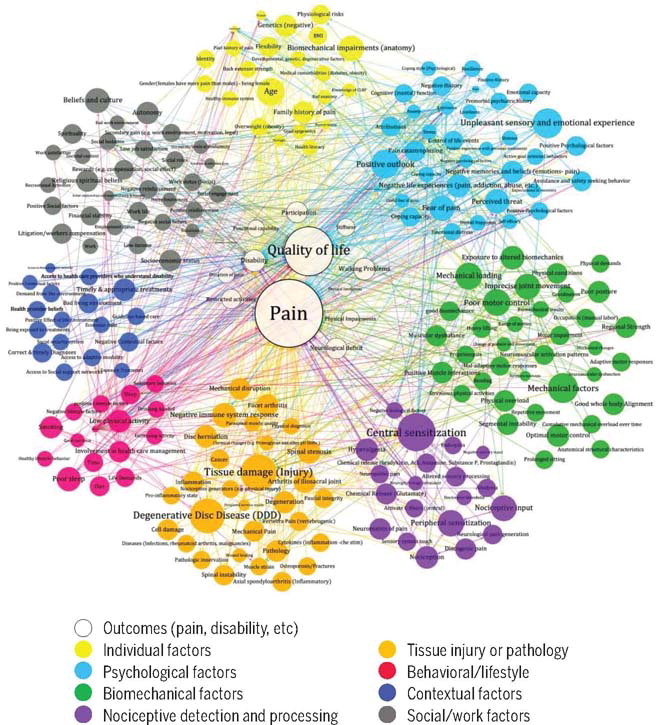
Throughout the Summit, this same image appeared three times.  Isn't it nice that the presenters were so like-minded that this could happen?  The picture shows contributors to low back pain (and likely applicable to most pain) from this JOSPT paper from 2019. Too hard to read?  Doesn't that emphasize the point that pain is incredibly multi-factorial and the orange colored tissue-related factors are a relatively small contributor when you consider the big picture?  
In my opinion, the virtual format was excellent because no travel was needed, however that does lose some of the in-person benefits like networking events and dinners.  The organizers tried to combat that with a virtual Happy Hour on Day 2 where many clinicians hung out and chatted about whatever we wanted - which of course included the sports teams we support, where we're all at in the world, and lots of other interesting topics. 

Day 3: ACL Injury and Rehabilitation

Presenter #5 was Derek Miles a physical therapist with Barbell Medicine who is well known for his posts about pieces of meat (representing the human body) being poked, prodded, needled, scraped, taped, or treated with other common rehab approaches to demonstrate how some of these approaches are not doing what we think they are. (IG: @derek_barbellmedicine).  Derek kicked off day three's focus looking at the biopsychosocial approach for ACL injury.  He reiterated the need to have a plan with rehab, outlining that the first step after an injury is to get the patient back to being a human, then an athlete, and last should be consideration for their specific sport.  Walk, then run, then play basketball.  How do we achieve this? Post ACL injury or surgery, there's a long list of things that people can't do. Patients should know that, but clinicians can direct their attention and focus on all the things they CAN do.  Keep your athletes around their teams and with their teammates as much as possible.  Send them to practice with clear understanding of what they are able to participate in.  It's hard because there's a lot of discussion about what they shouldn't do, but make the injury an opportunity to learn the sport in a different way. 

Early ACL rehab may be boring, but it's the foundation to the later steps and often these athletes can do more than they think they can.  The ACL injury only directly impacts one limb... but there is another leg, two arms, a torso and a head that all need to continue functioning and training and should not be ignored.  If your clinic doesn't have sufficient equipment to load these athletes and get them stronger, sufficient space to get them moving, and have a way to test the athlete - you probably don't have enough to adequately rehab an ACL injury. The key takeaway: LOAD HEAVIER!  As Erik Meira so eloquently puts it, "It's the quad until it's not the quad."  Derek said he tells his athletes to do quad sets ALL THE TIME and then, when you hate them, do 5 more, and repeat again tomorrow.  No reps and sets.  Just constant.  I think I'll just writing 1,000,000 sets on my Medbridge HEP sheets from now on!

Presenter #6 was Laura Opstedal, owner of Build Physio in Montana who does lots of ACL Rehab and research and also previously worked at Seattle Children's Hospital. Laura reiterated Derek's points about quad strengthening and how important that is to athletic movements as well as the importance of testing athletes who have had an injured ACL prior to allowing them to return to activity.  For me, one particular quote stuck out from this presentation. "Look at your entire ACL rehab program as preventing a hip strategy and forcing a knee strategy.  Keep the trunk upright." I know I valued quad strength and testing before seeing this presentation, but I definitely was not doing a sufficient job avoiding the hip strategy.  In fact, I've been guilty of encouraging it sometimes, but Laura addressed the inferior patella pain that some patients feel with a knee strategy that I previously was avoiding, acknowledging that sometimes these athletes are going to have a little bit of pain and we need to know when that should matter and when it's ok to continue. ACL hip strategy study. It's only been two weeks and I've already changed this in the clinic. Also encouraged were achieving passive terminal knee extension within 10 days of surgery, having at least an 80% LSI before returning to run, don't ignore calf strengthening in our patients with knee injuries, and do more open chain knee extension. There were considerations for the slow stretch shortening cycle compared to the fast stretch shortening cycle and training them separately... yup, I never thought of my rehab in those terms before, though I do have some drills I like that focus on both, the new perspective is going to make a big difference for my patients. 


I definitely didn't do these presenters justice, but hopefully this "small" taste will encourage those of you who are rehab providers to start following some new clinicians and those of you who aren't in rehab who, for some reason, like to see what I have to say, hopefully learned about the complexity of pain and can gain some appreciation for the effort that any of your medical providers are putting in to maintain their licenses through continuous education and growth.   

One final note: "When a measure becomes a target, it ceases to be a good measure."  Using certain tests which are meant to be used to show progress and not to show culmination of progress is not the best approach.  I know I often feel like my return to sport tests are the end of my rehab.  This might be fine for some injuries like an ankle sprain where the athlete has been playing their sport without issue and I'm looking for a way to determine if symmetry has been restored.  But in the case of an ACL injury, the RTS testing often occurs to allow the athlete to start playing their sport.  This isn't good enough - and it's another chance to be less wrong tomorrow. 


Thursday, May 2, 2019

2019 WNBA Season Training Camp Begins Sunday, May 5th!

The 2019 WNBA Season is almost here!!! This week, the Seattle Storm Sports Medicine Staff gathered at Storm Headquarters to prepare for our upcoming team physicals and training camp!  Players will be starting to arrive in Seattle and get settled in their apartments with camp starting on Sunday, May 5th!  It was nice to see the Championship Trophies, including the most recent 2018 WNBA Championship Trophy, proudly on display along with catching up with all my sideline pals.  This will be my fifth season with the Storm and many of the medical providers have been there for at least three of those other seasons - so it's always a bit of a reunion getting back together after the off-season.

All of this is occurring in the same week as the Women's National Soccer League announcing their official roster for the 2019 World Cup and a group of over 200 professional women's hockey players announcing they'll be sitting out this upcoming season.  So much going on in women's sports!  We're facing a time of change.  You can see it in politics.  You can see it in education. You can see it on the news.  You can see it at work.  And, without question, you can see it in sports. It has been inspiring to see the platform athletes have through sports, and I do not take it for granted that I have the opportunity to stand on the sidelines and watch with a front row seat.  But, in the wake of all this change, we have the chance to embrace opportunities and seize every chance that presents itself.

So today, I'll highlight a little about what the beginning of the WNBA Season looks like for the medical team working behind the athletes. In truth - all sports teams require multiple teams to operate at their best.  You have the athletes on the court, the sports medicine providers - like the team doctor, athletic trainer, strength and conditioning coach, and other specialists - you have the business staff that makes sure the front office operates - and this can include your ticket sales team, marketing team... so many teams!

Our meeting was to get everyone organized. New members of the crew were introduced.  We reviewed the medical status of all of the incoming players.  This is helpful to prepare for our physical exams that will occur in the upcoming few days to know who is coming in injured and may need some rehab programming right from the start versus getting a strength and conditioning program ready.  We get details on who will still be playing overseas in the European Leagues - because some of the Storm players are going to be playing for championships in other countries and will join us later than other players.  We won't get into the discussion on why this occurs - it's financially based and it certainly increases the risk of injury on these athletes by not allowing them rest breaks or an off-season - which makes our physical exams even more important.

Truly, doing physicals for incoming WNBA players and attending training camp practices has been one of my favorite times to work with the team.  Here's why:

1) The WNBA has 12 teams with 12 players on each team - so there are 144 professional female basketball players in our league.  This compares to the 30 teams in the NBA which have 15 player spots available for a total of 450 possible jobs to play professional basketball.  That means, whoever gets invited to training camp is the cream of the crop, ultimate best at what they do.  Who doesn't want to meet, and work with, the greatest athletes in the sport they love?  Of the group that comes in, a handful won't make the team, but they will get exposure from their invitation to training camp which will help their future in basketball anyways.

2) The rookies are usually coming in from college, their first job away from home, and it's an awesome opportunity to help them in whatever way possible.  They all have different needs.  For example, one year, the Storm Strength Coach and I were doing our physical exams on a player who had come from college... she hadn't even graduated yet.  We asked her how she was settling into Seattle and she expressed some concerns about grocery shopping and cooking.  Her college team and college dining halls had fed them most of their meals - so she had never had to do those things before.  We could provide her with resources from day one of where to shop, what things to look for, and which players on the team were excellent cooks that they should ask for advise on techniques.  The team also has a nutritionist that they can meet with to help design meals, but for starters, we needed to make sure they stopped eating out every meal, because it is far too expensive and time consuming.

3) Some of the best basketball practices are during training camp.  Because there are only 12 spots on the team, these athletes are fighting hard for their spots.  At this level, they work hard almost all the time, but for sure this is some of their best basketball.  Training camp or the playoffs.  When it really matters the most.  And the coaching staff sets the tone for the whole season right from the start.  So you're just in for a good time if you're on the sidelines.

What will we do at team physicals?  Well - the team physician will go through the usual things that any other person would have done at a physical exam.  Height, weight.  Any pain?  How is the body moving?  How is strength?  Any recent illnesses?  Listen to heart and lungs, look in eyes, ears, and mouth. Any reason to get any blood tests?  Nothing out of the ordinary.  Hopefully you've had your own physical recently... and if it has been more than a year - schedule one!

The team Strength Coach and I will do movement screens that we have developed over the past few years.  When I was with the Connecticut Sun, our team physical therapist and strength coach did movement screens too, so I would imagine all the teams in the league are doing some sort of assessment to determine where they should start their strength and conditioning programs for each athlete and see how everyone looks.  As a physical therapist, I’m looking at their squats, jumping and landing, overhead motion, and some core strength tests.  If you're not assessing your athletes before a season, you're guessing with their training for the whole time.  Baseline measures are essential.  And that's about it.  Then we can prepare for the season!

I'm ready... who's coming to a game!?!  Go Storm!


Thursday, April 25, 2019

It Takes a Village


ID 6052480

© 

| Dreamstime.com
Happy Thursday, blog followers!

Warning: In this week's blog post, I'm being selfish.  I'm making a situation that has nothing to do with me, entirely about me.  But it's OK to do that if you admit it up front, right?

This past week, I received some terrible news. The instructor of my weekly Turbo Kick class, Meg, informed our class that she is moving away.  I’m sure she’s making all the right decisions for her family, but to me, this was crushing, devastating, drop me to my knees in tears while unnecessarily over-reacting, punch me in the gut, painful news. I didn’t see this coming. I’m not prepared.  Do I have enough time to get used to the idea of a new instructor coming in?  It took me SO LONG to psych myself up into attending her class in the first place! And it just can't be the same with another instructor.  Say it ain't so!

So, this week I'm writing about the village of people I've assembled to help me get my health in order as well as the positive impact of attending group exercise classes. This was a great reminder that you might be changing someone else's life without knowing it.  Sometimes I forget this when I'm working with my patients.  I have no clue how I've impacted people other than with their physical therapy, but I hope I've helped others the way Meg has helped me.

I joined the YMCA in August 2018 as part of my elaborate and carefully plotted plan to combat my eating disorder and body image issues, which I first discussed here.  I had been in severe denial about what was going on in my life, blissfully ignorant to reality, and had started seeing my therapist at the same time.  I decided to create a small village of people to help me with my journey: a therapist, a dietitian, someone to revamp my physical fitness - who ultimately became Meg - along with some family and close friends. I was entirely unmotivated to move my body - which I was currently hating - and I was sick of my training routine. I wasn't looking for group classes when I joined, hoping could manage my physical health myself, but considerd I might need another person in my village to oversee that, too.

I was initially opposed to group classes because I experienced a particularly uncomfortable CrossFit situation when the instructor told me that "a girl of my size should be lifting a lot more weight." To some extent he was correct - I could squat and deadlift a lot more than I was using there.  But at that time I hadn't been training much and knew the planned workouts included high repetitions and the volume was too much for me to load up the barbell as they recommended.  They pushed me to lift more, I pushed back saying I wasn't ready, and it was ultimately an embarrassing and painful situation.  It is specifically why I treat my own patients meeting them where they are - not where I want them to be.  So I had that experience, plus, I hate the idea of people seeing my body moving.

2008 CT Sun Yoga Class

Those reasons led to apprehension for group classes with the exception of yoga. In 2008 I went to a group yoga class with the Connecticut Sun and have been able to continue with yoga intermittently since then. I wrote about my recent return to yoga here, but, as I previously wrote, I only do hot yoga where I get high (or delirious) from oxygen deprivation that I basically can't tell anyone else is in the room.  Group exercise class?  For sure the others would notice that I'm fat, that I can't jump, that I will get tired, that I sweat a lot and breathe heavy, and that I'm not very coordinated.  Now, many months later, I'm here to tell you none of this occurred.  It was all in my head!

In October 2018, after walking by Meg's class on several preceding Mondays, I finally talked myself into trying her class.  I told myself that I knew the music was good and that I had to complete the class but that if I absolutely hated it, I would try one different class before swearing off group classes for the rest of eternity.  Dramatic much? Thankfully, Meg ran up to me that first day, super spunky and upbeat, introduced herself saying that her class was super fun and that it didn't matter if I knew any of the steps, just keep moving however I wanted to. I've been hooked ever since.

Here’s why Meg’s departure hit me like a ton of bricks.  I was in a deep dark hole of emotions and confusion when I started this journey and quickly learned that I needed to ask for a lot of help. I built my village including three smart, beautiful, strong women to help me pick myself up off the floor and put my pieces back together.  My therapist and dietitian knew each other, use similar approaches for treatment, and know all about my issues. I don’t think they intend to be sympathetic towards me, but sometimes they are, and sympathy isn't what I want or need.

But Meg is different.  She's not sympathetic towards me because she has no reason to be. She doesn't know why I'm in her class or what I'm dealing with. She barely knows anything about me, really, and that's just how I liked it. She's empowering and motivating because that's in her nature. And yes, it's her job, but there are other instructors in there with totally different vibes. I've walked by their classes a bit, too, wondering if I should add to my routine. Choosing her class was not a mistake. She welcomed me in, kick started most of my Mondays since October with high energy, a positive attitude, motivation, and joy. I purposefully attend her class right before going to see my therapist because turbo kick is basically a class where you can punch and kick your problems in the gut and my G-d I needed that.  It also lets out a lot of energy, which calms me and helps me organize my thoughts before saying them out loud.  When I started pairing turbo kick with therapy, I was really struggling to see my therapist because it was so vulnerable. Dance fighting with a room full of strangers is vulnerable, too, but way more fun than one on on conversations in a room with a couch and too many boxes of tissues.  I can’t actually tell which “treatment” has helped me more over the past six months, but I can tell you what this class did for me.

First- a group class has other people working towards their own goals- but the goals can be kept private as you work towards them together. I don’t know if people in the class are trying to lose weight, get stronger, let off some anger issues, or hear some current music. I don't know if they secretly wish to be a performer on a stage - but instead work as an accountant because they need to pay their bills. I don't know if they want to learn ways to protect themself if they were attacked, because truthfully, I would definitely use the moves I've learned there if someone came at me. I don’t actually care why they’re there. It doesn’t matter. We’re all going to do the same moves and at the end be disgustingly sweaty and high five each other with a sense of accomplishment towards our own goals.  I can go deadlift and have an awesome lift on my own, but there won't be anyone to high five me when I'm done. And because people start recognizing each other, it really does start to feel like community. Like if you missed a week, someone might ask if you were OK, or if you went on a nice vacation. Sometimes you just need that!

Second- all my concerns about other people watching me were entirely unfounded.  Nobody else is looking at what I'm doing in this class. They don't care. Once we get started, I barely even notice there are other people in the room, except to watch out for kicking my neighbor and to follow Meg instructing the moves.  Everyone is trying to get the steps right for themselves.  The rule is to keep moving even if you don't know the steps... but sometimes I know the steps and choose to do something different. For example, I CAN do burpees... but I hate them... so when there’s a burpee in the routine, I do jumping jacks or squats or whatever I want. Because for me, the whole point is to move. Not get better at burpees. Once I stopped exercising to lose weight and started doing it because it made me feel good, things in my life started to get a whole lot better. It’s still a struggle to make myself move regularly, so I attend a weekly dance party with some uppercuts and roundhouses thrown in and I actually feel like I’m prepared to conquer the week - whatever it may throw at me.

Third- and probably most important for my personal journey- the room is lined with a wall of mirrors. For the first several weeks, it disgusted me to see myself in the mirror. I was sure others could see how gross my body was. When I was diagnosed with my eating disorder, my testing suggested that I didn't have any body image issues. This was apparently very wrong. I've learned it was/is a huge problem. Prior to facing my issues, I didn't realize I was avoiding mirrors.  We have them at work, too, and I didn't even notice how much I put my back to them.  If I lifted at the gym, I didn’t want to see myself doing it. I don’t have a full length mirror at home and have never had one since I moved to Seattle.  I didn't actually realize how much I had been avoiding looking at myself until one class I caught myself in the mirror while doing a punching move and realized holy crap! That's me!  That's my body! It's doing all these things.  It's working hard and feeling pretty good. I’m actually able to tolerate looking in the mirror and smile at myself a little now.  That may not sound big... but for someone who went from not knowing what their body looked like at all and hating her own skin to tolerating her body and appreciating the things it’s capable of, I think it's huge. I’m sure somewhere down the road, there will be a time when I might like my body- and maybe even love it. That's not where I'm at right now, but I’m sure that the road started with the mirror in turbo kick.

And so, while I am sad to know my village is evolving, I’m eternally grateful for the role Meg played in it at the beginning.  Can't wait for the next Turbo Kick class.

Thursday, December 27, 2018

2018 Year in Review

The last blog post of 2018! Since I started writing in November 2017, Abby's World has had 14,000 visitors.  I still don't like the title... Some posts were really popular... four posts had over 400 readers, others had less interest... and that's ok.  I think it's safe to say that I'm still figuring things out a bit to narrow down the scope, but I'm enjoying the variety of topics right now.  Thank you, so much, to everyone who has stopped by! I hope you've learned something and that I've been helpful to you in some way.

Today's post will serve as recap of 2018 - both personally and professionally - and a look back at some of my favorite posts of 2018.  As for 2019, I don't think I'm going to write a plan or set goals - other than to keep writing.
The Seattle Storm and UConn Connection
My 2018 biggest moments:
I'll start with the Seattle Storm winning the WNBA Championship, which I wrote about here.  I was so fortunate to be able to attend WNBA Finals Game 3 in Washington, D.C. with my brother, and still love basketball despite my poor skills at playing the game. I'm already looking forward to next season and it's still several months away.

Dear Evan Hansen, New York City, July 2018
As great as the championship was, my family celebrated a huge milestone this year.  In May, my niece and nephew became B'nai Mitzvah, which is a Jewish coming-of-age or right of passage.  They're thirteen years old, now!  The actual events for the B'Nai Mitzvah were incredible and I'm so proud of them for their accomplishment and hard work, but more special was the opportunity to celebrate them each in their own individual way.  I asked them a few months before-hand what they would want most, and I love how different they are and what they chose.  I celebrated my niece by taking her, my sister, and my mom to see the musical Dear Evan Hansen in New York City.  If you haven't heard much about this story, I encourage you to check it out, particularly if you have teenagers in the house. I'm so glad we could do that together, and that it was what she wanted to do - with her aunt, mom, and grandma.  I celebrated my nephew at the Denver Broncos versus Seattle Seahawks game in Denver, CO.  He's been a Broncos fan since birth because he liked the color orange and had always wanted to see their stadium.  As a sports fan myself, I really loved watching him experience something he had wanted to so much... and the rivalry of rooting for opposite teams but in a mature manner.  It was a chance to spend time with my favorite people as they head into teenage-hood and, soon, adulthood.  Next year they'll both attend Cheshire High School, the same school I graduated from fifteen years ago.  I remember holding them when they were born and all of these events were a flood of pride and emotions.   Because of them, I spent more quality time with my family in 2018 than I had since I moved to Seattle.  That was the best part of 2018.
Seattle Seahawks @ Denver Broncos, September 2018
Some of my other favorite things from 2018 that have nothing to do with Physical Therapy:
I saw the Goo Goo Dolls perform their 20th Anniversary celebration of Dizzy Up The Girls.
I rode in a helicopter for the first time. Total trip time was about 3 minutes.  It was awesome.
I read the first five books of the Harry Potter Series and watched the first three movies... my first time for all of that.  Don't worry, book six is in progress and I'll finish all of it in 2019.
I read a lot of books in 2018, actually.  Some really deep, sciency stuff.  Some much lighter and more relaxing.  I have come to embrace the audio book for commutes. I read The Origin of Species which I wrote about here and definitely do not recommend others read, but feel like I can read anything if I could get through that.
I got addicted to yoga.  And then dropped out of yoga.  I miss yoga.

My 2018 Physical Therapy Continuing Education was primarily focused on three areas.
1) Orthopedics from Mike Reinold, Lenny Macrina, and Eric Cressey.  I took Mike's shoulder seminar, which I wrote about here, Lenny's knee seminar which I wrote about here (and his elbow course), and Eric's shoulder course which I wrote about here.  I'm so grateful that there are mentors willing to share their expertise and knowledge online, and who also have made trips out to the West Coast for me to learn from in person.

2) Chronic Pain, primarily from Lorimer Moseley and Adriaan Louw.  I've written about those experiences here - from reading Explain Pain, and here from reading Explain Pain Supercharged and from meeting Lorimer Moseley at his presentation at the University of Washington.  Starting in two weeks, I'll be working with the Seattle Children's Pain Clinic as part of a collaborative team to help kids experiencing chronic pain.  I'm looking forward to putting all that learning to good use.

3) Strength and Conditioning.  I passed the CSCS (Certified Strength and Conditioning Specialist) exam in 2018, which I wrote about here and took a Medbridge Education Course instructed by Sue Falsone on this topic as well.  This has definitely made an impact on how I treat patients, specifically by loading them more and manipulating rep/set schemes a little bit more than I did in the past.  A few PTs have asked me if I thought this process was worth it, and for my patient population and side gigs, I feel that it is definitely useful.  I work in Pediatric Sports Medicine so my patient population is mostly athletic and getting back to sports.  They've generally never worked with a strength and conditioning coach or a physical therapist and don't understand any of the key basics of movement or how the body works.  I love having this background knowledge to educate them!

I feel like I spent a lot of time working towards growing as a physical therapist in 2018, but when I look back, it wasn't even close to what was most important.

Looking forward to 2019:  I'd be lying if I pretended that 2018 was perfect. Social media sometimes has that impact...  nobody posts their tears and struggles on Facebook and Instagram.  I certainly only post the happy times and the beauty I see around me. In truth, 2018 was a hard year.  I'm not sure 2019 will be easier... but there will be more family time and more hard work and growth.  And for all that, I'm grateful.

Happy New Year!

Thursday, December 20, 2018

Anatomy Semantics

I got an email from someone who has recently gotten into a regular workout routine, trying to get into better shape with some weight loss and increased strength.  He was wondering if I would look at the program he's been using for a while and make some recommendations on how it could be improved for better gains.  The program was made from snippets he put together from men's health magazine.  So we set up a phone call to go through the program.  I've previously written a little bit about strength training in this post, entitled "What do physical therapists do? We Strength Train."

Biceps - Two Muscle Bellies 

The strengths of the program he already had going were three:
1) He was regularly participating in exercise and the workouts were planned and programmed with ways he could progress them.  In my opinion, the best training program is one you will do consistently.  But once you've got consistency down... all programs are not created equal.
2) Pretty much all the body parts were covered in some way.
3) He had learned to squat and deadlift.  Though we've previously worked on his form via Skype when he was having some pain doing it.  I had him using a broom in his house to hip hinge and weight shift and change his set up and we had a blast doing that probably two years ago.

The key weaknesses that I noticed were:
1) The program was separated out into six different days: arms, shoulders, chest, back, legs, and core.  He spent 1 hour focusing on that body region when he did that training day, and he strength trains about 3 times per week.  Because of that, each body region was only getting targeted twice per month - and that was only if no days were missed due to scheduling complications.
2) There were several single muscle exercises including wrist curls and wrist extensions or hamstring curls that would be fine for some training goals, but really didn't optimize him reaching the goals he stated.  In my opinion, these take up time and energy from bigger bang-for-your-buck activities.  They have a place - and I use them with patients sometimes - but in general I'm team multi-joint exercise.
Triceps: Three Muscle Bellies
3) There were no single leg activities.  I use single leg exercises a lot with patients and have also written about the seven key movements a la John Rusin here. squat, deadlift, lunge, upper body push, upper body pull, and carries.  One of those key movement patterns is the lunge... and this program didn't include those. I really like single leg activities because it gives you a chance to work on balance which also incorporates the core and because it changes the stability demands that aren't present with a double leg exercise.  Also, life requires us to operate on one leg fairly often - going up/down stairs, walking, a curb, getting in/out of the car, playing sports... it's functional to train on one leg.  And when I mentioned this, he noted that he didn't like single leg exercises because of poor balance... soooo obvious solution.
4) It was a very high volume program... three sets of 15 for each of five different exercises that he then repeated a second time through.  He probably got some cardiovascular system development from this scheme, and maybe even some muscle toning, but felt that he wasn't making considerable strength gains, which makes sense.  With a volume like that, you're not recruiting enough muscle fibers.

Since he has no background in strength training or anatomy, we discussed some of the key concepts of training.  Ideas like the three planes of the body, push versus pull, horizontal versus vertical actions, pairing exercises a little more purposefully to either alternate body parts: like a bicep curl to a triceps extension or to overload the same one in different ways.  And then he said - "Oh ya, I've been meaning to ask you about that.  I recently was thinking about muscles while working out and wanted to know more about the semantics of the names biceps, triceps, and quadriceps. Bi = 2, tri = 3, quad = 4... of what?!" This was the moment. 

Quadriceps: Four Muscle Bellies
This was the moment when I realized that there have to be loads of people who go through life never studying anatomy or how the body works.  Working in pediatrics, I generally assume my patient population has not yet learned about anatomy.  Most haven't. Some know a little from playing sports.  But I've taken at least seven anatomy classes in my life and didn't think it was possible for an adult to have gone through all of their schooling (he has a bachelor's and two master's degrees!) without ever taking anatomy. I don't know how to write computer code or how to wire a light fixture or fix a leaky sink... why should I expect that everyone understands basic anatomy?  We're all capable of learning these things... but we don't all know them.  Talk about being a bit close-minded!

This was the moment I realized how much education it takes to be a physical therapist.  This is the moment I gained new appreciation for how people can really hurt themselves when they don't know enough about the human body and try to load it - whether intentionally through training, or unintentionally overloading through sporting activities or daily activities that their body isn't prepared for.  This was the moment when I realized that personal trainers, strength coaches, physical therapists, and anyone else suggesting exercises to clients or patients needs to understand how the body works and the concepts that the clients should understand to be more independent in helping themselves.

And so I taught him about the difference between the biceps, the triceps, and the quadriceps.  The body actually has two different biceps muscles - the biceps brachii in the arm and the biceps femoris in the back of the thigh. "Ceps" comes from the latin word caput which means head, and so each of these muscles has multiple heads.  The biceps of the arm has two heads - also often referred to as muscle bellies.  The triceps on the back of the arm has three muscle heads.  And the quadriceps of the front of the thigh has four muscle bellies.  I had to send him pictures to show what I was talking about because just saying the words was meaningless.  These muscle clusters are named as a group because they work together to elicit the same action. For example, the quadriceps, as a group, straighten the knee.

Combine the new basic knowledge of what a muscle looks like with those key concepts we already discussed such as the three planes the body can move in - front to back, side to side, and a rotational plane and how muscles work in certain directions and how important it is to consider all the directions for a well-rounded program.  We discussed some of the basics of muscle growth - and how there are muscle fibers that are more meant for endurance like high repetitions - which is what he had mostly been doing, but also muscle fibers that focus on strength and need to be more overloaded with heavier weight to use those, which had been missing in his routine.

I really enjoyed this conversation because it opened my eyes to the reality of the world... how could I have thought so many people understood these concepts which just come so much more naturally to me!?  I can't wait to take the opportunity to help more people better understand how their body works.  I also enjoyed the opportunity to educate someone so they can make changes to their workout program and develop a plan that could be more effective, and that they can modify independently.  I'm not an expert in training programs, but now he has three options of workouts and can hit each body region at least four times per month, he has a better understanding of how to change reps/sets and that there's a reason to choose these, that he probably was under loading himself, and that above all else, he has found the number one key to training: consistency.  Just by training regularly and making it part of his weekly routine, he's already miles ahead of everyone on the couch.

Can't wait to see what kind of results he gets!


Sunday, July 1, 2018

Shoulder Care with Eric Cressey

Last weekend I jetted off to Denver for a visit with family and a continuing education course.  The family time was fantastic - a few hours of biking around Denver - far more than I'm used to doing as I'm not a fan of bike seats - some really delicious tacos - beautiful art and the backdrop of the Rocky Mountains!

The course was "Shoulder Assessment, Corrective Exercise, and Programming" presented by Eric Cressey of Cressey Sports Performance and it was hosted at Landow Performance in Centennial CO.  Loren Landow is the newly hired Strength and Conditioning Coach for the Denver Broncos and his facility is beautiful with state-of-the-art equipment and autographed jerseys all over the walls from numerous professional athletes.  His bio says he has trained WNBA athletes, too - so extra points in my book!  If you're not familiar with Eric's work, he's a Strength and Conditioning coach with facilities in Hudson, MA and Jupiter, FL and, though he is most well known for his work with professional baseball players, he also works with the general population and is considered to be an expert in the shoulder.  He's published tons of research and has a blog with articles posted starting in 2002 with regular high quality content.  I previously wrote about one of his older blog posts here.  Most importantly, Eric is a UConn grad, so I've followed his work since I first learned about him somewhere around 2005 when I was in a class with Dr. William Kraemer, one of Eric's mentors, and have been looking forward to meeting him and attending one of his seminars for a long time.

With Eric Cressey June 24, 2018
Why did I want to take this class?  Beyond wanting to hear Eric speak live and get the chance to ask him questions, I previously took a course with a strength and conditioning coach (Matthew Ibrahim) in conjunction with a physical therapist (Zak Gabor) which I wrote about here, and felt that learning from people with different backgrounds was really impactful for me.  The audience was primarily strength and conditioning coaches who work with baseball players... but there were also a handful of physical therapists, chiropractors, massage therapists, personal trainers, and baseball coaches.  People had traveled from Australia and Korea and all over the United States, some of which trained athletes from unique sports like Professional Disc Golf or MMA fighters. The variety of people present was really neat... but also, the content is applicable to so many other sports.

More importantly, I have been treating a lot of patients and athletes with shoulder injuries and recently completed Mike Reinold's shoulder seminar, but also wanted a live course to better observe how other providers evaluate and treat shoulder pathologies. Eric's approach to shoulder treatment does not look like Mike's.  They have different "favorite" screening tools and exercises that they use.  If you observe their social media, you could probably pick up on these differences and similarities.  I'd say the biggest overlap I observed was that both of them regularly use the prone low trap exercise for rotator cuff strengthening which Eric has a video for here.

When it comes to my work with the Seattle Storm, though, we also have to consider that we're working in an overhead sport with repetitive action.  Shooting a basketball is nothing like the motion of throwing a baseball, but it still requires significant mobility and stability - and very different from baseball, it requires the athlete to be reactive to opponent players slapping at their arms while they're doing it.  The arm care programs used by the Seattle Storm should not look like the arm care programs used by the Boston Red Sox - but the principles involved in developing them do match.

I learned a lot from this course which I'm still processing, but was able to immediately use some of the skills in the clinic. Here are my top 5 favorite Eric Cressey quotes and take-aways from the weekend.

1) The biggest key for the shoulder is "Keep the ball on the socket." Simple.  Having a better biomechanical understanding of the force vectors of the rotator cuff is vital. If the scapula is sitting in a depressed position, the lats may be over-active which will influence upward rotation when getting overhead.  Similarly, if the scapula is tilted anteriorly, could there be shoulder impingement with elevation or is there enough muscular balance to safely overhead press?

2) Rehab and training are the same thing!  I've previously written about physical therapists' role as strength coaches here - and this came up in the course.  Eric Cressey is not a physical therapist and he discloses this and discusses how he interacts with PTs all over the country.  So it surprised me to see the differences between what Mike Reinold and what Eric Cressey do considering this statement, but I would not expect Eric to be seeing athletes post-op day 1 following labrum repair.  So, I took this to mean that once the acute healing phase is completed, rehab and training are the same thing.  There is a need for progressive loading to tissues and a need to understand periodization, even if your PT treatment sessions are not written like a periodized training program.

3) Scapular winging is a garbage term. It does not describe what is going on with the scapula.  I document scapular winging all the time - so this will be a change I need to consider moving forward.  Is the scapula winging because it is anteriorly tilted?  Upwardly rotated?  Because there is a flat thoracic spine so the medial border is just more pronounced?  And is this inherently pathological?  Or just a finding that you're documenting.  I can't promise I'll stop using the term scapular winging entirely, but I can commit to adding at least one descriptor of the scapular position to better describe the situation moving forward.

4) Stop telling people to bring their shoulder blades down and back.  It would only be a slight exaggeration to say that Eric Cressey is begging people to stop using this cue.  Too many people use this resulting in patients pulling their elbows back with anterior humeral head translation and improper mechanics that we could be creating problems!  I asked him what cue he likes instead - and he said he manually puts people into the position he wants them to be in, using optimal muscle activation, until they can do it independently.

5) Push:Pull ratios are not accurate nor are they adequate.  It has been well ingrained into my training that for every push exercise, you should be doing at least 2, probably more like 3 pull exercises.  I've been trained to teach that focusing on the back musculature 2-3x more than the front helps combat many of the anterior shoulder issues that are seen in the clinic.  However, Eric points out two key points that make you think about this more carefully.  First, the push:pull ratio is almost always considered for front:back motion and ignores top:bottom... but both planes need to be considered.  I think John Rusin tries to deal with this by including upper body push, upper body pull, and carries into his 6 foundational movement patterns, but the balance needs to be considered for both planes.  Second: not all pushes can be considered alike.  The bench press is a push exercise that necessitates the scapulae being blocked on a bench... compared to the push up where they are moving freely on the body.  This is also an important consideration as you're not getting the benefit for scapular control through the pushing motion when doing a bench press - and Eric says he doesn't have his baseball players bench pressing.

I'd be lying if I said this even touched the surface of all the things I learned at the class... but these were big takeaways that made me think and will change how I operate to some degree.   Thanks for an awesome course, Eric!

Monday, May 28, 2018

Mentor Spotlight: Dr. John Rusin

https://drjohnrusin.com/about-us/
When I started this blog in November 2017, I mentioned a few mentors who I like to follow - you can find that here.  I've gone into some detail about how I found a new mentor here and have written about some of the courses I've taken with these providers in the past.  Here's another post about mentorship, because this is a topic that I find worthy of regularly discussing, and because one has been producing some really neat new content that I wanted to share.  This could be a valuable resource for student and new grad physical therapists and strength and conditioning coaches to improve their knowledge and also to observe some real life interactions between a clinician and a client.

I spend a lot of time learning from Dr. John Rusin.  John is a physical therapist and certified strength and conditioning coach who, from what I've been able to observe, does a thorough evaluation of his clients' movement patterns and then uses strength and conditioning principles which I've previously touched upon here to progress his clients to improved function, better strength, increased cardiovascular fitness, and overall improved quality of life and health.  He's incredibly smart and provides me - and all of his followers - with boatloads of content that are generally organized in an interesting and user-friendly manner.

I'm not here writing a blog or developing a brand where I'm creating new ideas and new content (at least not yet). You won't see me videoing myself demonstrating exercises I've created any time soon.  With regard to physical therapy, my blog is a write up of what I'm learning about from the experts and trying to synthesize their information so that I can use it with my patients. I've written about several other mentors and their impact on my practice, but today it's all about Dr. John Rusin and the top three things I've enjoyed learning from him.

First - John focuses his training around six key movement patterns: the squat, the hip hinge (deadlift), the lunge (single leg), the upper body push, upper body pull, and the carry.  Prior to reading and watching John's work, I was already a fan of squats and deadlifts - though I haven't been under a bar in quite some time.  I also focus heavily on single leg work in my own workouts and patient programs, though I wouldn't say I used lunges quite as much in the past as I have been more recently.  I never used loaded carries before coming across John's work and I didn't do nearly enough pushing and pulling myself or with my patients who weren't rehabbing from an upper extremity injury.  I've taken the time to read numerous postings from Dr. Rusin about his movement patterns and have found these patterns to be useful in my personal training as well as with the patients I work with.

Second - I know I had a Motor Control course and a Pediatrics course in PT school - but the carry over to application with actual patients somehow didn't really click.  Dr. Rusin does a great job integrating these primitive progressions into his rehab programs as well as the educational materials he diseminates and I have been giving more and more attention to the sympathetic versus parasympathetic nervous system and energy systems (conditioning) because of him.  Pay attention to the normal development of babies.  First - they breathe.  Second - they'll lift the head - the body follows the eyes, and the extremities move on a trunk that generally stays still because we need proximal mobility for distal stability and globally, the mobility and stability need to work in combination with one another.

The stability components are key.  We physical therapists and rehab professionals are too often working on mobility and flexibility when a focus on stability would have greater outcomes, according to John's work. One area in which I strongly consider this is hamstring flexibility and toe touching.  I often find that kids who can't bend and touch their toes don't really need passive hamstring stretching.  They more frequently need strengthening and motor control of those hamstrings so that the muscle releases its protective hold and the person can function more optimally.

Finally - Dr. Rusin has recently been putting out video footage on his work helping to "Rebuild Dave Tate."  This stuff is really cool.  Dave Tate is a  world class weight lifter and body builder who was dealing with numerous orthopedic injuries, surgeries, and deconditioning for which he reached out to Dr. Rusin. These guys got together and have been filming their interactions and posting segments walking you through John's subjective and objective evaluation components, the program he developed for Dave, and some follow up/progressions of the program.  This site has links to the 9 current videos they've posted, and they're not done yet!  This is an incredible resource for others and I have enjoyed watching (and re-watching) and also discussing the posts on John's Facebook with other followers that it felt essential to share this.

I haven't yet had the chance to meet Dr. Rusin in person yet since he operates out of Wisconsin, but he has numerous products available and I'm hoping to try some of his training options in the future when I finish my current plan.  I'm so grateful there are clinicians out there that put out intelligent, immediately applicable information, all for free, all for the greater good.

Sunday, May 20, 2018

Stair Challenge!

Richmond Beach Park steps - Shoreline, WA
How is it almost June?!  That mean's it's time for the Shoreline Million Stair Challenge!  The purpose of this event is to have the community collectively climb one million stairs to increase fitness competing with neighbors. According to the site, last June I completed 11,444 steps!  The challenge was started in 2012 for community awareness of health as well as to bring more people out to the park near my house where there is a long stair case (188 steps) that can be broken down into portions as well as a smaller set of stairs nearby.  I use these when I train for my March stair climb for Multiple Sclerosis which I've previously written about here!

This year my goal is to complete 15,000 steps in the month of June.  That's an average of 500 steps per day or 3500 stairs per week.  I don't work out 7 days per week, so this seems like a lofty goal, but I'm excited to work towards it and spend more time outside.  Additionally, on the side of this blog, I've been tracking my miles walked and stairs climbed all year... and I'm a bit behind in my 75,000 stairs goal, so this should really help get me more on track!  Fortunately, the sun stays out a lot longer in June so post-work stairs will be in order!

I urge others to join me in this challenge and climb some extra stairs this June.  It might help you start a new exercise routine or change your daily habits.  Since I started training for stair climbs, I definitely notice myself taking stairs more than alternatives... and I've gotten stuck in a few stair wells for doing it! You can climb stairs anywhere and still participate in the challenge. We can motivate each other to train and get stronger and more fit!  I want to see photos of the stairs you climb - so if you sign up to join, I'll match your stair count (up to 1000 additional stairs!).  Seattle area friends, if you want to head to a local stairwell - there's a whole network of them listed on this website - let me know and I'll climb some stairs elsewhere! I won't race you - because it's not about doing them quickly.  It's about being active... and I'm slow!

Happy Summer and Happy Climbing!

Saturday, April 28, 2018

What do Physical Therapists Do: Installment #3 - We Strength Train

© creativecommonsstockphotos - ID 96113980
In the first installment of "What Do Physical Therapists Do? We Look at Mechanics," I described an experience with a patient who came to Seattle Children's with doctor's orders to do a biomechanical assessment to clear him for return to sport and discussed how it is our job to be "movement specialists."  In the second installment, "What Do Physical Therapists Do? We Listen," I touched upon the biopsychosocial model and the importance of considering the psychological stressors in addition to the internal biological influences on pathology.

Today I'm back with the third installment: "What Do Physical Therapists Do? We Strength Train."  I don't mean that we necessarily pump iron... although I do like to lift heavy things from time to time. Earlier this week, for example, I carried my ~50 pound kayak overhead about 1/4 of a mile to put it into the water... some overhead pressing would probably make that a bit easier.  It would be even cooler if I could suitcase carry it - but so far I'm not able to.  Some of my PT coworkers lift. Others do yoga, or ride horses, or ski, or hike, or play hockey, or lacrosse.  In general we're an active group which helps us to better understand how the body moves.  I once had a clinical instructor tell me that I should try out (or at least watch) any activity available so I could best understand where frequent injuries in that activity could come from and see the things the body is capable of.  It led me to take a snowboarding lesson and watch sumo wrestling - talk about immensely different ways for the body to move!  But that's not what this is about... I'm talking about what we do for our patients.

A common (and essential) physical therapy treatment is exercise.  Exercise covers a wide variety of topics, so the focus today is on strength training.  I'm not here to debate whether or not soft tissue work improves mobility of tissues or has neurological effects or changes the chemical composition of body tissues.  I believe all of these things happen to some extent and know there is debate in the literature on this topic.  Regardless of how soft tissue treatments are applied and what is happening in the body, after some mobility work is completed we need to load our patients. Here's why this is a problem:

Physical therapists guide their patients in strength training exercises but, in my opinion, we barely touch on the basic principles of resistance training and we certainly did not apply them sufficiently in PT school.  Earlier this week, I passed the Certified Strength and Conditioning Specialist (CSCS) exam by the National Strength and Conditioning Association (NSCA). "Certified Strength and Conditioning Specialists are professionals who apply scientific knowledge to train athletes for the primary goal of improving athletic performance."  Some of my patients are not participating in athletic endeavors, but all humans are athletes and all athletes are humans - so we need to treat them as such.  (I can't remember where that line came from - it's not mine, though).  So physical therapists serve a similar role as strength coaches in many ways.

While preparing for the CSCS exam, I was overwhelmed by how much I didn't know. When checking the literature for articles about physical therapists and strength training, I came upon this 2016 article entitled "Periodization and physical therapy: Bridging the gap between training and rehabilitation."  The paper also presented the basics of resistance training and the similarities and differences between physical therapy rehabilitation programs and strength and conditioning programs.

Both physical therapists and strength coaches apply the General Adaptation Syndrome.  "Physical activity is better described as a physiological stressor... when physical activity is properly dosed in individuals who possess the physiological capacity to respond acutely, homeostasis is restored."  The idea is that the body has a baseline set point that it normally operates at and a threshold beyond which it cannot properly recover.  Exercise is one type of stressor following which the body moves away from its set point, towards a threshold, and needs to have processes available to return to baseline.  There are baseline settings for numerous things in the body, all of which can be influenced by exercise including: fluctuation in blood pH, stimulus of hormonal changes and immune responses, changes to the cardiovascular and respiratory systems, altered hydration status, potential tissue damage... the list of is extensive.  The body is generally amazing in its ability to adapt and respond to this variety of changes to return the body to its resting state.   However, if the stresses are too high, injury, illness, or death (at extremes) can occur.  The goal from physical therapy and from strength training is to operate within the boundaries of applying stress so the body can adapt to and recover without over-reaching.

How do you structure this into patient/client programs in a way that makes their threshold improve so they can do more work or lift more weight over time?  Both Physical Therapy and Strength Training use the concept of progressive overload described in Essentials of Strength Training and Conditioning as "progressively placing greater-than-normal demands on the exercising musculature - applies to training to increase bone mass as well as training to improve muscle strength."  For example, we start with a movement pattern such as the squat, and we train it as a movement with just body weight and then progressively load it with dumbbells or barbells and we fluctuate the variables of our training volume and intensity so that the body has time to adjust and adapt and learn.  This means that the homeostasis set point and the thresholds from the general adaptation syndrome are flexible and can be improved with the possible exception of someone who has reached their full genetic potential.

With consideration for progressive overload, strength trainers design training programs for their clients.  In my opinion, based on my observations in numerous clinics over the past 3.5 years, this is where the two fields diverge and physical therapists don't use the same principles.  When planning for resistance training, we can consider four target outcomes: 1) strength gains, 2) improved power, 3) muscle hypertrophy, 4) muscular endurance.  Programming for a specific target outcome means varying the volume (reps/sets), the load (percentage of maximum able to be lifted), frequency of training, and rest breaks.   To target these outcomes, those variables have been studied and summarized as follows:

Target OutcomeReps per setSetsPercentage of 1RMRest
Strength< 62-6> 852-5 mins, full recovery
Power1-2 or 3-53-5depends but >752-5 mins, full recovery
Hypertrophy6-123-667-8530 sec - 1.5 mins
Endurance> 122-3< 67< 30 sec

Also important to consider is Matveyev's model of Periodization which considers the preparatory phase (basically off-season), transition period (changing over from off-season to in-season), and competition periods, but the preparatory period is broken down into three more sections: hypertrophy and endurance early on, moving into a basic strength phase, and then more of a sport specific strength and power phase.  So understanding how to vary the volume and align it with time on the field or court is essential.  But in the PT clinic, we don't usually program or progress in this manner.  We may consider similar rep schemes and progressive resistance, but we don't typically use loads of this magnitude because we're rehabbing people who either can't or should not yet be lifting loads of that intensity.  At the end of the day, we're all loading up our patients/clients.

Lastly, consider teaching a person a new task such as a squat.  At first, regardless of reps and sets selected, the initial changes that person will experience will be the brain learning how to squat.  This is the same for any activity - your body needs to learn the pattern and get the neurons linked together before you can experience significant muscle gains, improvement in function, and changes in strength.  They may feel stronger or that the task is easier, but these initial changes are neuromotor.  In the context of pain, people move differently and their neuromotor patterns change.  So, since about 99% of the patients I treat are in pain, I'm basically coaching them to make neuromotor changes and as they go through that work, their symptoms resolve, and they're done with physical therapy (because insurance dictates this).  Thus, they have so much remaining potential for strength gains, endurance training, hypertrophy, power, agility, and all the physiological benefits that remain for a strength coach to guide them.  I'm a little bit jealous that I don't generally get to observe these adaptations in my patients, but I get to see them in my own training.