Monday, November 18, 2019

Reconciling Pain Science and Biomechanics

Greg Lehman
It's finally happened. I finally attended a course presented by a Canadian! I also work with a
Canadian Occupational Therapist and from my sample size of n=2, I think it's possible that Canadians are smarter than Americans. Why is it that Canadians seem to know more about American politics than we do? I can only inadequately describe how our government operates and I know absolutely nothing about theirs.  It's like they care about what happens in the world, or something. We should do better, America.

Anyways, since I'm sure you also want to take a course instructed by a Canadian, I'm sure you want to know what course it was? "Reconciling Pain Science and Biomechanics" by Greg Lehman. Greg is a physiotherapist, chiropractor, strength and conditioning specialist, and biomechanist who also teaches a course called Running Resiliency, which is probably excellent if you run or treat runners, which I try to avoid.  (I avoid running.  I don't mind rehabbing runners).  "Reconciling Pain Science and Biomechanics" is a two day course that bridges the gap between the clinicians who focus heavily on pain neuroscience education and the psychological side of the biopsychosocial model versus practitioners who tend to focus primarily on perfection of movement patterns and anatomical tissue structural damage as potential drivers of pain.  If you're working in orthopedics or with pain management you should definitely check this one out.  The course was overall broad with big concepts that ideally could apply in multiple situations.  It also came with an extensive set of resources including his presentation and a huge number of literature papers for consideration.  So much evidence to support the discussions. 

I've previously written about pain here (and several other posts).  Greg defines pain for this course as "When all your loads/stressors exceed your ability to adapt/cope."  Pain is the balance between all the things that are harmful to you and all the things that are good to you. I often like to use the concept of inputs versus outputs with my patients, especially because people often don't recognize that pain is an output. I can't put pain into you. Pain is an output message from your brain in response to stresses that have been applied.  I can apply stresses to you so that a painful output occurs, but instead I try to find the minimum effective dose of stress to input so that your output is positive adaptation, not pain. 

Some examples of inputs: mechanical stress to tissue such as an incision or deep touch or the feeling of your rear end on the chair you're sitting on, chemical stress such as dehydration or improper nutrition, emotional stress such as those from your family or your job, light, sound, and temperature changes.  Inputs are not good or bad, they are just stresses that we have to process in our body.

Some examples of outputs: pain, emotions, sweat (loss of heat), neuromuscular adaptations such as increased strength, seeing your mental health counselor and talking it out, breathing, coping/calming strategies.

So when a person is experiencing pain, anywhere, the options for treatment could include:
1) Can you decrease some of the inputs?  Examples: Turn off the lights, focus on some breathing strategies, go for a walk, change your body position, change the temperature, increase or decrease the amount of touch on the area that hurts. 
2) Can you increase some of the outputs?  These could actually be the same as above because of things like hot versus cold where changing temperature in one way actually accommodates both, but also doing some yoga, exercise, see your therapist, take your regularly prescribed medication if you have diagnosed anxiety or depression that is being medically managed, or spend time with friends.
3) Or can you make it so that you're able to accommodate for more inputs without changing the input or output?  Again, there is overlap here.  But for many people, building up tolerance through strength training or meditation practices or learning ways to desensitize your skin can all have this sort of impact. 

It's important to also consider what is getting in the way of making some of these changes. Is the patient fearful of going for a walk because they have pain in their foot?  Are they catastrophizing or perseverating on horrible possible outcomes by participating in a certain activity so they're unwilling to try?  What are the current beliefs and expectations about their condition?  Knowledge about how the mind and body connect and work together can help decrease these roadblocks to facilitate recovery.

Greg provided some important questions to ask patients to help them return to their favorite things.  For example, "In what ways do you think you could be healthier?"  This open-ended question allows a person with headaches to consider that maybe they could better hydrate, have more nutritious meals, sleep at more optimal times, go for a walk at lunch time, maybe acknowledge some of the recent spikes in stress at their job or school... but it allows them to identify potential sources of their pain, allows them to outline what they believe is happening, and also gives you a chance to better learn about the patient. 

Greg Lehman and Me
He also discussed the importance of asking "What activities are meaningful to you?"  So, for me, I really like to play softball.  When I hurt my knee a few months ago, I was disappointed that I couldn't play for a week or two, but then I was able to return in a modified way.  If I hit well enough, I could hobble my way to first base and get myself a substitute runner for the rest of the bases.  I didn't think I would damage my knee worse by doing this, and I actually didn't have much pain when I tried that.  I spent a little more time in the dugout instead of alternating innings so I could avoid spending so much time in my catcher's squat position.  So, I was able to dose my activity so that I could do some rather than none at all, and this actually built my confidence to return back to my usual level of participation after healing and recovering. 

Which leads perfectly into "Encourage the patient to ask themselves 'Will the activity harm me? and/or 'Will I pay for this later?'"  Like with my softball example, I didn't hurt myself worse by participating and I didn't hurt more after playing. Certainly there are times when doing activities can be harmful. As a physical therapist, it is our job to recognize when that is the case and appropriately guide our patients, but modifications are often possible.  In particular, I really think it's important for our post-surgical patients who can't be playing their sport to spend time around their teammates. Be the team manager!  Learn more about your sport.  Spend that time with your friends.  It's better for mood, learning of the game, growth with teammates (and they'll get better support if they're around and showing their progress over time." 

Best Thanksgiving Food
In another example, this past weekend I attended a delicious Friendsgiving dinner at my friend's home. I've been managing some gut issues lately and had been eliminating several foods to try to identify where the problem was coming from. After a month with no wheat and two weeks without any onions or garlic, I wasn't exactly sure what would happen if I had some stuffing... but I really wanted it!  I actually did use this line of reasoning while I ate.  Will I do any permanent damage to my body by eating this? Not likely, no. Will I pay for it later? When I made the decision, I wasn't entirely sure, but I thought it was possible, which impacted my decision for quantity of stuffing that I took (dose). And yes, I felt like crap from it.  But was it worth it? That's very individual, and up for me to decide, and now I have data. Next week when I'm home for family Thanksgiving, I get to decide if I want to repeat this same thing knowing what the likely outcome will be, or not.  But I'm empowered to determine what I do to my own body, and that's something I think we can teach our patients, too. 

What else can we do as physical therapists to help our patients who are experiencing pain?  We need to help make sense of their pain using their own understanding of what's going on. A person who thinks their "back is out" can't just be told "that isn't really a thing, backs don't ''go out.'"  They'll never buy into your message if they have a belief of what's wrong and you just strong-arm them into an opposing idea.  So instead, we acknowledge their beliefs, educate them on how adaptive the human body is, and we facilitate cognitive restructuring.  An example that was suggested in the class was "I bet someone has told you that your spine is twisted," and by acknowledging their perspective, you can try to bend that belief just a little bit, "but actually your pain could be from something else, so why don't we work on getting you moving in ways you can tolerate."  You create a small hint of doubt into their beliefs and see if the patient gives you an opening and slowly you can chip away at the beliefs over time.  We can facilitate adaptability by using intentional application of specific stressors that induce adaptation for increased resiliency, and this includes with beliefs. We must meet our patients where they are at with the psychological and physical approaches, progressive loading ooth their thoughts and their tissues, which might be a really little bit of loading at the start, but sometimes that's all they can manage. We work hard to encourage their autonomy and self efficacy.  One of Greg's quotes which I really enjoyed: "Requirements for adaptability: 1) Human. 2) Not Dead."  He also made sure to include a statement about how physical therapists don't fix people.  We facilitate them.
Bob Ross


And so physical therapists need to understand barriers to recovery, which could be at the tissue healing level, or could be in the psychosocial realm, or a whole host of areas in between.  And we need to appreciate that what we do is, in fact, an art, while also being a science.  That makes Greg Lehman just like Bob Ross, I think.  He painted this one beautifully. So many happy trees.

And with that, I'll finish with another quote from the course "Limping is a helpful adaptive pattern. It is successful in keeping people moving. It decreases pain. But should we advocate for everyone to start limping?"

Thanks so much, Greg.  I hope you'll come back to the USA soon!


Thursday, November 7, 2019

Mindfulness in the Sensory Deprivation Float Tank

Today I did a thing.

No big deal, really.  You can stop reading, now.  Seriously... I'm not even sure why I'm writing this post. Today I did an activity that initially seemed far outside my comfort zone. You see, I've been working on my vulnerability and my mindfulness. For some, that may be easy. Ever climb a huge mountain?  Facing vulnerability and mindfulness seem that difficult to me. I can't explain why, but they're a struggle.

According to dictionary.com, Mindfulness is "1) The quality or state of being conscious or aware of something 2) A mental state achieved by focusing one's awareness on the present moment, while calmly acknowledging and accepting one's feelings, thoughts, and bodily sensations, used as a therapeutic technique." I won't bore you with the issues I have acknowledging and understanding my own feelings or my dissociation from my own body, but mindfulness is one of the strategies I've been working on for those issues.

My first attempt to work on mindfulness was when it was recommended that I read the book "Eating Mindfully" somewhere around February 2015. I really tried to absorb what was being recommended and even attempted some of the activities in that book. But when they walked me through putting a pistachio nut, in its shell, inside my mouth to taste the salt and then break it with my teeth to experience the cracking sound so close to my ear and then focus on the textures of the soft, green nut... I couldn't handle it.  Too many adjectives.  Too much thinking about food. Too much self awareness.  No thank you. I think the book even recommended trying to feel the ridges of a raisin with the tip of your tongue, but maybe I made that ridiculousness up... it's been a while. Either way, I didn't think mindfulness was the route for me to go to approach the eating issues I was facing, so I gave up. For a while.

Now, years later, I've learned that I don't actually practice mindfulness in a whole boatload of areas of my life. I am still not a mindful eater. I eat breakfast in my car twice a week paying attention to traffic and not to whatever I'm consuming. I eat a snack in my car on the way home from work daily so that I make myself a sensible dinner rather than hitting the drive through. There is a snack bin on my back seat now.  I usually also drive while listening to an audio book... so, yeah. I eat lunch while I'm talking to my coworkers or, on the rare occasion when I would be eating alone, I also read a book or scrolling around aimlessly on my phone.  The last thing I do while eating is pay attention to my food. But I am also not mindful of the space I take up when I'm moving around.  I bump into things.  I've been called a "bull in a china shop" more times than I care to admit. In sessions with my therapist, sometimes she'll ask me to sit with my feelings on a topic of conversation and I burst into laughter or start fidgeting and can't even look her in the eye.  It's horrible.  This could continue, but the purpose of this whole mindfulness conversation is more about things I'm doing to try to be more mindful, not really the reasons why I need to.

The most mindful activity I've come upon has been yoga, which I wrote about here, during which I'm very present in that moment. I definitely feel my emotions and they change in various positions. I also am more aware of my body in yoga than in most other ways.  So far, yoga has been my favorite mindfulness strategy... but I haven't gone in progbably six weeks, so I should maybe get that in soon.  I sometimes find swimming to be pretty mindful... I did that a few days ago.  It makes you focus on your breathing and your body or else you drown.  A little bit of life-or-death mindfulness, anyone?  And lifting weights does this a little bit, but is usually a lot more distracted than those other activities.

The problem is that I've been searching for mindfulness strategies that don't make me move.  I've tried those progressive relaxation strategies where you relax your big toe, then your foot, then your calf, up the whole trunk and to the top of your head and back down the other side. Eh. I can't seem to tolerate meditation the way most people seem to. All of these things seem harder than I think they should.  Why can't I just sit in a quiet space and focus on my breathing for ten minutes?  That doesn't seem hard.  I have never made it ten minutes. So when it was recommended that I try a Sensory Deprivation Float Tank, and would be forced into a quiet, dark space for a whole hour, I was very intrigued. I made a reservation a few days ago at Float Seattle in Greenwood (neighborhood in Seattle) and talked to several coworkers and friends about it over the past few days.  Only one person I spoke to had ever tried it and had some really interesting perspectives on it. Most people felt exactly how I felt... like it was insane to try and that I would probably freak out.  Despite those expectations, it was actually pretty awesome.

I arrived at the Float facility where Dean, the owner, gave me a little tour of how things worked, made some recommendations about positioning in the tank and best way to get the ear plugs into your ears and making sure your face is really dry before getting into the pod to avoid touching your face with a super salty hand while in there. He showed me how the tank worked, where the lights and sound are adjusted, and then left me in the quiet.  I took a neutrally temperatured shower to be clean, but not too hot because then the tank would feel cold, before entering the pod filled with 10 inches of water and 1000g of Epsom salts.  Because the water is set to basically match your body temperature, you almost don't even feel it.  There were a few periods while floating that I felt a little cold and then moved around a little bit and it quickly resolved. I was shocked that it didn't really smell like anything - which was one of the concerns I had because I tend to be smell sensitive, particularly with florals and some soaps that make me miserable and headachy - but later learned that reduction of smell is one of the many sensory inputs they're trying to reduce. The room had towels with just enough fluff to them, which brought me Marie Kondo level of joy.  I hate rough towels and would have been super annoyed to remove a ton of sensations for an hour only to come out to sandpaper towels.  And so I did the thing.

Me, in the Dead Sea, on January 14, 2004
I got into the pod, closed myself in, and transitioned from what felt like sitting in a bathtub into supine floating on the Dead Sea.  I've done that before... but I was covered in mud, it was nearly fifteen years ago, and I was not alone. That salt burned my skin.  This salt did not.  That trip was so long ago, I didn't have a Facebook account yet and I was still using a camera with film.  Guess I can't share images from that day. Just kidding, I dug into the scrapbook and took a picture of this picture to share with you. It took zero effort to get to floating and all the fears I had about potential claustrophobia were gone.  I turned off the blue light, and tried to relax while looking at the little twinkle lights in the ceiling of the pod.

Carmen, in case you don't know.
It felt a little like I was inside a planetarium and I had a flash of "Where in the World is Carmen Sandiego" because she was exploring outer space when I went to the planetarium as a kid.  And maybe because one of my friends was her for Halloween, so it was on my mind.  And then I started to let it all go.  I had the option of listening to music - I went without.  I had the option of keeping more light than the twinkle lights or going all the way into the darkness.  I did a little twinkling, but mostly in complete darkness.  I had the option of using a little foam pillow for my head if I wanted it - I tried both ways.  And let me tell you, I really enjoyed it. The only thing that seemed odd to me was that I had completely lost sense of time.  I don't think I fell asleep, but maybe I did.  I don't think I moved around a whole lot, but I did a little bit.  They told me that I would know the float was over because the music would start playing and then the light would come back on.  Maybe 30 seconds before that happened, I put the twinkle lights back on feeling like I was starting to get a little antsy.  OK actually I was starting to think I had to go to the bathroom.  But I made it!  The whole hour!  And I didn't lose my mind!  I also didn't cry, which I had thought was a serious possibility.  I hadn't really thought about anything that much... mostly I just let my mind go blank, which is something I really struggle to do.

According to the Float Seattle website, "There are many benefits of floating regularly. Most commonly our guests and members float for stress relief, pain relief, athletic recovery, and meditation/introspection."

It makes sense that you might have some stress relief from removing many of the inputs our body receives constantly throughout the day.  I spend a lot of time working with kids in pain, trying to find ways for them to output various stresses - through exercise, emotions, breathing, desensitization sensory input overload strategies... but it's so hard to remove input!  Removal of the input of light or computer screens, changing temperatures, sensations from sitting or from clothing allows the brain some freedom that is normally occupied by these things.  It makes sense that you might have pain relief soaking in saltwater that could potentially reduce inflammation and allowing muscles to relax in new ways.  But just having it make sense is not good enough for my science-minded brain.  I needed to see research!

So the Float Seattle site does include a list of publications here and when I searched, this other floatation company had an even longer list here. It summarizes that "The float environment systematically minimizes external sensory input to the nervous system including signals from visual, auditory, olfactory, gustatory, thermal, tactile, vestibular, gravitational, and proprioceptive channels."  A 2005 meta analysis is cited suggesting that this type of treatment does reduce stress and there are papers studying different hormone levels of change following sensory deprivation treatments.  I couldn't read all the articles between my float and getting this post put together, but I did read numerous headlines and how they used it with challenging patients with severe autism to reduce sensory input with some successes, and how several health markers improved by using floating.

Then I watched this YouTube video from comedian Joe Rogan about his experience floating, and all in all, I decided to share my experience with all my blog followers. If you're in the nearby Seattle Area, the cost at Float Seattle was $39 for the first session (and for all Happy Hour time sessions right now, which is basically the normal work day for most people, but I work a healthcare provider schedule and have days off during the week which means I can go on my day off for that rate). Yes they tried to sell me a package. No I didn't buy one... I think I would prefer to achieve the mental state I get from doing yoga, instead, but yes, I do think I would go again, particularly if I'm having a stressful week... or if the clocks have just changed and the world seems like it's going bonkers around me!  Have you tried floating?  Let me know what you think!

Monday, October 21, 2019

Rainy Days = Continuing Education

Steve Allen assesses the Lumbar Spine
The rains are upon us here in Seattle. Gross!  If you've never been here during the doom and gloom season, what you've heard is true.  It's grey, dark, cold, wet, and everyone is a bit more cranky.  (Or maybe that's just me?) But the leaves are beautiful to look at and the candles are lit and ALL the blankets are ready to get cozy and it's hot chocolate season... so that's all exciting.  And what better way to hide from the weather than to take some continuing education courses?

This past weekend, I completed my fourth NAIOMT (North American Institute of  Orthopedic Manual Therapy) course.  I've previously written about my experience with these courses on the blog here following the last one I took way back in 2017.  Since I started working at Seattle Children's Hospital in 2017 I've used considerably less manual therapy so these classes have fallen lower on my learning priority list.  The kids don't tend to need it so much and I've learned so much about the impact manual therapy sometimes has on patients psychologically that even when I'm in the adult clinic, I'd prefer to use it less.  As I continue to grow in my career, I keep learning what I like and what I don't which changes how I interact with patients. In general, I try to avoid "doing things to patients" and prefer to help them learn how to do things for themselves.  That's not to say I don't use manual therapy at all... it just isn't my first step most of the time. I do occasionally work with adults and they typically have expectations of receiving this sort of treatment, particularly because of the way the clinics I work at organize their schedules.  Sometimes they really do need it - but for sure not always.  And in the State of Washington, physical therapists who manipulate the spine need a special certification with specific continuing education, so to maintain my certificate, I took this class.
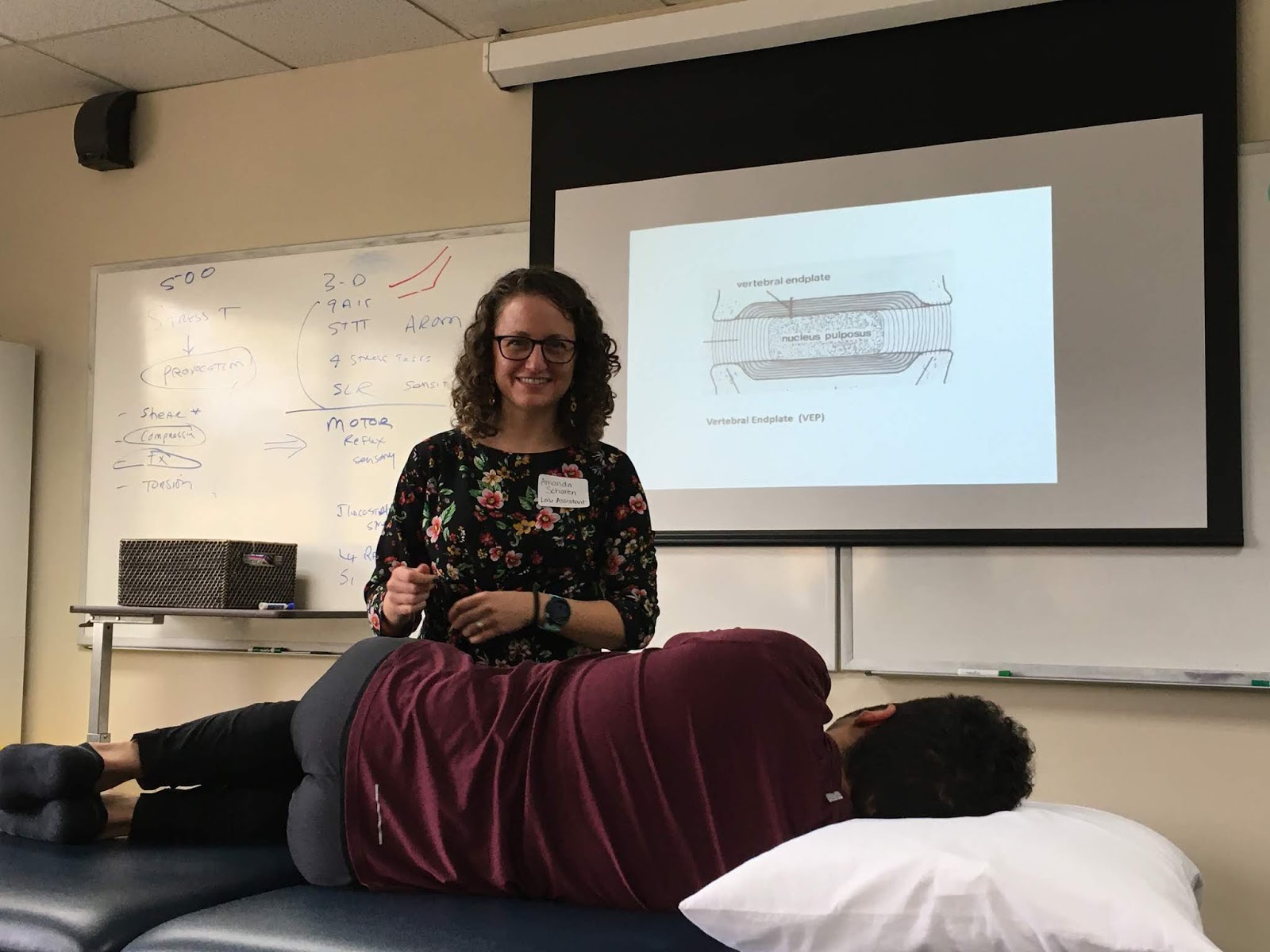
Amanda Scharen teaching lumbar instability tests

To be fair, these NAIOMT courses aren't just about manual therapy, either.  Sure, the photos I've included are of a manual technique performed by Steve Allen, NAIOMT faculty member and a Physical Therapy Historian who exudes love for the profession along with my friend and Director of Therapeutic Associates - Queen Anne - Amanda Scharen. I'll even quote Steve from this weekend, "Manual therapy is a small ut vital part of our practice.  Combine it with exercise for the best outcomes." But these classes also include advanced review of anatomy and biomechanics, which is important when you haven't studied it specifically since PT School.  There are many cases presented during the weekend which challenge clinical reasoning.  The partiipants of NAIOMT courses are all physical therapists so there are really interesting discussions about evidence supporting different topics, sometimes even debates, and some of the scientific literature is included for participants to read ahead of time.

SI Joint - from Wikipedia
For example, this course included this paper "Evidence-Based Diagnosis and Treatment of the Sacroiliac Joint" from 2008.  I had not previously read it, but did learn this in PT School.  It describes the different tests you can use to try to identify if the joint between the sacrum at the base of the spine and the ilium (pelvic bones) is contributing to a person's pain presentation. During class this weekend, we had a discussion on whether or not this joint moves at all - as many believe that it is fused and therefore immobile. I personally believe that the SIJ does move for three reasons: 1) I have seen too many patients with pain that improves with changes in their pelvic positioning or with exercises training stability for this region 2) When I have a specific pain pattern, treatment to my own SIJ resolves my symptoms almost immediately, and 3) I don't think women would be able to give birth if this was an immobile structure.  Doesn't really explain why it would be as mobile in males - but I don't usually see this as a problem region in men as much. If you're a PT who hasn't been exposed to the tests that may help identify the SIJ as a contributor to pain, the article outlines each one and presents pretty good psychometric properties when using them as a cluster.  Interestingly, the author describes the tests and then admits that he no longer uses SIJ manipulation as a treatment because it tends to be unsuccessful.  He recommends stabilization exercises and, if that is unsucessful, injection into the joint.

What I've come to understand more and more is that the healthcare you receive from any provider is biased to the beliefs of that provider.  For example - if you came to see me and I determined that you had tight hamstrings, I tend to guide you to strengthen the hamstrings in an effort to relieve some of that tension.  Some of my coworkers, however, would teach you how to stretch your hamstrings. There are articles supporting both methods. There are groups of people who support both sides. As a patient, if you don't have any prior knowledge on the topic, you're probably just going to take your therapist's word for it that they know what they're talking about.  As another example - I've been experiencing some really annoying abdominal pain for the past several months.  My GI doctor sent me for tests like an endoscopy and colonoscopy and is treating me for acid reflux.  Yes, the medication made me feel better, but I didn't think that was the underlying problem, so I sought out another opinion.  She's treating me for something entirely different.  Her beliefs about my symptoms match more with my own beliefs of my symptoms and I'm far more optimistic that I'll have a good outcome with this method.  As long as the patient gets better, does the method used to get there even matter? Regardless - the evidence is strong that for low back pain, physical therapy should be your number one choice for care.  Not medications.  Not injections.  Not surgery.  Not imaging.  PHYSICAL THERAPY.  Get PT First.

These are the things I think about during these dark Seattle fall-winters.

I have another continuing education class coming in two weekends.  I'd imagine it will still be raining then... so a blog post about it is likely.  It's very different from this one, so that will be a fun juxtaposition.


Monday, October 7, 2019

WNBA Finals Despite the Injuries!

Yesterday was Game 3 of the WNBA Finals. If you're not familiar with this league, the Finals are a best-of-five series which means you need to win three games (out of five) to be crowned champion. Last year, the Seattle Storm swept the Washington Mystics 3-0.  It was glorious!  Right now, the Washington Mystics are 2-1 ahead of the Connecticut Sun, with Game 4 being held tomorrow night at Mohegan Sun Arena in Connecticut.

Why is this important to me?  First, as the physical therapist for the Seattle Storm, I wish the Storm were playing in the Finals and that I was there to watch.  I love basketball and this really is some of the best basketball you can watch.  Haven't been to a WNBA game?  What are you waiting for?!?! Second, despite being dedicated to the team I work with, I'm also a supporter of the league as a whole and have a long history with the teams currently competing.  The current Head Athletic Trainer for the Sun, Rosemary Ragle, was the UConn Women's Basketball Athletic Trainer while I was in college - and also worked with me on my Grad School thesis.  The current Washington Mystics Head Coach, Mike Thibault, hired me to work for the Connecticut Sun when I was graduating from UConn in 2007.  I worked for him - and the Sun - for four seasons before PT School.  Their assistant coaches include his son, Eric Thibault, and former UConn and Connecticut Sun standout and Olympic Gold Medalist Asjha Jones who were both with the Sun when I worked there.  I can't possibly root for one team over the other - though I have a lot more Connecticut Sun t-shirts in my closet than Mystics attire. 

So I'm following the WNBA Finals, watching teams compete for the highest position in Women's Basketball - perhaps falling only behind the glory of an Olympic Gold Medal or World Championship - and the headlines are riddled with descriptions of injuries these players are experiencing.

Like these tweets:

Or this article today in The Guardian:


Elena Delle Donne plays through injury to move Mystics one win from WNBA title

  • Washington beat Connecticut Sun 91-81, lead series 2-1
  • League MVP has a herniated disk pinching nerve in her back
Elena Delle Donne drives the ball to the basket during Sunday’s game
 Elena Delle Donne drives the ball to the basket during Sunday’s game. Photograph: David Butler II/USA Today Sports
"Elena Delle Donne put forth a gutsy effort, playing through a back injury, and Washington beat the Connecticut Sun 94-81 on Sunday to move within a victory of winning the franchise’s first title. The league’s MVP has a herniated disk that is pinching a nerve in her back and was questionable to play in Game 3. She finished with 13 points, hitting five of her six shots and played 26 minutes."

I can't help but thinking - what message does this send to the fans, particularly the young ones?  Is this helpful?  What does it all mean, anyways?

First and foremost, a disclaimer. I am not working with either of these athletes.  I do not know what care they are receiving - but I would bet it's excellent from my years interacting with both organizations.  I care about the health practices around the WNBA and have been trying to help improve their standards for several years - so from the research I've done, I can say with confidence that it is highly likely that these basketball players are being well taken care of. 

Additionally, I absolutely 100% believe that the above-mentioned athletes with injuries are experiencing pain.  I read one account that said that Elena Delle Donne could not sit down because it was too painful, so the medical staff and coaching staff had devised a plan to bring her into their locker room when she was subbed out of the game to keep her moving and stretching and to avoid extended periods of sitting time.   This sounds like EXCELLENT collaboration between a medical and coaching staff and is something other teams should take notice of!  (The Storm is good at this, too, in my opinion!)  If an athlete is reporting pain, I believe that they have it.  All pain is real.  Pain is a personal experience that is influenced by many things.  But pain is also a protector and it doesn't necessarily mean these athletes can't be playing.  Here are my thoughts with what I've read and, more importantly, some thoughts on comments from fans who have opinions on the matter.

1) There are HUGE numbers of people with imaging showing torn labrums in their shoulders and disc herniations that DO NOT have pain.  This paper discusses the labrum tears and found that 55-72% of people without shoulder pain had a labrum tear. (The population was a little older than Alyssa Thomas, aged 45-60, but she is an overhead athlete so this presentation for her is not really that surprising).  Want something more specific to athletes?  This blog post from fellow UConn Graduate and well-known strength and conditioning coach with Major League Baseball players, Eric Cressey, presented the research on the same topic.  He quotes: " Miniaci et al. found that 79% of asymptomatic professional pitchers (28/40) had "abnormal labrum" features and noted that "magnetic resonance imaging of the shoulder in asymptomatic high performance throwing athletes reveals abnormalities that may encompass a spectrum of 'nonclinical' findings." This paper looked at a large sample (3110 subjects) without back pain and found on MRI that 30% of 20-year-olds have disc herniations and that the number increases over time.  This is why sometimes people have surgery but it does nothing to correct their pain... because the MRI findings and the surgical correction does not always fit with the pain.  

2) These are elite level athletes so it concerns me when I read that suggest they're "skipping surgery and playing through pain."  Tissue damage DOES NOT correlate with pain, so unless ESPNw was given reports from the teams stating that they had pre-participation MRIs that were normal and then started having pain the correlated with tissue damage (which goes against a lot of the evidence) a surgery may not even come close to fixing these problems.  Another way of looking at this is - why does their body adapt to present with the MRI findings that they have.  For example (hypothetically) is Alyssa Thomas' upper back too stiff for her to get her arms all the way overhead to shoot and rebound?  Because if that's happening, she's effectively cranking on her labrum to get her arms over head and then a shoulder surgery may fix her labrum, but it doesn't actually fix the initial cause of the problem.  She'll still have a stiff upper back, so it'll only be a matter of time until the labrum is reinjured unless the real underlying cause is addressed.  Why does everyone want people to rush straight to surgery, anyways?  That's painful!  As a physical therapist, my number one goal is to help athletes avoid having any surgery at all.  Sure - if it's necessary, such as in the case of Breanna Stewart having an entirely ruptured Achilles tendon, we're talking about something different.  But what if we just let these athletes recover after a grueling season (next week!).  

3) Can we acknowledge the additional stressors of playing in the WNBA Championships?  It is well known that emotional stress contributes to our experience of pain.  Elena Delle Donne was injured during Game 2 of the WNBA Finals.  Anybody else ever get injured at work and need to finish the shift or wake up with a super stiff neck or spasm in their low back and still have to go to their job the next day?  She has a job to do and it's far more in the spotlight than most people's work.  She'll get her symptoms managed and her pain will likely have a bigger impact on her job than on many other peoples' jobs, but she'll also participate in the conversation of whether or not she plays.  Or at least she'll have her agent do it.  Someone will be advocating on behalf of these players to protect their health. 

Many of the comments online were about how she was forced to play.  We don't really know that!  Any chance these commenters considered that she chose to play once the medical providers told her she would be allowed to?  The reality of this situation is that in less than one week the WNBA season ends, the physical and emotional stresses of the season will be reduced, and a period of relative rest (which means  they don't just curl up in a ball in bed) can begin.  What if they have some injuries, but they're also sleep deprived with elevated cortisol levels from their increased stress, not eating as healthy as usual with their family entourage visiting for the Finals and wanting to eat out?  It's so much more complicated than just "an MRI showed some damage." There will be time to stay away from the basketball court coming soon, time to reduce the amount of stress on their bodies and their minds with decreased physical activity including, less jumping, decreased torsion and load on injured anatomy, maybe some extra napping, some gentle swimming or yoga, and globally allowing the nervous system to calm down.  The Playoffs are three straight weeks of sympathetic Fight or Flight Mode... how about a nice parasympathetic Thanksgiving style dinner that puts you into rest and digest recovery mode?  Maybe we'll see that no surgeries will be needed for any of them!  

4) There are definitely circumstances where an injury to an athlete means they should not play their sport because it puts them at risk for further injury.  For example, after experiencing a concussion, it is dangerous to the athlete's health to compete before all symptoms have entirely resolved.  For example, if an athlete has a broken bone, not only could it be extremely painful to compete, but the athlete is at much worse damage with a subsequent injury.  For example, if an athlete cannot control their bowel or bladder or they have muscle weakness or numbness/tingling into their legs or arms - these can suggest a much bigger problem with the spinal cord. 

But there are many circumstances where an injury to an athlete means they will have pain while they do the things they love, but they may be OK to play with certain precautions.  For example, someone who recently sprained their ankle may be able to play while wearing an ankle brace.  The brace can protect from further injury while they are completing their healing.  For example, in many states it is approved for someone wearing a cast with a broken bone to pad the cast and play sports anyways.  The cast will protect the injured athlete from worse injury and the padding protects opponents from being hurt.  A torn labrum of the shoulder may be associated with a lot of pain for Alyssa Thomas, but is she at risk for any sort of red flag event by playing through it?  No.  And, without knowing the details of Elena Delle Donne's injury, I suspect she's experiencing a lot of back pain without the neurological symptoms into her legs that suggest spinal cord problems and that her medical team has determined it is safe to be playing.  She would not be on the court otherwise.

At the end of the day, tomorrow night could be the final game of the 2019 WNBA Season.  If it is, the Mystics go home with a Championship.  If not, they will play one more game.  I personally want to see all the best players on the court at the top of their performance.  So I'll send up some prayers for these two incredible athletes and role models and to all the other WNBA players currently having pain.  And I'll be rooting for the Sun and Mystics medical providers who will soon get a nice rest break, too. 

Monday, September 30, 2019

AASPT Traveling Fellowship

Fellows @ Cincinnati Football
Long before sunrise on the morning of Thursday, September 12, 2019, I boarded a sleepy airplane lightly coated in the typical Pacific Northwest mist heading towards a career-enhancing expedition.  After a brief pit stop in Denver, I continued on to Cincinnati airport, weirdly located across the Ohio River in Northern Kentucky.  Upon arrival at the CVG baggage claim I met two physical therapists who I would spend the next eleven days learning and observing various topics related to sports physical therapy. Rebecca Troulliet from North Oaks Health System in Louisiana and Patrick Barber from University of Rochester in New York joined me for the American Academy of Sports Physical Therapy (AASPT, formerly known as the Sports Section) Traveling Fellowship.  Sponsored by Kevin Wilk, LightForce and DJO Global/DonJoy. We spent about three days each at University of Cincinnati, Mayo Clinic locations in Minneapolis and Rochester, Minnesota, and The Ohio State University. 

What does it mean to be a Fellow?  According to Wikipedia, "a fellowship is a group of people who work together to pursue mutual knowledge or practice."  Though each of us had individual purposes for participation, we are all physical therapists working with athletes and we were all looking for growth in our careers.  Through observation and lecture attendance with more seasoned clinicians, we had exposure to different techniques and clinical approaches than our usual day-to-day experiences.  Now that I've returned to my usual swing of things and seeing my patients at Seattle Children's Hospital, I'm taking this opportunity to reflect on the experience and share why I chose to pursue this Fellowship along with some highlights from our trip. 

First: Why did I want to complete a Fellowship?

In May 2014, when I was completing PT School at the University of Connecticut, my career aspirations were to serve as a team physical therapist in the WNBA.  I had previously worked in a non-medical capacity for the Connecticut Sun for four seasons, but elevating to this new type of position as a new grad PT didn't seem remotely feasible.  Beyond the fact that I was a new clinician,  WNBA teams didn't have physical therapists, then, so this goal seemed unrealistic. (Most teams still don't, which I wrote about here)  I thought my fastest route to working with professional female athletes was to advance my education from PT School through a Sports PT Residency Program. In 2014 there were about twenty of those programs nation-wide, mostly offering one or two slots. I applied to three, including Ohio State, but was not successful in securing a position.  Now there are almost fifty SCS Residency programs with so many more opportunities nationwide! To search Residency programs in any PT Specialty area, click here.

Fortunately, physical therapists have an alternative route to obtaining board certification and specialization in sports physical therapy that does not require participation in a residency program.  You can find the requirements to do so hereAs I pursued the alternative route, I also landed a role with the Seattle Storm, and in March 2019 completed my Board Certification Exam.  In our cohort, Pat also took his exam in March following completion of the University of Rochester Residency program and Becca is currently working through the alternative route requirements to specialize in the future.  So because I did not complete a residency program but did pursue specialization, I felt like I lacked some of the mentorship and on-field hours that a residency would have provided, and this fellowship filled some of that gap.  


Second: What was the Fellowship like? 
Each location was very different from the others which helped us gain a broad spectrum of the possible roles and responsibilities for a sports physical therapist.  


Fellows and PT staff @Cincinnati
At the University of Cincinnati, we were hosted by Bob Mangine and Tim Machan and primarily spent our time in their athletic training room with them and on the sideline.  We had the chance to watch game-time coverage, led by Head Athletic Trainer Aaron Himmler and had a sit-down discussion with their concussion program and vision training expert, neuroscientist Dr. Joe Clark. We attended lectures on a variety of topics by members of their staff including wearable technology, use of the ACL-Return to Sport Index Outcome Measure, Neuroplasticity, Prevention of Catastrophic Injuries, and and we each presented our own lectures. My presentation examined the Impact of Fear Avoidance on Return to Sport, Becca discussed Sudden Cardiac Death and Pat outlined Upper Extremity Return to Sport Tests.  

With Timberwolves Robby Sikka and Matt Duhamel
After exploring Cincinnati, the three of us packed our bags to head to Minneapolis for the first half of our visit to the Mayo Clinic.  Our host in Minnesota was Corey Kunzer who is the coordinator of the Mayo Residency program.  The clinic in Minneapolis serves the community as well as having partnerships with the Minnesota Lynx (WNBA), Minnesota Timberwolves (NBA),  and Minnesota Twins (MLB).  Only days before our arrival, the Seattle Storm had knocked the Lynx out of the WNBA playoffs so I felt a little like I was in enemy territory, but I was glad to finally meet Emily Beyer, Lynx Team Physical Therapist as well as Matt Duhamel, Team Physical Therapist/Director of Athletic Therapy for the Timberwolves and Jeff Lahti, PT for the Twins.  We also met Robby Sikka, Timberwolves VP of Basketball Performance and Technology who uses wearable technology with the basketball players to improve their on-court performance.  Their basketball facilities are fantastic and, according to their staff is considered to be the best training site in the NBA. They have practice basketball courts with athletic training rooms and locker rooms for the teams right next to the medical clinics where they have physical therapists, orthopedic surgeons, physicians, athletic trainers, and other specialties who can thoroughly care for the athletes alongside the general public.  Can you imagine being at your PT session and rehabbing alongside (Lynx superstar) Sylvia Fowles or  (Timberwolf and UConn great) Shabazz Napier?! The Mayo providers collaborate with the team providers in their biomechanics lab which includes force plates and multiple angles of cameras for jump-testing and movement assessment as well as for recommendations for optimal care.  It was a really interesting arrangement for sports medicine for all levels of athlete.

Diagnostic Imaging with Dr. Jay Smith @ Mayo
Then we drove down to Rochester, MN, home of the original Mayo Clinic.  Founded in 1889, the Mayo Clinic is basically the entire town of Rochester and the area is spotted with old historical buildings that contain the most beautiful old libraries and intricate marble ceilings that tell the history of medicine in the US along with more contemporary constructions housing the huge variety of specialties that the Mayo Clinic houses.   We learned about Diagnostic Ultrasound from expert Dr. Jay Smith were taken to the Mayo Clinic Biomechanics lab which houses the machine used by Dr. Tim Hewett to extensively study ACL injury, and participated in a golf biomechanics lab.

Coach Tamika (Williams) Jeter @ OSU
After Minnesota we headed to Columbus, Ohio, home of The Ohio State University Buckeyes.  Our host, John Dewitt took us on a tour of their athletics and training facilities where I ran into former UConn and Connecticut Sun basketball player Tamika Williams for a quick reunion.  We attended a discussion on articular cartilage surgical procedures presented by Caroline Brunst and a lecture presented by Dr. Ken Yeager on Building Resiliency observed the nationally recognized Ohio State Marching Band rehearse, attended the marching band Skull Session pep rally and another football game.  We had the chance to meet many of the Ohio State Physical Therapy Residents studying in a wide variety of specialties including performing arts, oncology, sports, orthopedics, women's health, and neurology.  And I got to see some of my Ohio family living nearby, which was the cherry on top of a really awesome collection of learning experiences.

Fellows with John DeWitt @The Ohio State University
I can't recommend this Fellowship highly enough, and would be happy to connect with anyone considering application for future participation.  I'm sure that if you asked Pat and Becca, they would select different portions of our trip as their highlights or what was most impactful based on the differences between our patient populations and professional goals, but I'm so glad I was able to share this impactful experience with them.  Thank you so much, American Academy of Sports Physical Therapy for this opportunity!


Friday, September 6, 2019

Volunteering in Tanzania

Africa was never really on my bucket list. It's SO far away from Seattle and pretty expensive and I didn't see the point in taking so much vacation time to go somewhere that is portrayed the way Africa often is.  And on top of that, why would I take a vacation to work somewhere else for free?  I thought I was going to a very poor place, a desert that would have been all brown, ugly, and dirty, with people who I knew nothing about whose circumstances don't impact my life. I've heard that safaris were amazing, but I despise zoos because they make me sad for the animals and I thought that a safari would feel the same way.  So what reason would I have to put this on my bucket list?

Me and Kristen
A year ago, I met Kristen, my coworker at Seattle Children's Hospital and an East Coast transplant who says Florida like every other New Yorker ("Flaahhrida") and won't eat at a pizza restaurant that doesn't sell by the slice because that isn't the true New York way.  She exudes an incredible passion for life and is a really talented physical therapist.  And she LOVES Tanzania.  LOVES.  She invited me - and several of our coworkers- to go along with her as she supervised a group of PT students from her alma mater, Stony Brook University.  So with the above reasons I had identified not to go, among several others, one key reason on my "yes" list ultimately won: I realized that I wanted to.  It hadn't been on my bucket list because people weren't talking about it, because it's not a top travel destination, because I don't know anyone from Tanzania or even anyone who had ever visited. But I wanted to travel to a new place. I wanted to meet new people, experience new cultures and eat new foods.  I wanted to see an elephant and a giraffe and a zebra in the wild and see that it wasn't like the zoo.  I wanted to connect with my coworker outside our office - because we had already started to become friends - and what better way to really explore a new friendship than spending every minute together for two weeks?  I wanted to give my time to people who needed it more than those I usually give it to.  And I wanted to confirm or dispute all of my preconceived notions.

Mt. Meru
I learned that in many cases I was wrong.  I wasn't in the desert at all.  In fact, Tanzania doesn't have desert.  The Sahara doesn't cover the entire continent of Africa.  Yeesh...There were tons of sunflowers and trees and our hotel had this AWESOME view of Mt. Meru easily visible in the afternoons when the clouds had dissipated.  It even rained despite being the dry season.  The safari animals are truly free.  Lions out in the wild are breathtaking.  There are birds with so many bright colors, they gave Costa Rican parrots and exotic rain forest ornithological creatures a run for their money.  They cooked foods with curry and I didn't really have to eat that much rice, which was good, because I don't really like rice, but for some reason expected to be eating it all the time.  

In some cases I was also right.  I was eaten alive by mosquitoes despite bathing in bug spray and sunscreen.  If you've seen any of my Facebook posts where I'm wearing a bandana or a headband - those weren't for fashion.  They were bathed in permethrin in an effort to reduce my bug bites.  I think it helped - my face didn't suffer nearly as much as my arms and legs did.

Traveling Pharmacy
Our group collectively did need most of the pharmacy that I brought with me.  I exclusively consumed bottled water including for brushing my teeth, but many meals did not agree with  my digestive tract. I got a nasty cut on my finger that required first aid care. Others in my group experienced some illnesses. Plus, the anaphylactic reaction I wrote about here.  

Our work and the things we saw were emotionally intense and left my mind wandering into the wee hours of the night, limiting how much sleep I was getting. (I would never blame late night chats with Kristen for the lack of sleep... ) I over-estimated what was available to the people of Tanzania, and as such, was a bit shocked by what I saw and what I learned.  Now I've been back home for just over two weeks and I'm still processing the experience. When it came up in conversation today at work, a wave of emotions flushed over me, just as it did while I was there.  The number of times "how was your trip" gets asked declines exponentially, but the feeling hasn't changed yet. 
Sandals made from recycled rubber tires
I've really been struggling to write and talk about my experience volunteering in Tanzania.  As much as I have tried to explain it, my words and photos are insufficient.  It's far easier to talk about the animals on safari and pretend like the volunteer work never even happened.  The zebras don't really elicit my emotions.  But talking about my volunteer work sometimes comes out as if I saw a world of poverty, despair, and sadness.  This was not the case.  

The people I met in Tanzania were a wonderful community who prioritize hospitality, traditions, family, and kindness and who happen to live in a place that simply has less.  Less of pretty much everything.  Less material "stuff" available to them than where I come from. Like shoes - where multiple times I saw these sandals made from recycled car tires.  Less money (Tanzania has .03% of the world's wealth averaging $2716 per adult - 2nd from the bottom of this list - compared to the US which has 25% of the world's wealth and $201,319 per adult - 3rd from the top - and consider that we have 607 billionaires in America according to this article averaged in along with the Americans living beneath the poverty line).  Less opportunity.  Less healthcare (269 hospitals in the country for 50 million people over 365,000 square miles (5.38 hospitals per million people) compared to the US 6200 hospitals for a population around 320 million spanning 3.7 million square miles (19.375 hospitals per million people) which just means both countries have areas where people have to travel far for a hospital, but in Tanzania, there are many more people trying to use less facilities.  Shorter life expectancy: 61.8 years compared to the US 79 years. Less schooling for children with disabilities - we learned about every single school for children with disabilities and how many students they accommodate and how many teachers they had in less than 45 minutes.  For all of Tanzania. Less infrastructure.  Less electricity.  Less drinkable water.  Less education (27 universities and 15 colleges versus 4298 higher education institutions in the United States.
Shanga Employee Wheelchair

So they have less... but does that make it bad?  No. And in some cases, cases that really matter, they also have so much more.  They have more family time.  Families live in close proximity with one another and honor their past traditions as they try to be a little bit current while simultaneously adhering to their tribal laws.  They have more respect for their elders - in fact they even have a specific greeting intended to be used with elders rather than for peers. They have more kindness.  They have more generosity.  They have more sharing.  I'm pretty sure they have more work ethic than many of us, working in more labor intensive work than many of us face.  They have more connection to their land and to their animals and to their religion.  They have more healthful food that does not contain the chemicals and processing we add to ours. They have more national holidays.  They have better maternity leave (12 weeks fully paid). They have the same sun, moon, and stars in the sky, but less pollution obstructing your view to see them.  They have the benefit of waking daily to the crow of the rooster, rather than those annoying ring tones installed by Apple set to go off every 9 minutes.  I really started to like waking up to the roosters.

Despite what you may have heard, there may be one planet Earth, but the world is not the same everywhere.  Tanzania is nothing like the United States.  But that does not make the United States better.  It just makes us different.  And, at the end of the day, we're all human beings who bleed red and breathe the same air.

Glass beads made at Shanga
The group of volunteers I went with were four Physical Therapy students from Stony Brook, one of their professors, Kristen, and myself.  Seven Americans split between two facilities volunteering in Tanzania.  One of the facilities was a school for children with disabilities called Step by Step where Kristen supervised two students.  My team was at Shanga which is basically a workshop and store that makes and sells crafts from recycled products and employs people with physical disabilities.  Shanga provides employment and salaries to individuals who would otherwise have much more difficulty finding work  Through sale of their products, visitor donations, and their larger parent company, they can feed their families and have support with access to medical care and equipment.

George teaches group exercise class
At Shanga, we assessed the needs of the employees.  A year before us, they had been visited by Stony Brook students who had developed an exercise program that the staff would participate in about twice per week.  They embraced their new program last year and were eager for some upgrades.  The previous program had some limitations such as a key focus on mobility, but not very much on strength.  We were able to update the program and we taught the leadership team basic concepts of exercise and ways to modify the program to try to give them more ownership and ability to have variety.

We also did one-on-one evaluations of several employees experiencing pain or with mobility issues they were hoping to improve.  There were some employees who had amputations who needed assessments of their prosthetic limbs, something I never do at Seattle Children's but had done on my clinical affiliation in New Mexico during PT school.  Other employees had experienced injury or been having some health issues they wanted checked out like cardiac concerns.  Some had seen last year's PTs and wanted an updated program, as well.

And so, I've described my volunteering experience.  But really, I've tried to explain that the way we view the world from here is through a distorted lens.  I, too, am guilty of this.  It isn't gone now, I'm just a little more aware, now.  Our pre-occupation with money and objects in the United States may be holding us back from some of the other beautiful values seen around the world.  I pray that this experience helps me reflect on what is truly important and embrace those things more in the future.