Thursday, May 30, 2019

Hydration while Hiking

When I first moved to Seattle, I learned that this is a place for "outdoor people."  You know the type... people who like to do activities outside for fun.  Hiking, fishing, skiing, snow shoeing, biking, boating, camping, backpacking, rock climbing... basically a lot of things I wasn't really into.  Prior to moving here, I ran outside or went for walks and I have always loved to kayak, but mostly my outdoor activities were barbecueing and sitting by a pool.  Eager to fit in and make friends in the PNW, I accepted an invitation from a coworker to hike at Mount Rainier.  We had probably walked about two miles when I said... "Ummm.... I don't think I've ever actually hiked before."

"What do ya mean?" she asked. "Well," I replied, "Connecticut doesn't really have high mountains.  I can see we are still headed away from the car and have probably already walked two miles, but my previous hikes would never have surpassed maybe 3 miles and were a lot flatter.  I'm not sure if I'm well enough prepared for what we're going to do today." She did the smartest thing you could possibly do in that moment.  She asked what was in my backpack.  What was my water situation? I had two 20-oz plastic bottles in my backpack, both mostly frozen still.  Did I mention it was August and at least 70 degrees in direct sunlight?  What else was I carrying?  I had a peanut butter and jelly sandwich and an apple, an extra pair of socks, and a long sleeve shirt.  That was it. 

Mt. Rainier August 2016
I ran out of water.  I ran out of food.  And my phone said we walked about 12 miles that day. By the time we got to the car, my legs felt like brick walls and you can imagine how my feet did walking that much in an old pair of NIKE Shox tennis shoes.  But the view!

Since that first hike in August 2016, I have regularly fallen into the trap of agreeing to hike with this same friend.  If it sounds like I'm blaming her, I'm not. I really love going.  I've seen some really incredible places and made a great friend along the way... I just tend to hit a wall of physical misery somewhere around 10 miles of walking and she does an awesome job of finding us 12 mile hikes.  We recently went to the Olympic Peninsula and did the Dungeness Spit hike... my phone says we walked 14 miles that day. I feel like I keep falling for the same trick... or I keep asking for it!

Every time we go for a hike, I think I get better with my preparation.  I no longer wear all cotton.  I now have a Camelbak Backpack that can carry multiple liters of water.  (This same hiking friend got it for me, isn't she the best?!)  I carry sunscreen so I can re-apply.  I carry nail clippers and band aids and a small amount of medical stuff in case there is a need for it.  There is a lot more food on every outing, also.  As a physical therapist, I really should have known the importance of hydration and nutrition on this amount of physical exertion as well as for recovery, but I really didn't know how under prepared I had been.

Recently I was chatting with some of my current coworkers discussing the basic things you should have when you hike.  I don't really feel the need to carry fire starting materials or shelter when I go for a day hike, because I don't plan to spend the night in the wilderness, but some websites recommend you prepare to be stuck out there and carry these types of things. Also, I have an irrational fear of getting lost and a terrible sense of direction, so I should probably prepare better for this type of situation. If you're curious to know more about the basic essentials you should bring hiking or camping, REI has a post about it, here, and I'm sure they'll sell you all the equipment listed so that you can have the safest hiking or camping experience ever!

But today the focus is hydration.  Water is essential for our survival.  This scientific paper was really interesting and explains a lot about the importance of hydration.  Water makes up our blood, helps regulate our body temperature, serves to transport nutrients and wastes, and is an essential component of cellular processes.  The paper states "during challenging athletic events, it is not uncommon for an athlete to lose 6-10% of their body weight... decrements in performance can occur with as little as 2% loss of body weight" Running out of water while hiking or exercising can be scary because drinking water found in nature can make you really sick.  I don't know all the rules, I just know that when I ran out, my friend wouldn't let me drink from the lake because of the risk of bacterial infections which lead to serious tummy aches... and other gastrointestinal issues that I'll spare you the details of.  Just know that if you drink water in the wild, you could end up feeling really miserable.  Fortunately she had enough water to share to finish our hike.  But how much should you bring when you have to carry it and it can be super heavy? 

I read several websites and articles looking for the recommendations.  Most of what I found says a half liter for every hour you plan to be out walking.  More water if it's hot, if you're going on a steep incline/heavy exertion hike, you're not a regularly trained hiker, you sweat a lot, or you tend to drink a lot of water in general. 

If you're thirsty, you're already probably a bit dehydrated and need to drink.  In fact, the paper  listed above describes the need to drink before you reach this point, even when not thirsty, while being active.  There are recommendations of consuming water every 20 minutes, but again, this really varies based on exertion level, fitness level, temperature, and sweating.  Still, dehydration and heat stresses can become medical emergencies if they're not properly handled.  Conversely, you can drink too much water without sufficient salt which is also a medical problem.

You can actually find out a more specific amount of water you should consume by weighing yourself, exercising while measuring your water intake, and then re-weighing yourself.  The Seattle Storm go through this every season in order to try to determine how much fluid replacement players might need for optimal recovery after practice and games.  Fluid replacement is important with exercise of all types, but for today, I'll just try to be safer while hiking and be prepared as much as I can be for the conditions I'm expecting.  There are so many other important reasons to consider hydration.  In the clinic, we discuss drinking more water with patients experiencing post concussion syndrome and chronic pain a lot, also headaches, and anyone experiencing dizziness.  In general, we probably all need to drink more water, particularly when we're active.  Let's hope the summer sunshine is here to stay in Seattle, and here's to a summer filled with gorgeous hikes!

Sunday, May 19, 2019

Physical Therapists in the WNBA

The 2019 WNBA Season is finally here!  Earlier this week, the WNBA announced their new Commissioner, Cathy Engelbert, CEO of Deloitte, after a search that began in October.  You can read about that here. She's coming into the WNBA at a time when the league and players' union are negotiating the collective bargaining agreement as well as a time when women's sports are on the rise.  Since the WNBA is the longest running women's professional sports league, they have a sizeable platform which comes with responsibility and opportunity.  The choice to use the title of "Commissioner" rather than President, which has been the historical title of the WNBA's highest leader, is, I'm sure, purposeful. Thanks to Wikipedia: "A commissioner is a person who has been given an official charge to do something."  Most men's professional sports leagues in the USA are directed by commissioners - Adam Silver in the NBA, Roger Goodell in the NFL, Rob Manfred in MLB... there are more.  Cathy Engelbert will be the first WNBA Commissioner, and while I can't really find a source that defines the difference between a Commissioner and a President, this choice makes her appear to be at the same level of Adam Silver rather than the previous title that made all WNBA Presidents look like they were a step below the NBA Commissioner.  Whether or not she reports to Adam Silver, I like the way this looks. 

Photo: Steven Yee
Also this week, the Seattle Storm played their two 2019 pre-season with games against the Phoenix Mercury and Los Angeles Sparks.  I love pre-season games because it gives all the recent college graduates who are trying out for teams the opportunity to play WNBA basketball.  The college game may look the same as the WNBA to some people when you're watching on TV, but truly, they differ.  The size, strength, and speed of these athletes - who are truly the elitest of the elite - just can't be matched by the college teams.  Both are excellent to watch, in my opinion, but they're different. Also, sometimes I forget in the off-season how big Brittney Griner really is... but then you see her on the court and remember.  SO BIG. Wikipedia says 6' 9" and 205 pounds... but basically she's a brick wall on the basketball court.

I also look forward to pre-season games to see how the staff gets into their game day routines.  Just like the players on the roster change and each person has to find their role among that list, the staff evolves and each person's roles may change from season to season.  With new medical staff on board this year, this was the first opportunity for us to all work a game together and see how everyone fits and what roles we will all play.  And every year since I started with the Seattle Storm, I've wondered how many physical therapists are on WNBA staffs this season, and what role do they play?  But this was the first year that I wondered how this compares to the NBA?  So... I did a search, and this is what I found:

In the WNBA - there are only two teams out of the twelve in the league that list physical therapists among their staff.  The Atlanta Dream have a Head Athletic Trainer who is also a physical therapist and the Seattle Storm have me on their list.  In addition, the Seattle Storm Head Athletic Trainer is also a physical therapist.  So 16% of WNBA teams list a physical therapist on their staff list and my google searching suggests that Minnesota may also has a dedicated team physical therapist, though she's not listed on their staff directory, but if we count her in the mix, it makes 25% of teams.  This number seems insanely low - but even more concerning to me was that there were three teams who don't even have a Head Athletic Trainer listed on their website!  We're in-season and it is required that all teams must have one. This concerns me because it gives the impression that the sports medicine personnel are not an essential part of the organization. While teams obviously do not have to announce who they are using, every NBA team has their athletic trainer listed. I realize the season is just starting and getting websites updated is time consuming so maybe the sites haven't been updated for this season. 

Let's assume that the WNBA team websites would be at least as frequently updated as the NBA lists.  Where I had to search extensively in the WNBA to see if teams even have sports medicine personnel at all, the NBA makes it pretty easy to search because they have professional organizations for their athletic trainers and strength and conditioning coaches.  The NBA Athletic Trainers Association (NBATA) and NBA Strength Coaches Association (NBSCA) list members from each team. I first went through all the NBATA members which showed that fourteen NBA teams (46%) have physical therapists on staff, most of whom are dual-licensed athletic trainers and physical therapists, and that about half of the teams had a head athletic trainer along with two more assistant athletic trainers.  Then I went through the strength and conditioning coaches association and found a few more teams, but some of these were duplicates with the NBATA because it looks like physical therapists are allowed to be in both. 

And then I did a google search and found that every single team in the NBA has an affiliated physical therapist.  100%.  Many of the teams that did not list them in their staff directories are clinic owners that consult for the team and likely aren't listed in their staff directory for this reason.  This might be happening a little in the WNBA, but more likely, injured WNBA players are not seeing someone designated to their team and with training specifically corresponding to training high level athletes.  I strongly believe that every team should have a physical therapist, but also realize that this would be a financially complicated situation.  Athletes of this caliber don't just show up in every neighborhood PT clinic every day, and most clinics aren't equipped with heavy enough equipment to adequatlely rehab people this strong!  Overwhelmingly, the medical staff lists in the NBA are much longer than those in the WNBA despite having rosters that are only 3 players larger than in the WNBA.  I suspect that there will be more and more physical therapists moving into professional sports in the upcoming few years as more athletic trainers pursue the dual degree designation.

Some interesting findings during my google searching: at least two NBA strength and conditioning coaches were previously strength coaches for the Seattle Storm.  There were at least six women listed among the NBA's High Performance positions.  For example, the San Antonio Spurs Director of Rehabilitation is a female physical therapist.  And finally, there were at least two graduates from the University of Connecticut working in the NBA, which is just another testament to the level of education the kinesiology department there offers.

I am hopeful that the new appointment of Commissioner Cathy Engelbert will also improve the medical staff opportunities around the WNBA.  The NBATA and NBSCA regulations do not allow WNBA medical providers to join them, but they offer really awesome continuing education opportunities, improved ability to collect data and publish research related to injuries and training, more opportunities for league-wide sponsorships, and shared resources that ultimately improve the safety and health of the league as a whole.  The NHL, NFL, and MLB also have similar groups, but the WNBA does not. Yet.  It's not because the providers in the WNBA have not tried to start their own organization.  They have.  And continue to do so.  As the WNBA moves forward with their negotiations looking towards better pay, better travel arrangements, better living accommodations, and a more realistic livelihood - I hope that their healthcare options might also be considered and that this component is taken seriously.   My best day working for the Storm is when no players are injured and nobody needs any care - but regardless of injury status, there's always room for players to gain strength and improve their performance.  Here's to a healthy 2019 WNBA season!


Thursday, May 9, 2019

Show Me the Money!

I really love being a physical therapist.  It's funny to say that now, because I didn't know this was the right career path for me.  I never said I wanted to be a PT when I was growing up.  I applied to the PT program at UConn as an undergraduate - but was also considering several other options.  When I was accepted, I set up a meeting with the program director and the dean and was told that I could not continue my role as a manager for the UConn Women's Basketball Team if I wanted to be in the PT program - the two were just not compatible.  I withdrew from the PT program.  #BasketballIsLife

Anyways, a few years later, I was again at a cross roads.  My basketball life was going in a direction that didn't really fit me and I felt like I was meant to do more for the athletes than travel arrangements and video taping practices.  There's nothing wrong with those jobs - some people love doing that - it just wasn't what I was meant to do.  So I applied to PT School again.  Got accepted again.  And back to UConn I went.  I didn't know it was the best career decision for me until I started my job at Seattle Children's Hospital.  Now I'm certain it was the right path.  Despite the cost. 

Free photo 3643050 © Melissa Evanko - Dreamstime.com
I work in an office with a lot of younger clinicians balanced by a few more experienced ones who share their experiences and wisdom generously.  Those more experienced clinicians, however, do not typically share the same burden of student loan debt that many of the rest of us face.  I've briefly discussed my student loan payment approach here where I celebrated my achievement of getting my student loan balance under $100,000 from my starting balance around $124,000.  In that November 2018 post, I talked about some of Dave Ramsey's principles that I had applied to my payment plan to try to move the balance down.  That post was six months ago.  I'm currently sitting at a balance of $86,500, and, thanks to Facebook, I recently learned about Fitbux.  

If you're a new graduate physical therapist - I'm going to 100% recommend you reach out to them as soon as you know how much your total debt looks like from school.  You may have accumulated your loans at a much higher rate than you can get by making a change.  I waited almost five years to do this - who knows how much more money I could have saved if I did it sooner.  If  you're not yet done with school or you've been out for a bit longer, I'll also recommend you connect with them, just to see if they have any recommendations.  It only takes 30 minutes.  Here's how it works:

Fitbux is a company run by Joseph Reinke, a CPA (certified public accountant)- who actually was the one that posted a comment on Facebook in response to questions about mountains of student loan debt- and whose wife is a physical therapist.  They've combined their finance knowledge with their knowledge of physical therapy income and high student loan debt and created this company.  Fitbux offers FREE CONSULTATIONS to anyone (physical therapist or other careers) to assess their student loans to make recommendations on payment plans, approach for payment, consolidation, refinancing, and - I'm sure - many other things, though I don't know finance so I probably don't understand those.  

Until now, I had been doing a pretty good job of paying off my student loans and making a dent in them, but I still felt like it was a huge burden and had hoped something could make this a little better.  I had asked my own accountant about recommendations regarding consolidation and refinancing in the past and was advised not to do either.  Perhaps those were the best choices at the time, but my consultation with FitBux showed me that I could lower my average interest rate from 6.73% to a fixed loan at 3.75%.  My FitBux consultant calculated that I could now be done in five years and pay at least $8,000 less than the plan I was previously on.   They even found me a loan company that offers a bigger discount in interest rate to APTA Members! Yes, I'm paying a little bit more money per month than I was previously committed to in order to get that low interest rate, but we're talking a 3% decrease!  If I keep making extra payments like I had been - I could be done even sooner!

I'll repeat here that I'm not advising anyone to refinance or make financial changes without some professional advice.  They explained a lot of things to me that I thought I understood - but now understand much better.  I will advise everyone to take these free consultations.  FitBux explained to me that they get paid if you choose to refinance through one of the companies they point you to - and there are many options.  So, since they advised me to check what rates I would be eligible for through one of the companies they work with, and I then had this new company buy my loans for a new rate - FitBux will get a kick back from this arrangement.  The loan companies pay them so we can have this free service and I didn't have to commit to anything - but FitBux supported me through the entire transition of my loans.  FitBux also offers a tracker that you can purchase which will track your student loan payments to make sure they're being applied to your loans in the way in which you intend them to be paid.  So that's how they can offer this service for free.  

And who doesn't like free stuff?  Check it out.  Worst case scenario - you're already in the best student loan debt situation you can find yourself in and nothing changes.  Best case scenario - you save a boat load of money!


Thursday, May 2, 2019

2019 WNBA Season Training Camp Begins Sunday, May 5th!

The 2019 WNBA Season is almost here!!! This week, the Seattle Storm Sports Medicine Staff gathered at Storm Headquarters to prepare for our upcoming team physicals and training camp!  Players will be starting to arrive in Seattle and get settled in their apartments with camp starting on Sunday, May 5th!  It was nice to see the Championship Trophies, including the most recent 2018 WNBA Championship Trophy, proudly on display along with catching up with all my sideline pals.  This will be my fifth season with the Storm and many of the medical providers have been there for at least three of those other seasons - so it's always a bit of a reunion getting back together after the off-season.

All of this is occurring in the same week as the Women's National Soccer League announcing their official roster for the 2019 World Cup and a group of over 200 professional women's hockey players announcing they'll be sitting out this upcoming season.  So much going on in women's sports!  We're facing a time of change.  You can see it in politics.  You can see it in education. You can see it on the news.  You can see it at work.  And, without question, you can see it in sports. It has been inspiring to see the platform athletes have through sports, and I do not take it for granted that I have the opportunity to stand on the sidelines and watch with a front row seat.  But, in the wake of all this change, we have the chance to embrace opportunities and seize every chance that presents itself.

So today, I'll highlight a little about what the beginning of the WNBA Season looks like for the medical team working behind the athletes. In truth - all sports teams require multiple teams to operate at their best.  You have the athletes on the court, the sports medicine providers - like the team doctor, athletic trainer, strength and conditioning coach, and other specialists - you have the business staff that makes sure the front office operates - and this can include your ticket sales team, marketing team... so many teams!

Our meeting was to get everyone organized. New members of the crew were introduced.  We reviewed the medical status of all of the incoming players.  This is helpful to prepare for our physical exams that will occur in the upcoming few days to know who is coming in injured and may need some rehab programming right from the start versus getting a strength and conditioning program ready.  We get details on who will still be playing overseas in the European Leagues - because some of the Storm players are going to be playing for championships in other countries and will join us later than other players.  We won't get into the discussion on why this occurs - it's financially based and it certainly increases the risk of injury on these athletes by not allowing them rest breaks or an off-season - which makes our physical exams even more important.

Truly, doing physicals for incoming WNBA players and attending training camp practices has been one of my favorite times to work with the team.  Here's why:

1) The WNBA has 12 teams with 12 players on each team - so there are 144 professional female basketball players in our league.  This compares to the 30 teams in the NBA which have 15 player spots available for a total of 450 possible jobs to play professional basketball.  That means, whoever gets invited to training camp is the cream of the crop, ultimate best at what they do.  Who doesn't want to meet, and work with, the greatest athletes in the sport they love?  Of the group that comes in, a handful won't make the team, but they will get exposure from their invitation to training camp which will help their future in basketball anyways.

2) The rookies are usually coming in from college, their first job away from home, and it's an awesome opportunity to help them in whatever way possible.  They all have different needs.  For example, one year, the Storm Strength Coach and I were doing our physical exams on a player who had come from college... she hadn't even graduated yet.  We asked her how she was settling into Seattle and she expressed some concerns about grocery shopping and cooking.  Her college team and college dining halls had fed them most of their meals - so she had never had to do those things before.  We could provide her with resources from day one of where to shop, what things to look for, and which players on the team were excellent cooks that they should ask for advise on techniques.  The team also has a nutritionist that they can meet with to help design meals, but for starters, we needed to make sure they stopped eating out every meal, because it is far too expensive and time consuming.

3) Some of the best basketball practices are during training camp.  Because there are only 12 spots on the team, these athletes are fighting hard for their spots.  At this level, they work hard almost all the time, but for sure this is some of their best basketball.  Training camp or the playoffs.  When it really matters the most.  And the coaching staff sets the tone for the whole season right from the start.  So you're just in for a good time if you're on the sidelines.

What will we do at team physicals?  Well - the team physician will go through the usual things that any other person would have done at a physical exam.  Height, weight.  Any pain?  How is the body moving?  How is strength?  Any recent illnesses?  Listen to heart and lungs, look in eyes, ears, and mouth. Any reason to get any blood tests?  Nothing out of the ordinary.  Hopefully you've had your own physical recently... and if it has been more than a year - schedule one!

The team Strength Coach and I will do movement screens that we have developed over the past few years.  When I was with the Connecticut Sun, our team physical therapist and strength coach did movement screens too, so I would imagine all the teams in the league are doing some sort of assessment to determine where they should start their strength and conditioning programs for each athlete and see how everyone looks.  As a physical therapist, I’m looking at their squats, jumping and landing, overhead motion, and some core strength tests.  If you're not assessing your athletes before a season, you're guessing with their training for the whole time.  Baseline measures are essential.  And that's about it.  Then we can prepare for the season!

I'm ready... who's coming to a game!?!  Go Storm!


Thursday, April 25, 2019

It Takes a Village


ID 6052480

© 

| Dreamstime.com
Happy Thursday, blog followers!

Warning: In this week's blog post, I'm being selfish.  I'm making a situation that has nothing to do with me, entirely about me.  But it's OK to do that if you admit it up front, right?

This past week, I received some terrible news. The instructor of my weekly Turbo Kick class, Meg, informed our class that she is moving away.  I’m sure she’s making all the right decisions for her family, but to me, this was crushing, devastating, drop me to my knees in tears while unnecessarily over-reacting, punch me in the gut, painful news. I didn’t see this coming. I’m not prepared.  Do I have enough time to get used to the idea of a new instructor coming in?  It took me SO LONG to psych myself up into attending her class in the first place! And it just can't be the same with another instructor.  Say it ain't so!

So, this week I'm writing about the village of people I've assembled to help me get my health in order as well as the positive impact of attending group exercise classes. This was a great reminder that you might be changing someone else's life without knowing it.  Sometimes I forget this when I'm working with my patients.  I have no clue how I've impacted people other than with their physical therapy, but I hope I've helped others the way Meg has helped me.

I joined the YMCA in August 2018 as part of my elaborate and carefully plotted plan to combat my eating disorder and body image issues, which I first discussed here.  I had been in severe denial about what was going on in my life, blissfully ignorant to reality, and had started seeing my therapist at the same time.  I decided to create a small village of people to help me with my journey: a therapist, a dietitian, someone to revamp my physical fitness - who ultimately became Meg - along with some family and close friends. I was entirely unmotivated to move my body - which I was currently hating - and I was sick of my training routine. I wasn't looking for group classes when I joined, hoping could manage my physical health myself, but considerd I might need another person in my village to oversee that, too.

I was initially opposed to group classes because I experienced a particularly uncomfortable CrossFit situation when the instructor told me that "a girl of my size should be lifting a lot more weight." To some extent he was correct - I could squat and deadlift a lot more than I was using there.  But at that time I hadn't been training much and knew the planned workouts included high repetitions and the volume was too much for me to load up the barbell as they recommended.  They pushed me to lift more, I pushed back saying I wasn't ready, and it was ultimately an embarrassing and painful situation.  It is specifically why I treat my own patients meeting them where they are - not where I want them to be.  So I had that experience, plus, I hate the idea of people seeing my body moving.

2008 CT Sun Yoga Class

Those reasons led to apprehension for group classes with the exception of yoga. In 2008 I went to a group yoga class with the Connecticut Sun and have been able to continue with yoga intermittently since then. I wrote about my recent return to yoga here, but, as I previously wrote, I only do hot yoga where I get high (or delirious) from oxygen deprivation that I basically can't tell anyone else is in the room.  Group exercise class?  For sure the others would notice that I'm fat, that I can't jump, that I will get tired, that I sweat a lot and breathe heavy, and that I'm not very coordinated.  Now, many months later, I'm here to tell you none of this occurred.  It was all in my head!

In October 2018, after walking by Meg's class on several preceding Mondays, I finally talked myself into trying her class.  I told myself that I knew the music was good and that I had to complete the class but that if I absolutely hated it, I would try one different class before swearing off group classes for the rest of eternity.  Dramatic much? Thankfully, Meg ran up to me that first day, super spunky and upbeat, introduced herself saying that her class was super fun and that it didn't matter if I knew any of the steps, just keep moving however I wanted to. I've been hooked ever since.

Here’s why Meg’s departure hit me like a ton of bricks.  I was in a deep dark hole of emotions and confusion when I started this journey and quickly learned that I needed to ask for a lot of help. I built my village including three smart, beautiful, strong women to help me pick myself up off the floor and put my pieces back together.  My therapist and dietitian knew each other, use similar approaches for treatment, and know all about my issues. I don’t think they intend to be sympathetic towards me, but sometimes they are, and sympathy isn't what I want or need.

But Meg is different.  She's not sympathetic towards me because she has no reason to be. She doesn't know why I'm in her class or what I'm dealing with. She barely knows anything about me, really, and that's just how I liked it. She's empowering and motivating because that's in her nature. And yes, it's her job, but there are other instructors in there with totally different vibes. I've walked by their classes a bit, too, wondering if I should add to my routine. Choosing her class was not a mistake. She welcomed me in, kick started most of my Mondays since October with high energy, a positive attitude, motivation, and joy. I purposefully attend her class right before going to see my therapist because turbo kick is basically a class where you can punch and kick your problems in the gut and my G-d I needed that.  It also lets out a lot of energy, which calms me and helps me organize my thoughts before saying them out loud.  When I started pairing turbo kick with therapy, I was really struggling to see my therapist because it was so vulnerable. Dance fighting with a room full of strangers is vulnerable, too, but way more fun than one on on conversations in a room with a couch and too many boxes of tissues.  I can’t actually tell which “treatment” has helped me more over the past six months, but I can tell you what this class did for me.

First- a group class has other people working towards their own goals- but the goals can be kept private as you work towards them together. I don’t know if people in the class are trying to lose weight, get stronger, let off some anger issues, or hear some current music. I don't know if they secretly wish to be a performer on a stage - but instead work as an accountant because they need to pay their bills. I don't know if they want to learn ways to protect themself if they were attacked, because truthfully, I would definitely use the moves I've learned there if someone came at me. I don’t actually care why they’re there. It doesn’t matter. We’re all going to do the same moves and at the end be disgustingly sweaty and high five each other with a sense of accomplishment towards our own goals.  I can go deadlift and have an awesome lift on my own, but there won't be anyone to high five me when I'm done. And because people start recognizing each other, it really does start to feel like community. Like if you missed a week, someone might ask if you were OK, or if you went on a nice vacation. Sometimes you just need that!

Second- all my concerns about other people watching me were entirely unfounded.  Nobody else is looking at what I'm doing in this class. They don't care. Once we get started, I barely even notice there are other people in the room, except to watch out for kicking my neighbor and to follow Meg instructing the moves.  Everyone is trying to get the steps right for themselves.  The rule is to keep moving even if you don't know the steps... but sometimes I know the steps and choose to do something different. For example, I CAN do burpees... but I hate them... so when there’s a burpee in the routine, I do jumping jacks or squats or whatever I want. Because for me, the whole point is to move. Not get better at burpees. Once I stopped exercising to lose weight and started doing it because it made me feel good, things in my life started to get a whole lot better. It’s still a struggle to make myself move regularly, so I attend a weekly dance party with some uppercuts and roundhouses thrown in and I actually feel like I’m prepared to conquer the week - whatever it may throw at me.

Third- and probably most important for my personal journey- the room is lined with a wall of mirrors. For the first several weeks, it disgusted me to see myself in the mirror. I was sure others could see how gross my body was. When I was diagnosed with my eating disorder, my testing suggested that I didn't have any body image issues. This was apparently very wrong. I've learned it was/is a huge problem. Prior to facing my issues, I didn't realize I was avoiding mirrors.  We have them at work, too, and I didn't even notice how much I put my back to them.  If I lifted at the gym, I didn’t want to see myself doing it. I don’t have a full length mirror at home and have never had one since I moved to Seattle.  I didn't actually realize how much I had been avoiding looking at myself until one class I caught myself in the mirror while doing a punching move and realized holy crap! That's me!  That's my body! It's doing all these things.  It's working hard and feeling pretty good. I’m actually able to tolerate looking in the mirror and smile at myself a little now.  That may not sound big... but for someone who went from not knowing what their body looked like at all and hating her own skin to tolerating her body and appreciating the things it’s capable of, I think it's huge. I’m sure somewhere down the road, there will be a time when I might like my body- and maybe even love it. That's not where I'm at right now, but I’m sure that the road started with the mirror in turbo kick.

And so, while I am sad to know my village is evolving, I’m eternally grateful for the role Meg played in it at the beginning.  Can't wait for the next Turbo Kick class.

Thursday, April 18, 2019

Wishing Stewie a Speedy Recovery!

My heart hurts to write this week’s blog post. 

A few days ago, WNBA Most Valuable Player – and Seattle Storm superstar – and former University of Connecticut standout – and all-around philanthropic and kind person - Breanna Stewart - ruptured her Achilles tendon playing basketball overseas.  Since my social media feeds are filled with a combination of women’s basketball gurus and physical therapists/strength and conditioning coaches, there were A LOT of posts on my feed about her injury and the political implications of it.  If you're not squeamish, you can watch this video of her injury:
(Note: she injures the other leg - not the one that lands on Brittney Griner.  And it has now been publically announced that she has ruptured her Achilles on multiple news outlets, by the Seattle Storm, and by Breanna Stewart herself.)

So many people have focused on the fact that her income in the WNBA requires her to play overseas and that if the pay scale was more equitable to what the NBA players make she wouldn’t need to play overseas for more income (meaning WNBA players should earn the same percentage of league income as NBA players – not that they would have equal salaries to the men). I get it. I understand the value of that conversation.  I understand many of the challenges the WNBA faces limiting their ability to increase the salaries of their players.  I should also mention that I serve as the Seattle Storm team physical therapist, a role I have served in a volunteer capacity for the past four seasons.  I would have taken a pay cut to make it so Stewie could have avoided this injury, because in my professional opinion, it's the worst, but alas, I have no funds to defer to even share with her.  Instead of looking at the political implications for the WNBA players and their finances, I’m going to look at her injury from the physical therapist perspective to share why this injury means she's not going to be seen in a Storm jersey this season. 

Just a few days ago, Dr. Tim Hewett at the Mayo Clinic posted this video of an Achilles tendon rupture. 
In real-time, it happens much faster with a high force while the foot is plantarflexed (toes below the heel, as occurs when jumping off the ground) and is generally described as feeling like you were shot in the back of your heel.  The video of Stewie's injury certainly looks like it matches the usual description.  When I wrote my thesis for PT School, a survey of WNBA and NCAA (Former) Big East Women's Basketball Players, only two people playing in the WNBA had recovered from Achilles Tendon Ruptures.  That's good news because it shows that people recover from this severe injury which is so much less common in elite athletes than the ACL tear we more frequently see.

Some additional elite-level women's basketball players who returned from Achilles tendon ruptures (I'm sure not an exhaustive list):
1) Nykesha Sales who tore hers in her senior year at UConn in 1998 and then returned to play nine WNBA seasons including six WNBA All Star Game appearances
2) Tamika Catchings - who tore hers in the 2007 WNBA playoffs and returned to play for the Indiana Fever in 2008 as well as in the 2008 Olympic Games
3) Liz Cambage - tore in the Australia vs USA exhibition game leading up to the World Championships in 2014 and ultimately returned to her national team and WNBA
4) Riquna Williams - ruptured abroad in Dubai in 2016 and returned to play for the LA Sparks
5) Brittany Boyd - tore hers in 2017 and returned to the New York Liberty
6) Chiney Ogumwike tore her Achilles in 2016 in China and returned to the Connecticut Sun Lineup in 2018
7) And of course, there are NBA players too.  Kobe Bryant tore his Achilles and made it back to the NBA, for about 1.5 more seasons.  Fellow Uconn Husky Rudy Gay (weird - he's the 3rd Husky on this list!) made it back with decreased minutes.   DeMarcus Cousins tore his last summer and a whole article was written on all the players who had injured their Achilles tendon and how many had made it back to the NBA.  The odds were ok... not great... but none of those dudes were Stewie.

For rehabilitation from a surgery, there are often protocols used by physical therapists as guidelines to progress someone recovering from an injury.  Protocols are helpful ways to communicate between a surgeon and a physical therapist because the surgeon was actually able to see the extent of damage done and how complicated the repair or procedure was.  So, for someone who is young and healthy like Breanna Stewart, her protocol may allow for a faster progression than perhaps the 65 year old dentist I rehabbed from an Achilles repair two years ago because her tissue quality should be better than his.  If, however, Stewie had been having aches and pains in her Achilles for years prior to this injury and her tendon quality was not in good shape, it's possible the surgeon would recommend a slower return to activities because of the health of the materials he was working with.  Regardless, there are standard healing times for different types of tissues that will need to be followed.

Numerous protocols exist online as guidelines to rehab from an Achilles Tendon Repair, but truthfully, they should all take into account the basic properties of healing and the input of the surgeon based on their findings.  For example, this protocol from the University of Wisconsin has the START of running (in a straight line) at 4 months post surgery.  That does not mean jumping, cutting, hopping on one foot, turn around jumpers, or doing any sort of awesome acrobatics that Breanna Stewart customarily performs in basketball games.

This protocol from Mass General Hospital starts with two weeks in a cast, then about twelve more weeks in a walking boot, before transitioning to a shoe.  Then, it allows for start of run/walk intervals at about five months post op with jumping and sport activities from six to eight months after surgery.  There's quite a bit of variability between these programs - but in my experience, nobody is getting back to sports, especially at an elite level like Stewie, in less than six months.  Tendon just needs that much time to heel and an annoyingly slow progression  in loading it to get back to previous level of activity.

Stewie posted a few things on social media heading into surgery today.  I'm sure she knows the road ahead is long, but that she's got a lot of good things on her side, most notably her age and support system.  That and she's a fighter.  Wishing Stewie a speedy recovery and can't wait to see her on the Storm Sidelines this season as she works her way back to the court for 2020.
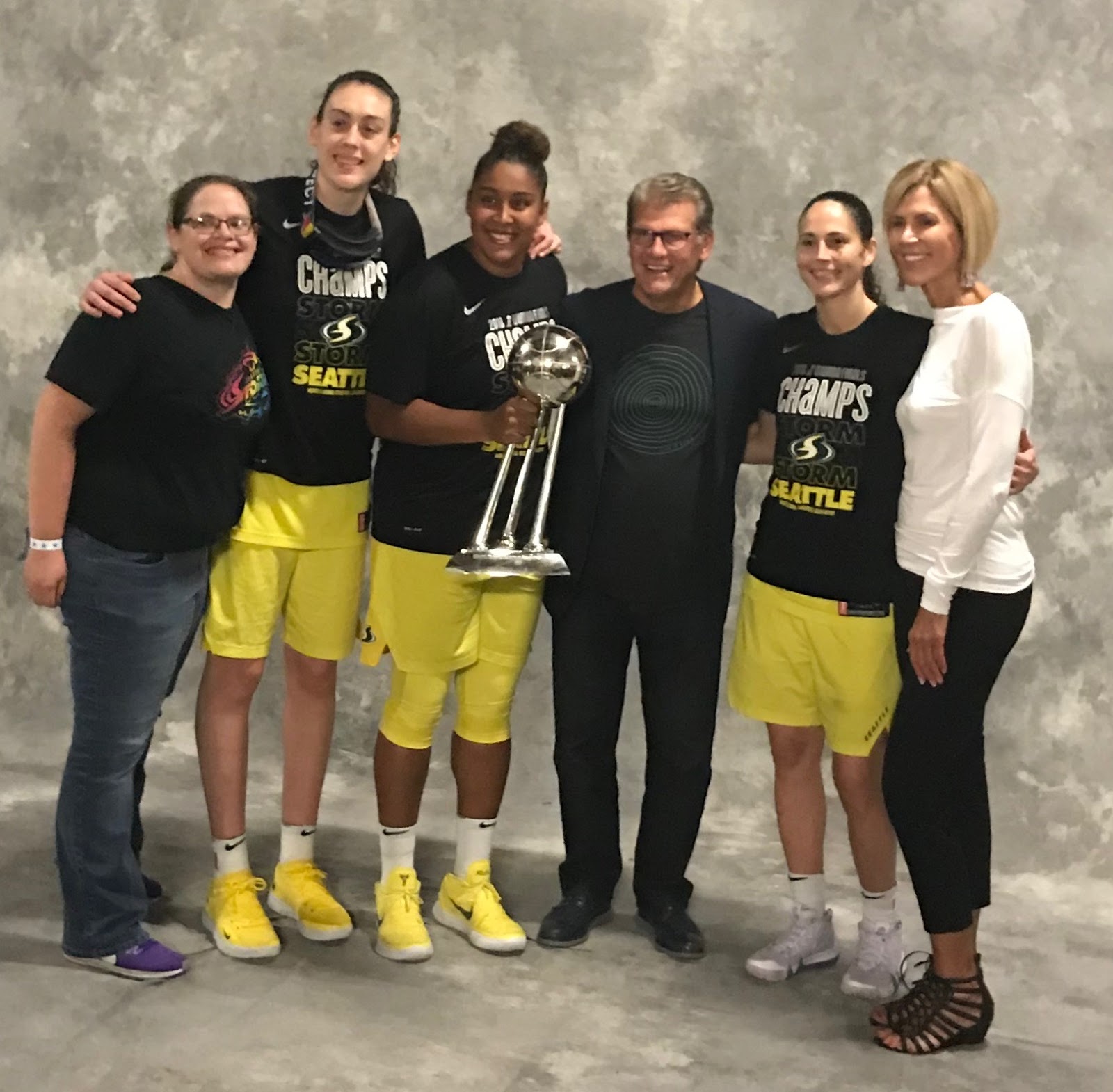
UConn and the Storm: Me, Breanna Stewart, Kaleena Mosqueda-Lewis, Coach Auriemma, Sue Bird, Coach Dailey


Thursday, April 11, 2019

In the Blink of an Eye

Still Smiling After 12 Weeks at Seattle Children's
Thirteen weeks ago, I was a physical therapist, treating my caseload on my own, going about my usual day-to-day activities at work and at home, minding my own business.  Then, on January 15th, a PT Student from the University of Connecticut arrived.  My first student.  From my Alma Mater.  And now, in the blink of an eye, she's gone.  How is it already April?! I wrote about becoming a clinical instructor and some of the expectations for her affiliation here but now that she's gone, it's time to reflect on that experience.

It's funny how sometimes you become something because someone else made it so.  You become a mother because you have a child.  You become a boss when you have employees. You become a basketball player when the coach picks you to play on the team.  I guess you can be a basketball player without making the team, sort of... but it isn't the same.  I was a physical therapist before... but my student made me into a Clinical Instructor, a new role that changed my perspective and helped me to grow, and came at just the right time in my career.  Can you be a teacher if you don't have any students?  Does a tree falling in the woods make a sound if there is nobody to hear it?

For about the past six weeks, I basically sat back and watched... or stayed outside the room completely... as my student worked with the patients we had seen together for the previous six weeks. I attended the initial evaluations and we discussed each patient, how the treatment sessions went, the status of each person, her thought processes, what went well and what could have been better. But for many weeks, she did the patient care and documentation and I worked on a bunch of projects I had lined up.  Just before her affiliation with me ended, I read this post from Physical Therapist Phil Plisky entitled "What I Wish Physical Therapy Students Knew About Their Faculty (and all PTs for that matter)."  I immediately sent it to her, loving the fact that it outlines key truths that new physical therapists really should know:
1) We don't know everything.  Really, we don't!  OK, I probably know a little more than she does. But there is so much I don't know... and I learned from her, too!  More than she will ever know.
2) Our patients DON'T all get better.  Sometimes eight to twelve weeks in the clinic might not be enough to really see it, but this happens.  Sometimes it means we can't figure it out... fortunately I am surrounded by a team of excellent PTs that if I feel like someone isn't making progress, I can share them and get another perspective.  Sometimes the patient refuses to do what is recommended, which is insanely frustrating, and they are the barrier to their own recovery.  Sometimes it just happens, for any number of other reasons.  Fortunately, most do get better, but the ones who don't stick with you.

But more importantly, Phil outlines the three keys to becoming a better PT:
1) Did I prepare for each patient session as much as I could?  One attribute you can't really teach is putting in the extra effort to prepare.  My student beat me to work every single day, had questions ready for when I got in, and I'm sure was looking things up that she didn't know.  She asked for articles or resources to learn about treatment techniques and evaluation methods.  She asked for opportunities to learn from different providers - like watching surgery or spending the morning learning about biofeedback or with speech therapy. In my opinion, preparedness is a habit that doesn't change - something you value or you don't.  It influences how you approach your day, week, and career.  I still come early to prepare for my day, I still look at my patient caseload in advance to review diagnoses of new patients in case I'm unfamiliar with something.  Some people don't feel this is essential.  I couldn't go without it, and I was glad to see that she was a preparer.
2) Did I care/give 100% to each session?  In this profession it would be odd to find someone who doesn't care about others, but, to treat everyone you come across with dignity and respect and to care constantly is sometimes challenging.  One time we were working with a teenage boy who was grunting responses, rolling his eyes, and being flat out rude.  It wasn't a good day for him, and I found it entirely annoying.  But that doesn't mean we stopped caring about him or his session.  In fact, I asked him if he wanted to leave, and when he chose to stay, we just poured on extra caring and moved forward with the session.
3) Did I reflect?  Personally, I had major imposter syndrome as a new grad PT.  Reflection was essential to understand that people weren't just getting better because of chance, they were getting better because they followed suggestions I made on how to move differently or load themselves in new ways that made them feel better. As a student, it has to be insanely difficult to work with patients all day long, focusing hard on caring and giving 100% and preparing and not messing up... only to later find time to reflect on each and every single patient interaction, parent interaction, coworker interaction, CI interaction.  That's a lot to think about.  Mentally exhausting.  I do think this is essential for growth, for identifying strengths and weaknesses, to find what has been working for you and what has not.  That's why I'm reflecting on being her clinical instructor now.  And that's why we had weekly meetings to encourage her to reflect on the previous week, set goals for the upcoming week, and to figure out areas we should focus on.  We did a lot of reflecting... both together and independently... and I think it made all the difference.

So I sent her the article and she wrote back.... "you already taught me all this." I guess she had been listening to me all along. (New Grad PTs - you really should click on the link and read his post... it's brief but so valuable and he's far more articulate about it than I am).

Reasons why having a student was really great:
1) First and foremost, having this particular student made me a better physical therapist.  Without question.  I don't know if this would have happened with a different student.  Maybe.  That's luck of the draw - and I won this hand with a royal flush.  I give her all the credit for my growth over the past three months.  She made me think about my patient care decisions by asking questions.  Sometimes I'd just ask her the same question back, but sometimes I really had to think about what was being asked. In her first week, we worked with a kid with "tight hamstrings" and I chose to give them strengthening exercises rather than stretching exercises, which is something I do a lot with kids - but that I sometimes approach differently with adults. When she asked me why, I couldn't immediately explain my rationale.  That wasn't good enough for me and it shouldn't have been good enough for her or for the patient.  So I had to consider my own reasoning, for that decision - and for all my other decisions - and that meant personal growth.

2) She made me think about what I value as a physical therapist.  If you had asked me five years ago as a new grad PT what was most important for patient care, I think I would have said getting rid of people's pain. If you had asked me two years ago, I think I would have said getting people back to their favorite activities or to their prior level of function.  Now, I think it is most important to connect with patients and form a therapeutic alliance.  Some people won't ever get rid of their pain, so to make that the goal sets those people up for failure.  Some people won't get back to full prior level of function - and that may be ok, or it may be the hand they were dealt.  I no longer want to use that as the barometer of success.  We as PTs have to be OK with these outcomes because that's how the human body works - and we have to be supportive of patients who experience those changes.  Now I aspire to encourage self efficacy, self confidence, and personal empowerment, particularly with teenage girls.  I feel that I have been a successful physical therapist if I find a way to connect to my patients, to build trust, to encourage them to change habits and find ways to move that make them feel good.  If I can't connect with a patient, I want to find them a physical therapist in my office who can.  I measure success differently now.  I don't treat patients the same way as I did five years ago.  I don't use the same words to describe what I think is wrong, I don't use the same treatment techniques, and going through this process, I could see my own personal growth.

3) She gave me a chance to watch someone else treat my patients.  In my clinic, there are lots of therapists treating their patients in the same space simultaneously.  I frequently have the chance to overhear conversations or treatment techniques between other PTs and their patients, but I'm focusing on my own patient right in front of me, and without knowing the context for the other patients, it doesn't make much sense to try to eavesdrop.  I already knew that my coworkers and I did things differently.  But when someone else is working with your own patient right in front of you, and that's who you're focusing on, it gives you a chance to see similarities and differences of treatment styles and to appreciate that we really don't need to be doing it the same way to be effective.

During her first week, I was honest with her that I didn't want her to be a copy of me, that her treatments could look very different than mine, and that would be OK as long as there was a reasonable thought process behind her choices. I truly wanted her to find her own style and beliefs.  I think we achieved this.  Physical therapy may be based on science... but really, it's a form of art.  My form of PT is a bit loud, somewhat aggressive, sometimes even competitive, and usually a bit silly.  Hers is a bit more quiet, patient, serious, and conservative. I doubt mine will change because I've come to love being a goofball all day long, but hers might change as she keeps doing it.  Even if it doesn't, both ways work.

4) It's really not that much extra work. Sure, some of the days were a bit longer.  And I am super lucky to work for an awesome organization that values these experiences and gave me time each week for meeting with her.  I really wanted to have a student in the past and the timing couldn't have been better - for personal and professional reasons - so I didn't mind it.  But above all that - every practicing physical therapist graduating in the past eight years needed several clinical instructors to get there - so maybe we should all embrace the opportunity to provide this service and help out our schools for the next group coming through.  It feels good to give back, particularly to UConn, because they gave me so much. Sure, the grading system for student PTs, the CPI, is a major pain... but we made it as fun as we could and in the scheme of things, it's no big deal.

5) Lastly, I got SOOOOO much done while she was here that wasn't patient care: I studied for and took the Sports Certified Specialist PT Exam including about forty hours of Medbridge continuing education videos, I prepared for and presented at a physical therapy conference, I wrote a case study and submitted the manuscript for publication to the Journal of Orthopaedic and Sports Physical Therapy, and I started working with the new Seattle Children's Hospital North Pain Clinic that took a lot of learning and early growing pains - all in her twelve weeks.

Reasons why I might take a few years before doing it again:
1) I started to miss my patients!  Being a PT is a big part of my own identity and that was gone for a while.  I get to play games all day and joke around with kids.  I play basketball and soccer and hop scotch and talk about Harry Potter and The Little Mermaid and unicorns and NBA Basketball or March Madness. Part of me was apparently missing the past several weeks.  I'm glad to have it back.

2) My level of physical activity dramatically decreased for the past several weeks because I wasn't doing exercises with patients, standing all day, moving around like I usually do.  I was confined to a chair, making extra trips to the bathroom across the building just to get up and move, sometimes pacing around the office because I needed to do something else, and I think I became a distraction to the office (more than usual).  I gained weight, which is a big problem for me.  I didn't sleep well because I wasn't moving around enough.  My exercise routine got messed up.  But now that I'm back to my usual routine, things are already getting back on track, and I could have managed this situation better, I just hadn't anticipated it and once I let the situation take control, I didn't do a good job turning it around.  That's on me to keep track of in the future.

3) I don't know that the next student would come close to how great this one was.  And I'm putting it in writing...for her to see... and everyone else to see.  As my last words as her clinical instructor... cheering for her as she launches her PT career.  And I'm pretty sure I might have been a major pain in the neck for my own CI's, so there's got to be some karma coming if I take more students in the future.

4) I really hate saying goodbye.  I'm too sentimental and my emotions get in the way. In fact... I didn't really even say goodbye this time.  I took her to the most stressful possible outing - watching UConn Women's Basketball in the Final Four - and then I gave an awkward side hug and ran away.  That's probably not a reason to hold off on having another student.

Anyways, best of luck to my student as she graduates and takes the PT Licensing Exam... and to all the other new grad physical therapists.  Congratulations on finishing three intense years of learning, and welcome to the real world.  It truly is better on this side of things.  And the years seem to go by in the blink of an eye.